

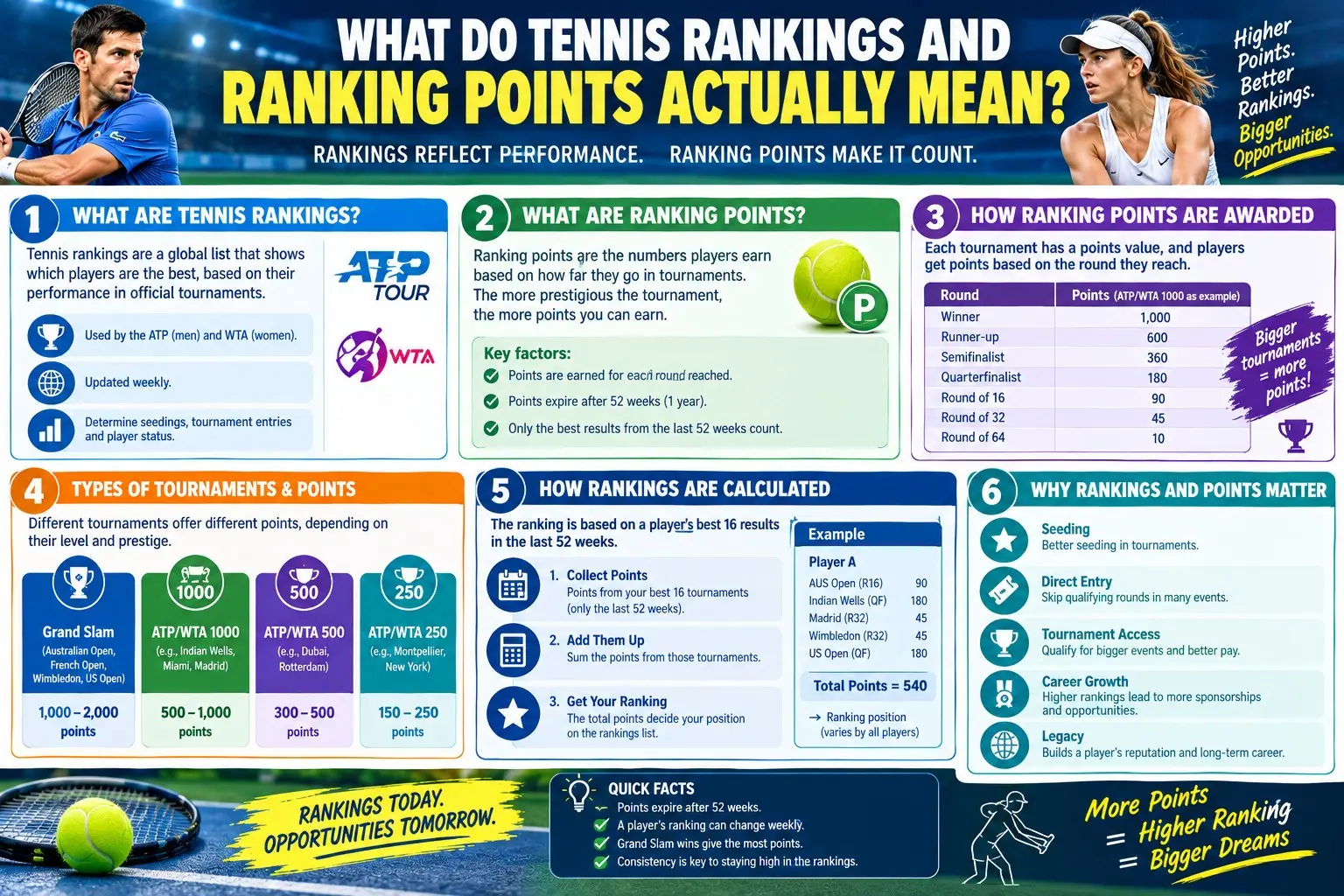
Tennis rankings are everywhere — beside players' names on scoreboards, in tournament seedings, in qualification lists for the year-end Finals, and in nearly every conversation about who is "the best." Yet for many fans, the ranking system remains opaque. Why does one tournament offer 2,000 points and another 250? How do points disappear? What is the difference between the ranking and the Race? Why can a player win a title and still drop in the rankings? Understanding what tennis rankings and ranking points actually mean requires unpacking the machinery behind the numbers — and once you do, the weekly fluctuation of the tour makes far more sense.
This article explains the ATP and WTA ranking systems in detail: how points are earned, how they are counted and removed, what the numbers signify about a player's standing, and how to read rankings like an analyst rather than a headline.
1. The Basic Idea: A Rolling 52-Week Points Total
At its core, a tennis ranking is a rolling 52-week sum of points earned at sanctioned tournaments. Every Monday after a tournament concludes, two things happen simultaneously:
1. Points earned at this year's edition are added.
2. Points earned at the same tournament 52 weeks ago drop off.
This add-and-subtract cycle means a player's ranking is a constantly refreshed snapshot of the last year's results — not a lifetime achievement award, not an average, and not head-to-head-based. Win a title this week and your total jumps; fail to defend last year's title and the points vanish regardless of this week's result. The system measures recent sustained performance.
Because only certain results count, the tours also apply a "best of" filter:
· ATP: The best 19 results in the 52-week window count — mandatory events (Grand Slams, Masters 1000, and the ATP Finals when qualified) always count, supplemented by the player's best results elsewhere.
· WTA: The best 16 results count, with Grand Slams and mandatory WTA 1000 events always included, plus the best additional results.
This "best of" structure means irrelevant early-round results at small events don't drag down a player who performs at the majors — but it also means every mandatory event missed or bombed matters enormously.
2. The Points Ladder: What Tournaments Are Worth
Ranking points are structured like a pyramid, with event prestige determining the height. The standard singles structures (ATP and WTA) look like this:
Grand Slams (Australian Open, Roland Garros, Wimbledon, US Open)
Result | ATP Points | WTA Points |
Winner | 2000 | 2000 |
Finalist | 1300 | 1300 |
Semifinalist | 800 | 780 |
Quarterfinalist | 400 | 430 |
Round of 16 | 200 | 240 |
Round of 32 | 100 | 130 |
Round of 64 | 50 | 70 |
Round of 128 | 10 | 10 |
Masters 1000 / WTA 1000
Winner: 1000 points; Final: 650; Semifinal: ~400/390; Quarterfinal: ~200/215 — declining through rounds. (Starred figures in official tables vary slightly by draw size — 96-draw vs 48/56-draw events.)
ATP 500 / WTA 500
Winner: 500/500; Final ~330/325; Semifinal ~200/195; declining thereafter.
ATP 250 / WTA 250 (and WTA 125)
Winner: 250/250 (125 for WTA 125 events); proportionally reduced by round.
Year-End Finals
The ATP Finals and WTA Finals reward round-robin performance: 200 points per round-robin win, 400 for a semifinal win, 500 for the final win, and up to 1500 for an undefeated champion — a uniquely valuable prize reserved for the top eight qualifiers.
Qualifying and Lower Rounds
Qualifying rounds award small point amounts (e.g., 10–16 for Grand Slam qualifying progress, 2 for first-round qualifying losses in some tiers), reflecting opportunity rather than achievement.
The hierarchy — 2000 / 1000 / 500 / 250 — is deliberate: one Slam title equals four Masters titles equals eight 250 titles. This encoding of prestige means the calendar's architecture (four Slams, six Masters 1000s, supporting events) directly shapes ranking strategy.
3. How a Ranking Is Calculated: A Worked Example
Suppose a player's current total is 4,500 points. At this week's tournament (an ATP 250), they reach the final, earning 165 points. Meanwhile, 52 weeks ago, they earned 250 points as champion of the same event. The calculation:
· Add: +165 (this year's final)
· Subtract: −250 (last year's title defence fails)
· Net change: −85 points
Despite reaching the final, the player falls in the rankings — the dreaded "defence" problem that every tennis fan knows. Conversely, a first-round exit that replaces a previous first-round exit (10 points out, 10 points in) leaves the total unchanged — explaining why players sometimes hold position despite poor weeks.
This mechanic creates the annual rhythm of the tour: each 52-week anniversary of a player's big results brings "points defence" pressure — peak anxiety periods for players defending Slam finals or Masters titles.
4. Rankings vs. the Race: Two Parallel Systems
Both tours run two standings simultaneously, and confusing them is one of the most common fan errors:
· The Ranking (official "world ranking"): The 52-week rolling points total described above. It determines seeding at every tournament, entry eligibility, and the public hierarchy (World No. 1, No. 2, etc.).
· The Race (Race to Turin for ATP / Race to the WTA Finals): A calendar-year-only tally of points earned during the current season. It is used solely to determine the eight (or so) qualifiers for the year-end Finals.
A player who excelled in the previous autumn but struggles this spring may remain highly ranked (protecting old points) while plummeting in the Race (earning few new ones) — or vice versa: a hot start to the new year can rocket a player up the Race while the ranking climbs more slowly as old results haven't yet dropped off.
5. What Rankings Actually Measure — and What They Don't
Interpreting rankings wisely requires knowing their strengths and limitations.
What they measure well:
· Consistency over 52 weeks across the events a player entered.
· Performance weighted by event importance — the system correctly treats a Slam run as more meaningful than a 250 title.
· Relative standing for seeding — providing a mathematically defensible bracket order.
What they don't measure:
· Lifetime achievement or peak greatness: A retired champion's ranking goes to zero; rankings are snapshots of currency, not legacy.
· Head-to-head superiority: Player A ranked above Player B does not mean A beats B — rankings aggregate results against different opponents.
· Current form precisely: A player defending maximum points all spring can hold ranking while losing early everywhere; the Race often reflects "now" better than the ranking.
· Injury-adjusted quality: An injured player's points slowly erode as they defend with zero scores — rankings punish absence heavily by design.
Analysts therefore use rankings as one input — alongside form, surface aptitude, and Elo-style ratings that account for opponent strength — rather than as the final word on quality.
6. Special Rules: Injuries, Protected Rankings, and Special Exempts
The system includes several modifications for fairness:
· Protected Ranking (PR): Players absent due to serious injury (typically 6+ months) can request a ranking based on their points at the time of injury, used for entry purposes upon return — allowing gradual reintegration without grinding low-level events from zero.
· Injury time-out and absence protocols: Limited use of "special exempt" entries for players deep in tournaments the previous week, and procedures ensuring players aren't punished for forced withdrawals under medical rules.
· Mandatory event obligations: Top players at specified events who miss without valid reason can face ranking penalties (zero-score entries) and fines — the tour's mechanism for ensuring star participation.
· Age eligibility rules (WTA/ATP): Restrictions on main-tour scheduling for very young players, affecting early-career point accumulation.
These rules matter when reading news about players' ranking movements — not every drop reflects poor form.
7. Historical Context: How the System Has Evolved
The current structures are the product of decades of refinement:
· The modern 2000/1000/500/250 pyramid replaced older, flatter systems that under-rewarded Slam performance relative to quantity of events played.
· The 52-week rolling window succeeded older systems that could stretch points over longer periods, improving responsiveness to form.
· Debates continue about calendar crowding (too many events diluting importance), ranking inflation comparisons across eras, and flexible schedules for older players — reforms are periodically proposed and trialled.
· The WTA and ATP occasionally adjust mid-tier point values (e.g., WTA 125 inclusion, changes to 250/500 distributions) to balance player opportunity against competitive integrity.
Understanding that the system is designed — not natural — helps explain its quirks: the deliberate gulf between Slam and 250 rewards, the harshness of defences, and the precision of weekly updates.
8. Practical Implications: Why Rankings Matter in Practice
Rankings translate into tangible competitive realities:
3. Seeding: Top seeds are protected from meeting each other early in draws — directly affecting tournament paths and, statistically, expected results.
4. Entry and qualification: Ranking determines direct acceptance into events; below thresholds, players must qualify through tough multi-round preliminaries.
5. Year-end Finals qualification: Race points decide the elite eight — a major season goal distinct from ranking maintenance.
6. Career earnings and sponsorship: Ranking brackets unlock appearance fees, endorsement leverage, and national funding in many federations.
7. National selection: Davis Cup, Olympics, and Billie Jean King Cup picks often reference rankings alongside form and surface.
For players outside the top 100, ranking points are survival currency — the difference between main-draw comfort and the qualifying-grind; for the top 10, they are defensive obligations measured week by week.
9. Common Misconceptions
A few myths worth retiring:
· "Rankings show who would win a match." No — they aggregate disparate results and provide seeding order, not simulation.
· "Dropping points means playing badly." Sometimes it simply means last year's result was extraordinary and this year's merely good.
· "More tournaments = higher ranking." The "best of 19/16" cap means quality saturates; excess events add little once superior results are banked — and fatigue-induced early exits add nothing.
· "The Race and ranking should agree." Divergence is structural (calendar vs rolling year), not error.
10. How to Read Rankings Like an Analyst
When you next scan the rankings list, add these interpretive layers:
· Defence calendar: What big results from last year are coming up for a given player? Expect volatility around those weeks.
· Race vs ranking gap: Large divergence signals hot/cold form relative to last year — often a leading indicator of future ranking moves.
· Surface windows: After clay season, players built for clay shed points during grass/hard stretches — temporary "drops" are predictable.
· Proximity clusters: Players within 100–300 points of each other will reshuffle frequently — small results flip orderings constantly in the mid-table.
· Points-to-entry math: For a player chasing a Slam seeding or Finals spot, the points gap divided by realistic upcoming yields reveals whether the goal is feasible — analysts do this arithmetic constantly during qualification runs.