

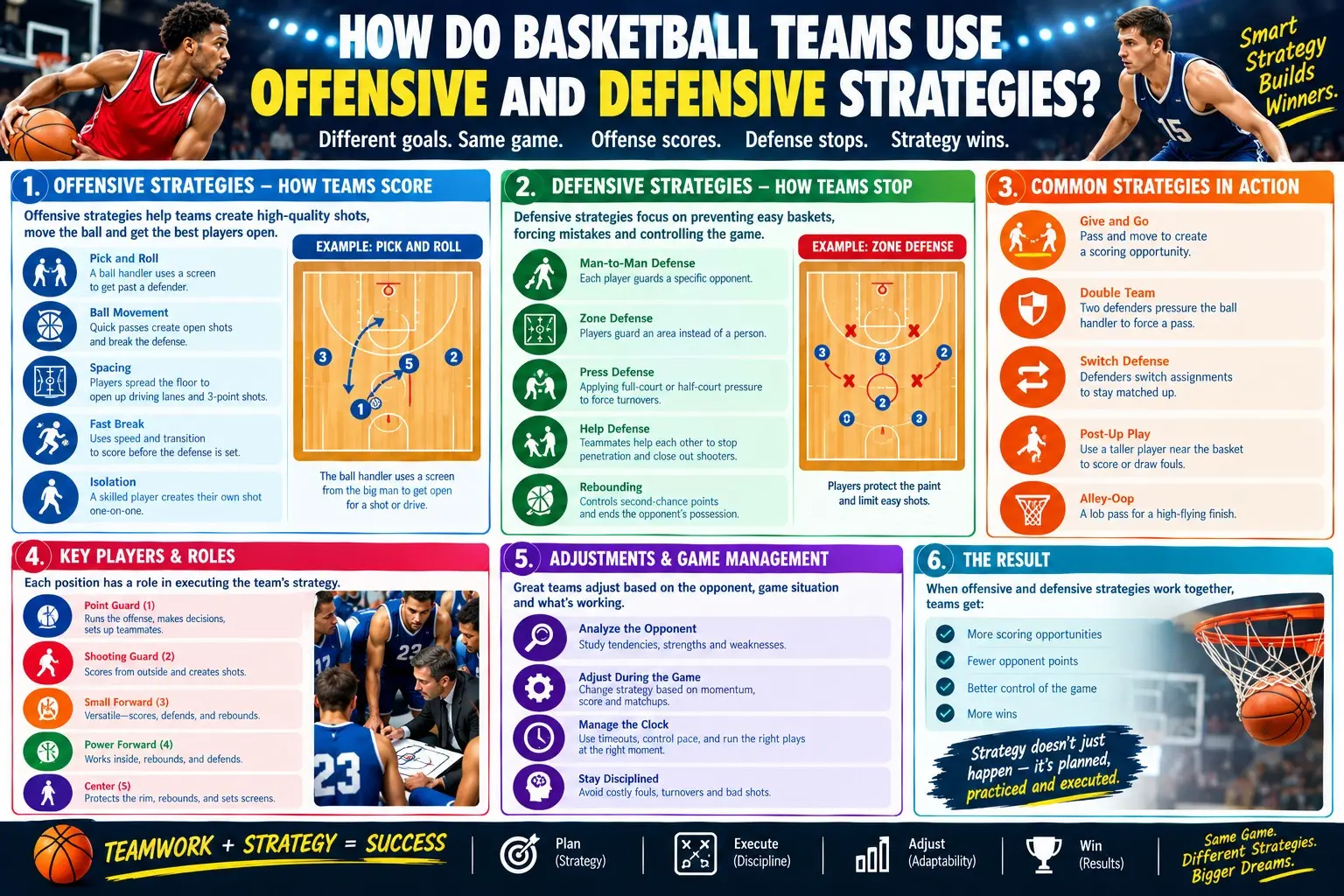
Basketball is a sport of continuous strategic negotiation. Every possession is a tactical question — how do we create a high-value shot, and how do we stop the opponent from doing the same? Behind the highlight dunks and step-back threes lies a deep ecosystem of offensive systems (pick-and-roll architectures, motion offenses, pace-and-space designs) and defensive schemes (drop coverage, switching, zone presses, blitzes) that coaches deploy, adjust, and counter-adjust within games and across seasons. Understanding how basketball teams use offensive and defensive strategies is essential for appreciating the modern game at a deeper level — from the NBA down to college and international play.
This article breaks down the principal offensive and defensive strategies in basketball, the data behind them, how coaches choose and adapt them, and how the sport's analytics revolution has reshaped tactical thinking.
1. The Strategic Foundation: Pace, Spacing, and Shot Quality
Three principles underpin virtually every modern basketball strategy:
· Pace: How many possessions a team uses per game. Fast-paced teams create more total opportunities; slow-paced teams reduce variance and control games. Pace choices interact with roster fitness, depth, and talent profile.
· Spacing: The geometric arrangement of offensive players to stretch the defense — typically maximizing three-point threats around a rim-attacking creator. Poor spacing lets defenses collapse; elite spacing opens driving lanes and kick-out threes.
· Shot quality: Analytics has established the value hierarchy of shots — rim attempts and open threes yield the best expected value; long mid-range twos are the least efficient. Modern offense is largely an exercise in generating the first two while avoiding the third.
Defensively, the mirror principles are: protect the paint (the highest-value zone), contest threes without fouling, and force low-value mid-range attempts — the strategic battleground where modern basketball is decided.
2. Offensive Systems: How Teams Create Shots
The Pick-and-Roll (Ball Screen Offense)
The pick-and-roll is the single most common action in professional basketball — NBA tracking data shows ball screens initiating a huge share of half-court possessions. The ball-handler uses a teammate's screen to attack downhill while the screener "rolls" to the rim or "pops" to space.
Variations include:
· Vertical spacing rolls (rim-running bigs like lob threats).
· Pick-and-pop (stretch bigs shooting threes).
· Spain pick-and-roll (a back-screen on the roller for chaos).
· Short roll playmaking (the roller making decisions in 4-on-3 situations — a Jokic/Green hallmark).
The offense's effectiveness depends on the ball-handler's shooting threat (does the defender go under or over?), the roller's gravity, and the spacing shooters' accuracy. Modern defenses counter with drop coverage, switching, hard hedges, and blitzes — the strategic chess match within every game.
Motion Offenses and Read-and-React
Motion offenses emphasize constant player movement — cuts, screens, and passes — to distort the defense without a single dominant initiator. Principles from the classic triangle offense to Princeton-style continuity systems share goals: create advantage through passing and cutting rather than isolation.
Read-and-react frameworks give players rules (if the defender does X, do Y) rather than set plays — producing adaptable, egalitarian attacks popular at collegiate levels where elite one-on-one creators may be scarce.
Pace-and-Space (Five-Out and Four-Out)
The analytics-driven evolution: surround creators with shooters, play with pace, and attack closeouts. Five-out lineups (all players capable of standing beyond the arc) maximize driving lanes — a revolution accelerated by the three-point shot's rising value. Teams like the modern Warriors and various analytic-era NBA clubs exemplify this: the offense's geometry is its strategy.
Isolation and Hero Ball
When spacing and motion fail to create advantages, elite isolators (think modern wings creating one-on-one) take over. Isolation is analytically "inefficient" in aggregate but invaluable in late-clock situations, playoff half-court grinds, and against switching defenses that neutralize screens. The trick is leveraging isolation only when the defense has been softened by prior actions.
Early Offense and Transition
The most efficient offense happens before the defense sets. Pushing after rebounds and steals — "early offense" — generates layups, open threes, and fouls against scrambling defenses. Transition points consistently rank as the highest-value possessions in basketball analytics; teams that win the transition battle often win games without needing complex half-court execution.
Set Plays and ATOs
Even in motion-heavy systems, coaches script set plays for specific moments: after timeouts (ATO plays), sideline out-of-bounds (SLOB), baseline out-of-bounds (BLOB), and final-possession designs. These rehearsed actions target mismatches, free shooters off staggered screens, or exploit known defensive tendencies — the "chess opening" of a possession.
3. Defensive Systems: How Teams Prevent Points
Man-to-Man Defense (with Coverage Variants)
The default: each defender guards a specific opponent. Within man-to-man, the critical tactical layer is ball-screen coverage:
· Drop coverage: The screener's defender sags toward the paint, containing the drive and conceding mid-range pull-ups or floaters — conservative, protects the rim, vulnerable to elite pull-up shooters.
· Switching: Defenders exchange assignments on screens — neutralizes pick-and-roll advantages but can create mismatches (big switched onto quick guards).
· Hedge/Show and Blitz: The screener's defender jumps out to slow the ball-handler aggressively — high-risk, high-reward pressure that can trap elite creators.
· Ice/Side coverage: Forcing ball-screens toward the sideline, cutting off middle drives — common against dominant right-handed pick-and-roll operators.
Choosing coverage depends on personnel: teams with versatile, switchable defenders (modern "positionless" rosters) switch freely; teams with drop-protective traditional centers play drop and funnel shooters into contested middies.
Zone Defenses
Zone defenses assign players to areas rather than opponents. Common types:
· 2-3 zone: Protects the paint and corners, dares opponents to shoot over the top.
· 1-3-1 and 3-2 zones: Varying pressure and trap opportunities.
· Matchup zone: Zone principles with man-to-man responsibilities — blurs the line between systems.
Zones are used strategically: to change tempo, protect foul-troubled players, disguise tendencies, or disrupt rhythm — but elite shooting teams increasingly punish static zones with ball movement and corner threes.
Full-Court Pressure and Trapping
Press defenses (man press, 1-2-1-1 diamond traps) aim to speed opponents up, force turnovers, and manufacture transition points. They cost energy and risk layups against press-break mastery — typically deployed in spurts rather than as a full-game identity (with notable college exceptions).
help-and-Recover Principles
Regardless of scheme, elite defenses share spacing rules: protect the paint first (help), close out under control to shooters (recover), communicate switches, and box out. The best defenses combine scheme with relentless individual technique — closeout speed, lateral agility, and defensive rebounding.
4. The Analytics Revolution: Data-Driven Strategy
Basketball was a pioneer of sports analytics, and data now shapes strategy at every level:
· Expected value of shots: The drive-and-kick-three model emerges directly from shot-chart economics — mid-range suppression, rim and three-point promotion.
· Effective field goal % (eFG%) and true shooting % (TS%): Adjust shooting metrics that account for three-point value and free throws — the baseline stats for offensive evaluation.
· Offensive/Defensive Rating: Points per 100 possessions — pace-adjusted team quality measures that structure all modern team evaluation.
· Player tracking metrics: Speed, distance, acceleration, screen assists, defensive matchup difficulty, and shot-contest quality — turning previously invisible work into measurable contribution.
· Lineup data: Net rating by five-man unit reveals which combinations outperform — coaches now manage lineup ecosystems, not just rotations of individuals.
· Clutch and late-game splits: Performance in high-leverage minutes informs end-of-game play-calling and personnel choices.
Analytics has not replaced coaching judgment — it has disciplined it. Intuition about "good shots" now faces xG-style validation; rotation hunches face lineup net-rating evidence.
5. How Coaches Choose and Adapt Strategy
Strategy selection is a personnel-first exercise:
1. Roster audit: Do we have a rim-protecting center (drop viable?)? Switchable wings (switch scheme viable?)? Elite pull-up shooters (drop dies against these)? A dominant creator (iso/ PnR heavy)?
2. Opponent scouting: What does the other team run? Where are their coverage weaknesses? Who are their non-shooters to help off of?
3. Game-state management: Leading late — slow pace, foul-management, milking clock; trailing — pace up, aggressive trapping, foul-drawing attacks.
4. In-game adjustments: Halftime scheme changes (e.g., switching to zone after poor man-to-man stretches), rotational shifts to exploit small-ball or size advantages, and targeted play-calling at identified mismatches.
Playoff series intensify this cat-and-mouse: teams adjust coverage game to game (drop → blitz → switch), and counters evolve in real time — the heart of basketball's strategic beauty.
6. Positional Roles in Strategy Execution
While this article's focus is systems rather than positions, strategy离不开 role clarity:
· Point guards / primary initiators run the engine — reading coverages and making advantage decisions.
· Wing creators attack closeouts and isolation late-clock.
· Big men set screens, roll, protect the rim, and anchor coverage decisions.
· Shooters provide gravity — their value includes the space they create even without touching the ball.
· Defensive specialists take toughest matchups, enabling scheme flexibility.
Every system is essentially a set of role contracts — when players fulfill them, structure works; when roles blur, defenses feast.
7. Common Strategic Mistakes
· Non-shooters spacing poorly — standing in driving lanes instead of corners or slots.
· Predictable pick-and-roll usage — same action, same side, same coverage repeatedly without counters.
· Over-helping — collapsing off competent shooters, conceding open threes at unsustainable rates.
· Ignoring shot quality for pace — running fast but generating low-value attempts.
· Poor end-of-game management — failing to attack mismatches, taking contested twos with clock remaining, or mismanaging timeouts/fouls.
Film study exists to eliminate these patterns; analytics exists to detect them early.
8. International and Collegiate Variations
· FIBA basketball (international) features a shorter three-point line, different defensive three-seconds rules (allowing zone camping), and 10-minute quarters — shifting strategy toward more zone usage and paint protection than the NBA norm.
· College basketball (NCAA) emphasizes set plays, matchups, and half-court execution with a 30-second shot clock (men's) — coaching strategy is more scripted, and zone defenses remain more prevalent than in the NBA.
· Women's basketball at elite levels mirrors modern NBA spacing trends with its own personnel emphases — the strategic principles translate across the sport.
Understanding these rule-context differences prevents simplistic cross-league comparisons of style.
9. The Future of Basketball Strategy
Emerging trends shaping tomorrow's tactics include:
· Positionless five-out ubiquity — every player a playmaker-shooter hybrid.
· Defensive versatility arms race — switch-everything schemes demanding multi-positional defenders.
· Load management and rotation science — strategic rest altering regular-season patterns.
· Real-time data integration — enhanced live analytics feeding coaching decisions within games.
· Rule evolution pressures — discussions around take-foul penalties, defensive time limits, and freedom-of-movement emphasis all nudge strategy toward open, spaced play.
Basketball's strategic core — create better shots than your opponent — remains constant; the methods continue to evolve at speed.
10. Case Study: How a Single Game Plan Manifests
Consider a hypothetical matchup between a pace-and-space team and a drop-coverage defense. The offensive plan: initiate 30+ pick-and-rolls, force the drop big to choose between the rolling big and the pull-up shooter, and punish retreats with corner threes generated by drive-and-kick. The defensive counter-plan: stay home on shooters (no over-help), drop conservatively to contain the drive, and force mid-range contested jumpers — the analytically lowest-value shot. Within the game, adjustments compound: the offense counters the drop by adding slip cuts and short-roll playmaking; the defense counters by mixing in occasional blitzes to disrupt rhythm. Substitution patterns follow — small-ball units to pull the rim protector away, or a second big to control the glass against switching lineups. This possession-by-possession negotiation, repeated forty times a half, is the tactical contest: not one play call, but a living system of plan, counter, and counter-to-counter. Understanding this layered structure is what allows fans to see beyond the box score and appreciate why two teams with similar talent produce such different outcomes.