

A Landmark Gift in a Changing Landscape
With its grand atrium, 500-seat acoustics-led concert hall, and other state-of-the-art spaces, Oxford's Schwarzman Centre stands as the newest example of an elite UK university showcasing a billionaire's endowment. Completed last year, it was paid for by a £185-million ($250-million) gift from American private equity titan Stephen Schwarzman, founder of Blackstone. This donation is part of a string of primarily domestic and US mega-philanthropists donating to Britain's top universities this century.
The big-donor era, which emulates the more established philanthropy of the United States, has coincided with UK government cuts to higher education funding. These cuts have prompted universities to hike student fees and boost gift-netting efforts. The Schwarzman Centre, housing seven humanities faculties, two technology institutes, and the new Bodleian Humanities Library, is a physical manifestation of this shift. Its concert hall and a separate 250-seat theatre will host annual public cultural programmes, which launched in April 2025.
Philanthropy Trends: Giving Earlier and More
According to sector experts, the super-rich are giving more and earlier in their lives. Karl Wilding, lecturer at Kent Business School's Centre for Philanthropy, noted, "Increasingly, we are seeing philanthropists giving from earned income… while they're still active in business." He added that US philanthropists form a substantial proportion of this class of elite givers, reflecting the distribution of wealth globally, though such philanthropy is also growing in East Asia.
This trend is not without criticism. When the donation was announced in 2019, Oxford faculty and students opposed it, writing in an open letter that the centre "will be built with the proceeds of the exploitation and disenfranchisement of vulnerable people." Schwarzman's Blackstone, one of the world's largest commercial landlords, has faced condemnation over alleged practices. Student reaction is mixed; classics student Grace, 21, told AFP, "I can't say I'm thrilled about it. But I definitely benefit from the building so… it's a tough one."
Inside the Schwarzman Centre: A Vision Realised
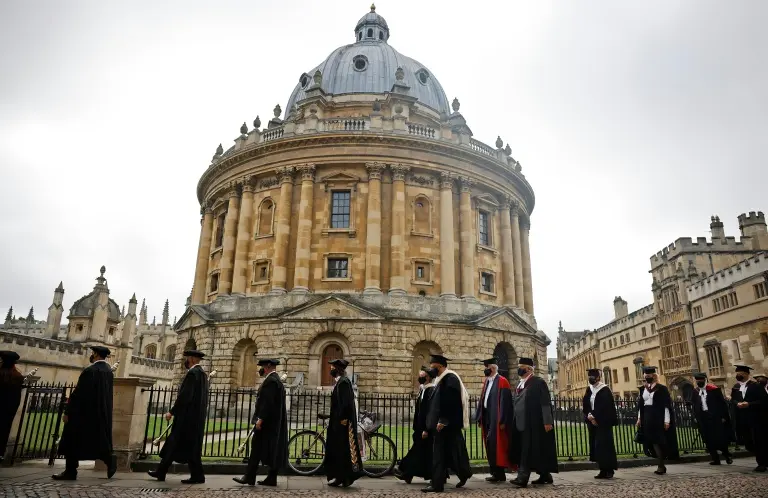
The centre's design echoes Oxford's iconic 18th-century Radcliffe Camera, with its atrium built to the same specifications. Schwarzman, who received an honorary British knighthood in 2024 for his philanthropy, gazes down from a portrait near the atrium. John Fulljames, the centre's cultural programme director, called the donation "transformative." He highlighted that the gift's vision included opening the university to artists and the cultural sector. Fulljames noted that Schwarzman was "engaged" during years of construction, saying, "It's been wonderful to see him here taking care of an investment which is going to bear dividends across the next century."
The Bigger Picture: Donations to UK Universities
Such gifts to UK universities increased by 93 percent in the decade to 2022, reaching a record £1.5 billion that year, according to a 2023 report by higher education association CASE. However, the distribution was uneven, with Oxford and Cambridge—known as "Oxbridge"—accounting for nearly half. Underlining the imbalance, British billionaire hedge fund owner Chris Rokos in March 2025 announced a £190-million gift to Cambridge, billed as the largest in modern times to a UK university.
Amir Pasic, dean of Indiana University's School of Philanthropy, noted, "The overall giving continues to go up, but it relies on a smaller number of bigger donors. Higher education does tend to be a magnet for the very large gifts." In the US, President Donald Trump is battling major universities, including cutting their funding, amid accusations of left-wing tilt and alleged antisemitism. Pasic said it was too soon to assess the impact on philanthropy, while noting that American donations to Oxbridge are a longstanding tradition, though now with a modern tilt.
Historical and Contemporary Examples
Pasic observed that donors today are "trying to use other vehicles also to pursue social impact," rather than creating classical foundations like those of the Rockefellers and Carnegies. Examples include the Bill and Melinda Gates Foundation launching a scholarships programme in 2000 with a record $210 million donation to the University of Cambridge. In 2012, Wales-born US venture capitalist Michael Moritz and his wife gave Oxford £75 million to establish scholarships for low-income students. British investor and right-wing media mogul Paul Marshall's 2021 £50-million gift to the London School of Economics showed that other top-tier institutions can also net big sums.
The trend is also visible beyond traditional donations. On Oxford's southern fringes, another American and Trump ally, Oracle co-founder Larry Ellison, has spent more than £1 billion building his for-profit technology institute, forming a "strategic alliance" with the university. Billed as "where science, education, and commercialisation reinforce one another," the alliance will see Ellison invest at least £100 million in joint ventures "to tackle global challenges."
Broader Implications for Higher Education
The influx of large donations is reshaping UK higher education. While it brings much-needed resources, it also raises questions about accountability and the influence of wealthy donors. Critics argue that universities risk becoming beholden to the interests of billionaires, potentially compromising academic independence. Supporters counter that philanthropy fills gaps left by government underfunding, enabling world-class facilities and programmes that benefit students and society.
As government funding continues to tighten, the reliance on mega-gifts is likely to grow. Universities are increasingly investing in development offices and donor cultivation. However, the concentration of donations among a few elite institutions may exacerbate inequalities across the sector. Smaller universities struggle to attract such gifts, relying more on tuition fees and public funding.
In the case of Oxford and Cambridge, their global prestige makes them magnets for wealthy donors, particularly from the US. The Schwarzman Centre, the Rokos gift to Cambridge, and other recent donations underscore a new era of philanthropy that is both transformative and controversial. As one student put it, the benefits are clear, but the ethical dilemmas remain.
The Schwarzman Centre is now open, hosting its first cultural programmes. Its halls will echo with music, debate, and learning for generations. Whether this model of funding is sustainable or desirable is a question that will continue to be debated in the years ahead.
Source: Yahoo News News