
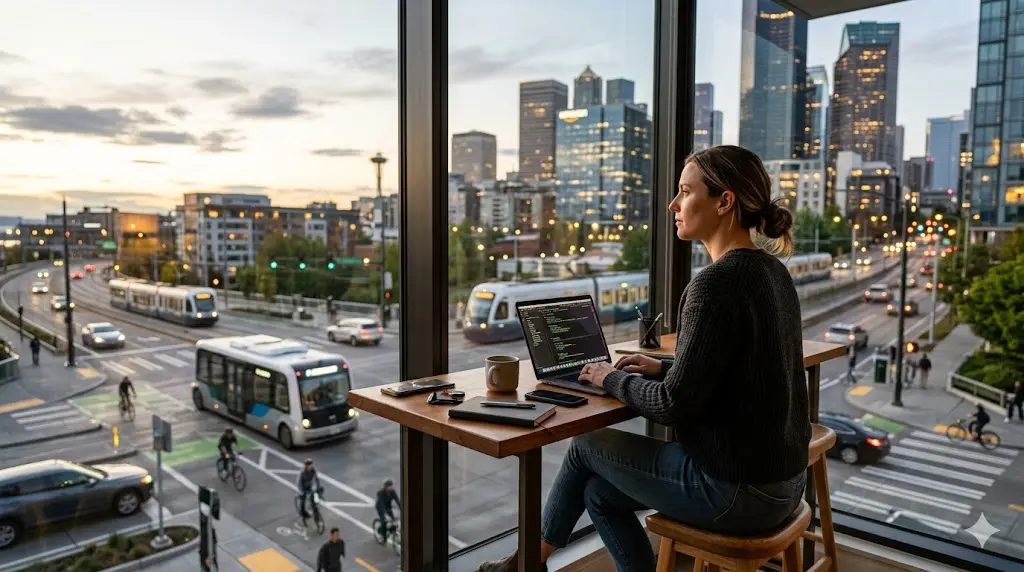
Remote work is quietly reshaping how people move, when they move, and even whether they need to move at all. The rise of distributed jobs is changing transport demand in ways cities didn’t fully plan for. In simple terms, remote work transportation trends are pushing commuting patterns away from predictable rush hours and toward more flexible, uneven travel habits.
You’ll see fewer daily peak-hour commuters in many urban centers, but at the same time, more occasional, purpose-driven trips. That shift is forcing transport systems, real estate planning, and even fuel demand forecasts to adjust faster than expected.
Remote work is reducing daily commuting frequency, flattening peak travel hours, and increasing irregular travel patterns. It’s also pushing cities to rethink public transit design, road usage, and last-mile connectivity. Over time, transportation systems are shifting from fixed rush-hour capacity models to flexible, demand-responsive mobility networks shaped by hybrid work habits.
What Are Remote Work Transportation Trends?
Remote work transportation trends refer to the changing patterns in how people travel as more jobs become remote or hybrid. These trends include reduced daily commuting, more flexible travel timing, increased use of local mobility services, and shifting demand for public and private transportation infrastructure.
What most people overlook is that this isn’t just about fewer office trips. It’s about restructuring mobility behavior itself. People are now planning their travel around tasks instead of routines. That sounds subtle, but it changes everything from subway frequency planning to ride-hailing demand curves.
Here’s the thing: transportation systems were built around predictability. Remote work breaks that predictability.
Why Remote Work Transportation Trends Matter in 2026
By 2026, cities are no longer debating whether remote work is permanent. They’re adapting to it. Some transport planners I’ve spoken to (informally, through industry discussions) admit they underestimated how sticky hybrid work would become.
Let me be direct: fewer commuters doesn’t automatically mean less congestion. That’s the counterintuitive part.
Instead, congestion shifts. Midday traffic increases. Weekend travel spikes. Suburban roads get busier while central business districts feel oddly quiet on certain days. In most cases, transit agencies are dealing with uneven demand, not reduced demand.
Another overlooked angle is energy usage. Transportation emissions don’t just drop because fewer people commute daily. Longer individual trips, especially car-based ones, can partially offset those reductions.
A useful reference point for broader mobility shifts can be seen in global transport research by organizations like the International Energy Agency, which tracks how behavioral changes influence transport emissions and fuel demand patterns.
How to Adapt Transportation Systems to Remote Work — Step by Step
Cities and mobility providers are slowly rethinking how transport should function in a hybrid-work world. Here’s a simplified breakdown of what that shift looks like in practice.
1. Map real travel behavior instead of office schedules
Traditional transport planning assumed fixed office hours. That’s no longer reliable. Planners now need anonymized mobility data to understand when and why people actually move.
2. Shift from peak-hour optimization to all-day balancing
Instead of designing systems for 8–10 AM rush hour, agencies are experimenting with steady service frequency across the day. It’s not perfect yet, but it reduces sudden overloads.
3. Strengthen last-mile connectivity
People working remotely tend to travel shorter distances more frequently—cafés, coworking spaces, gyms. That increases demand for micro-mobility like e-bikes, scooters, and feeder buses.
4. Rebalance public transit routes
Some routes lose riders, while others gain unexpected demand (especially suburban-to-suburban routes). The old hub-and-spoke model doesn’t fully fit anymore.
5. Integrate flexible pricing and incentives
Off-peak discounts, dynamic fares, and employer-linked travel benefits are becoming more common. The goal is simple: spread demand more evenly.
Common Misconception: “Remote Work Means Less Transportation Overall”
This is where people get it wrong.
Remote work doesn’t always reduce transportation—it redistributes it.
You might see fewer daily office commutes, but more scattered travel patterns: coffee shop work sessions, mid-day errands, coworking space visits, and irregular meetings. In some cases, people actually travel more often, just in smaller bursts.
I’ve noticed this personally in urban behavior shifts. When I expected quieter streets during weekdays, I instead saw more mid-day movement. It felt like the city didn’t slow down—it just changed rhythm.
Expert Insight: What Actually Works in Real Cities
Here’s what most guides miss: transportation systems don’t fail because demand drops. They fail because demand becomes unpredictable.
Cities experimenting with flexible transit models are seeing better outcomes when they stop treating mobility as a fixed schedule problem. Instead, they treat it as a living system.
One practical observation from urban mobility pilots is that adjusting bus frequency dynamically—based on real-time demand—often improves rider satisfaction more than simply adding new routes.
Another thing I’ve personally seen work in mixed-use districts is encouraging “local commuting ecosystems.” Basically, if people can live, work, and socialize within a smaller radius, transport pressure spreads out naturally without forcing major infrastructure changes.
Expert Tips on Remote Work Transportation Trends
Small adjustments often matter more than big infrastructure promises.
Expert Tip 1: Don’t assume remote workers stay home all day
Many planners underestimate “micro-commutes.” These short trips add up and shape local congestion patterns more than expected.
Expert Tip 2: Focus on midday mobility, not just rush hours
Midday travel is becoming the new planning challenge. It’s inconsistent but growing steadily.
Expert Tip 3: Suburban networks need more attention than central cities
In many regions, suburban travel demand is rising faster than downtown traffic.
Expert Tip 4: Behavioral incentives often outperform infrastructure expansion
Small nudges—like flexible transit pricing—can shift travel timing without building anything new.
Expert Tip 5: Data without context can mislead planning decisions
Raw mobility data might show decline, but localized spikes often tell a different story.
People Most Asked About Remote Work Transportation Trends
How is remote work changing daily commuting patterns?
Remote work reduces the number of daily commutes but increases irregular travel. People no longer travel at fixed times, which spreads mobility demand across the entire day instead of peak hours.
Does remote work reduce traffic congestion permanently?
Not necessarily. In many cities, congestion shifts rather than disappears. Some areas become less crowded, while suburban and mid-day routes experience more traffic than before.
What happens to public transport because of remote work?
Public transport systems are adjusting schedules, reducing peak-hour dependency, and experimenting with flexible frequency models. Some routes see reduced demand, while others remain stable or grow.
Are cities redesigning infrastructure because of remote work?
Yes, but gradually. Many cities are rethinking zoning, encouraging mixed-use development, and investing in last-mile connectivity to match new mobility habits.
If you’re looking to amplify your brand presence and strengthen SEO ranking with high authority backlinks, our network site provides powerful solutions through guest posting services and press release distribution that support organic traffic growth and media coverage. With platforms like Rank Locally UK and Webinfomatrix, businesses gain access to targeted digital marketing services, local SEO services, and link building services designed for measurable visibility. It’s a practical route for startups, agencies, and brands aiming for instant publishing and stronger online authority.