

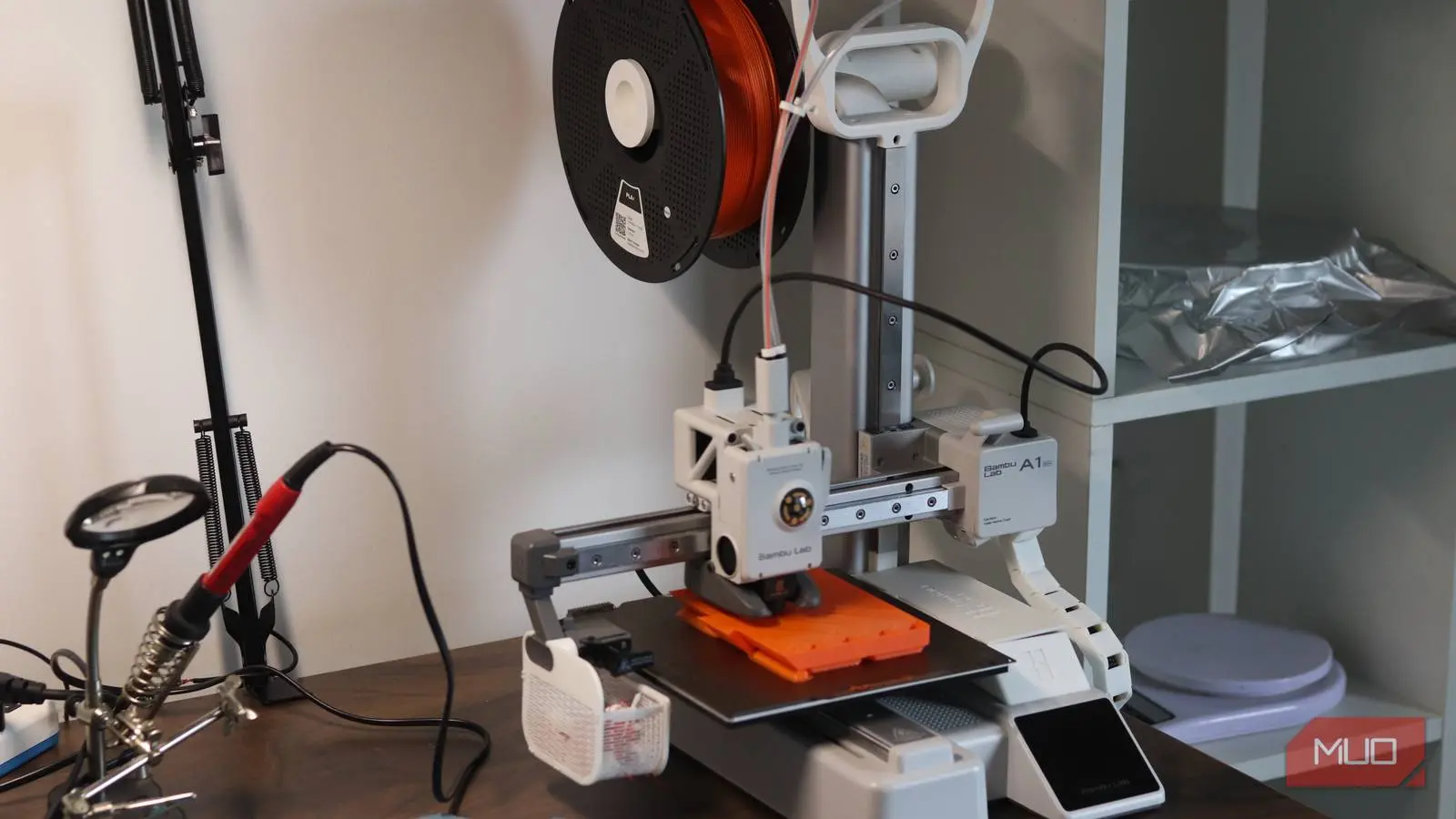
For years, I told myself I didn’t need a 3D printer. I had worked with them, repaired them, and knew exactly how frustrating they could be. That experience came in 2017, when my first job involved maintaining two 3D printers. Back then, a successful print felt like a small miracle. I spent more time leveling beds, clearing clogs, and babysitting nozzles than actually making useful objects. That decade-old memory kept me from buying my own printer until 2026. Looking back, I was wrong about almost everything.
The printer was never the problem
My early experience was with the Wanhao Duplicator 3, a huge, heavy machine with a small bed and a loud enclosure. Getting a print to stick meant guessing at the bed level with a piece of paper. The machine shook, whined, and demanded constant attention. That led me to believe all 3D printers were like this: noisy, finicky, and deserving of their own room.
The reality changed when I bought the Bambu Lab A1 Mini. It sits on my electronics workbench, which is right next to my normal work desk. Its footprint is tiny. It looks good. When it is printing, the motors are almost silent. I have run prints all day while working a meter away and barely noticed the sound of anything except the cooling fan.
What actually happened
- Noise: Nearly silent compared to older machines.
- Space: Fits easily on a standard workbench with room to spare.
- Setup: Automatic bed leveling removed the most stressful step.
- Unattended printing: Built-in camera and remote monitoring make it possible to print from anywhere.
Speed mattered less than I expected
My second fear was time. I remembered 3D printing as a glacial process. A small part could take the better part of a day. That was true of the old printer I maintained. The A1 Mini dismantled that assumption. It prints the standard Benchy test boat in about 20 minutes at default speeds. Functional parts such as brackets, enclosures, and organizers finish in a fraction of the time older machines would have needed.
The other layer of time concern was supervision. I expected to hover over every print, watching for first-layer failure or a clogged nozzle. Modern printers solve this with technology. The A1 Mini levels its bed automatically before every print. A filament runout sensor pauses the job if the spool runs dry. A built-in camera lets me check progress from an app. I have even started prints while hundreds of kilometers away and returned to a finished part waiting on the bed. Once you set your filament profiles correctly, printing becomes a background task, not a full-time job.
Maintenance turned out to be mostly a myth
Beyond time, I expected maintenance to eat into my schedule. With the Wanhao Duplicator 3, I considered myself lucky to get through a full day without clearing a nozzle or adjusting the bed. I had mentally budgeted for bed calibration, clog clearing, and belt tension checks as recurring chores.
In practice, the A1 Mini asked almost nothing of me. After 134 hours of total printing, the only thing I did was calibrate my filament, and even that was optional. Generic PLA profiles worked well with filament from several brands. For my everyday work, which includes custom ESP32 enclosures, mounting brackets, cosmetic parts, and replacement pieces, the process has been remarkably low-friction.
The one area where I would temper expectations is multi-color printing with the AMS or AMS Lite. I did not buy one because of the plastic waste it produces. Multi-color prints also use more time and filament than single-color prints. But for most everyday projects, maintenance is no longer something to fear.
What changed in 3D printing
The 3D printing industry has transformed over the past decade. Consumers now expect plug-and-play devices rather than kits that require hours of assembly. Features that were once premium options are now standard. Automatic bed leveling, filament runout sensors, flexible build plates, and cloud monitoring are common even on budget machines. These advances explain why a modern printer behaves more like a home appliance than a hobbyist tool.
Brands such as Creality, Elegoo, and Prusa have all followed this path. The Bambu Lab printer I own shows what is possible when a company treats reliability as a priority. I set it up, made a few adjustments, and let it work.
Key facts from the experience
- Modern FDM printers are quiet enough to operate in a shared workspace.
- The Bambu Lab A1 Mini prints a benchmark Benchy boat in roughly 20 minutes at default settings.
- Automatic bed leveling eliminates the most frustrating preparation task.
- A filament runout sensor pauses prints instead of ruining them when filament runs out.
- Remote monitoring through a built-in camera allows prints to be started and tracked from a phone or Home Assistant dashboard.
- After 134 hours of printing, maintenance amounted to optional filament calibration.
- Multi-color printing produces significant plastic waste and increases print time.
- Most modern printers from major brands require far less tinkering than their reputation suggests.
The biggest mistake was waiting so long
I held on to a mental image of 3D printing from nearly a decade ago. I never updated that image. If your hesitation is also about time, know that the equation has changed. Printers are faster. They are safer to leave unattended. They handle their own calibration. And they do not demand constant maintenance.
I wish I had stopped waiting much sooner. The technology I feared had quietly evolved into exactly what I wanted: a quiet, reliable tool that stays out of the way and lets me make useful things. That is the part I got wrong. The only real mistake was not buying a 3D printer earlier.
Source: MakeUseOf News