

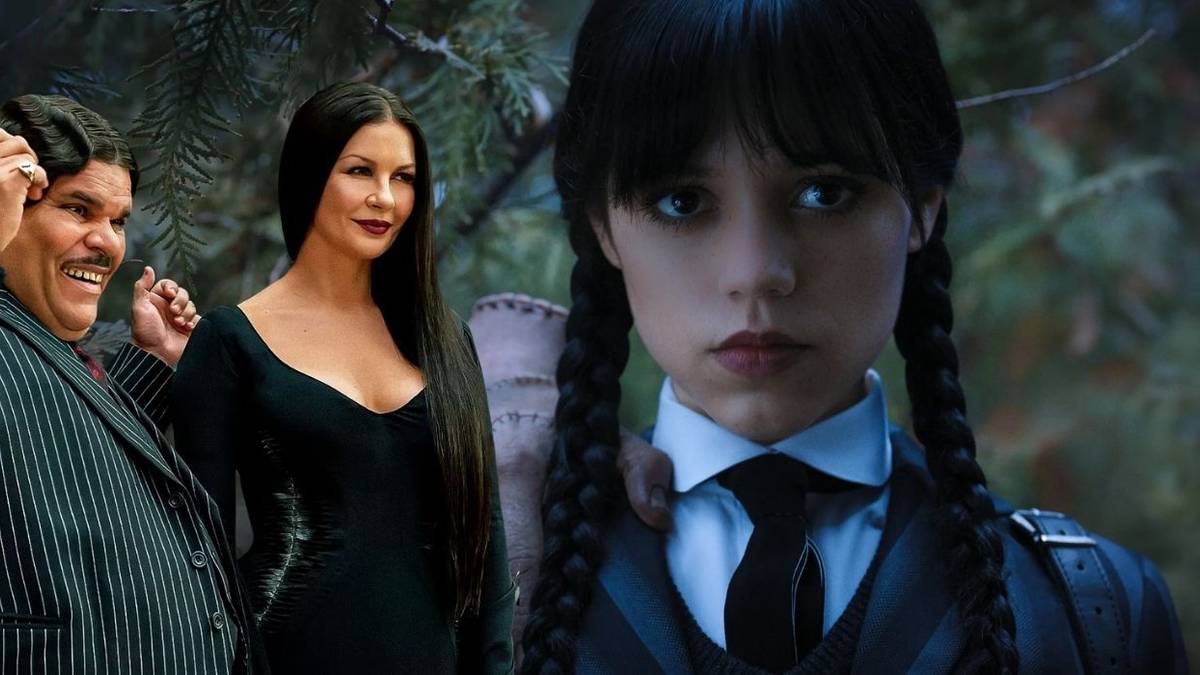
Jenna Ortega has rightfully received widespread acclaim for her performance in Netflix's Wednesday. The Addams family's eldest child moves through the halls of Nevermore Academy with a calm, unreadable presence, delivering deadpan humor so flat and precise that even the smallest shift in her face feels loaded with meaning. Yet one of the most talked-about aspects of Ortega's performance is something almost too small to notice at first: she barely blinks. This tiny detail does not announce itself; instead, it slips quietly into scenes where everything else feels normal. Dialogue continues, characters react, and the story moves forward, but Wednesday remains almost unnervingly still, her gaze fixed in a way that starts to pull attention away from everything else on screen.
Ortega's choice to not blink is incredibly smart and serves as the perfect example of how well she understood the iconic morbid character. While many actors rely on grand gestures or rapid facial expressions to convey emotion, Ortega opted for restraint—a decision that transformed Wednesday Addams into an enigmatic figure whose internal world remains a mystery to viewers. Over the course of the first two seasons, this subtle physical tic became a hallmark of the character, helping to distinguish this iteration from all previous portrayals.
An Unplanned Detail That Became Essential
Ortega's no-blink detail did not begin as a carefully planned acting direction. Early in filming, while fully immersed in Wednesday Addams' tightly controlled movements, she unintentionally delivered an entire take without blinking. Director Tim Burton noticed immediately and decided to keep the trait, recognizing that it enhanced the character's unsettling aura. Instead of correcting it, Burton leaned further into the calm it created. From there, Ortega began refining her performance around that restraint, pairing the no-blink with the now-famous "Kubrick stare," where her chin dips slightly while her eyes remain locked forward. The result makes Wednesday feel less reactive and more observant—almost as if she is silently studying everyone around her rather than emotionally participating in the moment.
This choice is especially effective because it remains consistent even in the most chaotic situations throughout the show. Wednesday barely reacts when standing in front of Tyler Galpin's broken espresso machine as smoke pours into the room, when Tyler attacks her in his Hyde form, or when she is haunted by the ghost of Larissa Weems. The same restraint carries through scenes involving the secrets surrounding her parents and even the brief moment where she releases piranhas into the school pool without a hint of panic crossing her face. Even though the no-blink was never part of the original blueprint for the character, it fits naturally alongside Ortega's hands-on approach to shaping her version of Wednesday. Throughout production, she also rewrote portions of dialogue and choreographed Wednesday's now-viral dance sequence herself. Together, those choices helped create a version of Wednesday Addams who feels unusually controlled, emotionally unreadable, and impossible to stop watching.
How the Lack of Blinking Enhances Deadpan Humor
After a few episodes, something subtle starts to click into place. The no-blink stops feeling like a behind-the-scenes choice and starts reading as part of how Wednesday Addams actually "speaks" without making a noise. It blends into the Netflix show so naturally that it becomes hard not to notice how deliberate every second of her stillness feels. From what stands out on screen, her humor is almost entirely built on restraint. Ortega delivers every line with Wednesday's trademark deadpan precision, and it is that stripped-down delivery that creates a very specific kind of comedy—one that lands because of how seriously everything is held in contrast to the chaos around her.
The lack of blinking sharpens that effect. Most characters in Wednesday communicate emotion through visible facial expressions that signal shock, frustration, excitement, or confusion, and those reactions naturally guide the audience through the emotional logic of a scene. Wednesday operates without that layer of feedback. Her expression stays composed and controlled, maintaining the same steady presence even in situations that are clearly heightened or chaotic. Watching those interactions unfold, there is a noticeable shift in focus. Attention moves away from her reactions and toward everyone else's. The show's comedy often lives in that imbalance: something absurd happens, the world around her responds accordingly, and she remains unchanged, as if quietly registering everything without feeling the need to mirror it outwardly. The no-blink quietly reinforces that sense of calm, making her deadpan humor feel even more precise and, in many ways, more unsettling in the best possible way.
Ortega's Career and Dedication to the Role
Jenna Ortega's rise to stardom has been remarkable. Prior to Wednesday, she gained recognition for her roles in horror films like Scream (2022) and X, as well as in the Disney Channel series Stuck in the Middle. But it was her portrayal of Wednesday Addams that catapulted her to global fame. Her commitment to the role went beyond the no-blink detail. She spent months studying the character's mannerisms, often drawing inspiration from Christina Ricci's iconic 1990s portrayal while also injecting her own unique spin. Ortega also pushed for Wednesday to be more emotionally complex, ensuring that the character's stoicism never came across as one-dimensional. In interviews, she has spoken about how she rewrote entire scenes to make Wednesday's dialogue more authentic to her personality, and how she insisted on the character's signature dance being performed in a way that felt awkward yet mesmerizing—a scene that quickly went viral.
Ortega's hands-on approach extended to collaborating closely with director Tim Burton, who praised her instincts and allowed her to experiment with physical nuances. The no-blink detail, though accidental, became a perfect example of how Ortega's improvisation elevated the character. In an era where television often relies on rapid-fire dialogue and exaggerated reactions, Ortega proved that stillness can be just as powerful—if not more so—than movement.
The Impact on The Addams Family Legacy
The Addams Family has been a pop culture staple since the 1930s, with Wednesday Addams evolving from a simple comic strip character to a multi-dimensional figure. Each iteration has brought something new: Christina Ricci's version in the 1990s films was morbidly mischievous; the 1960s TV show featured a more lighthearted Wednesday. But Jenna Ortega's interpretation stands out for its emotional restraint and subtle physicality. By not blinking, Ortega created a Wednesday who seems to exist slightly outside of time, observing the world with a detached curiosity that is both humorous and unnerving. This detail, combined with her deadpan delivery, has made her version of Wednesday one of the most acclaimed in recent memory.
The success of Wednesday has also revived interest in the entire Addams Family franchise. Netflix confirmed a third season even before the second debuted, signaling the streaming giant's faith in the show's creative direction. Season 2 expanded the supernatural mythology, introducing Wednesday's psychic connection with her Aunt Ophelia and delving deeper into the family's mysterious history. Fans are now eagerly anticipating Season 3, which promises to explore new threats and further develop Wednesday's relationships with characters like Enid Sinclair (Emma Myers) and Tyler Galpin (Hunter Doohan).
A Masterclass in Less Is More
Across both seasons, Wednesday's deadpan humor, emotional restraint, and lack of blinking all work together to create a character who communicates as much through absence as through action. The fascination with her does not come from dramatic transformation, but from how unwavering she stays while everything else keeps shifting around her. Ortega's performance is a masterclass in the principle of "less is more," proving that sometimes the smallest details—like forgetting to blink—can leave the biggest impression. Beneath the gothic mystery, supernatural chaos, and sharp one-liners, Jenna Ortega's performance keeps pulling attention back through these subtle physical choices. One of the clearest examples of this comes at the end of Season 1, after Wednesday's fight with Joseph Crackstone and Enid Sinclair's battle with Tyler Galpin in his Hyde form. When Wednesday finally sees Enid alive, she hugs her tightly and closes her eyes in relief. For a character who spends most of the series emotionally guarded and nearly expressionless, that moment feels surprisingly vulnerable. It briefly reveals the humanity underneath all the control.
With Christina Ricci, Catherine Zeta-Jones, Emma Myers, and Luis Guzmán also delivering exceptional performances, Ortega manages to stand out because she understood the iconic character so well. Even small details, like not blinking, are perfect examples of why she was such a good choice to play the emotionally reserved child. Her performance has already set a new benchmark for the role, and audiences are eager to see how Wednesday continues to evolve in the seasons ahead.
Source: GameRant News