

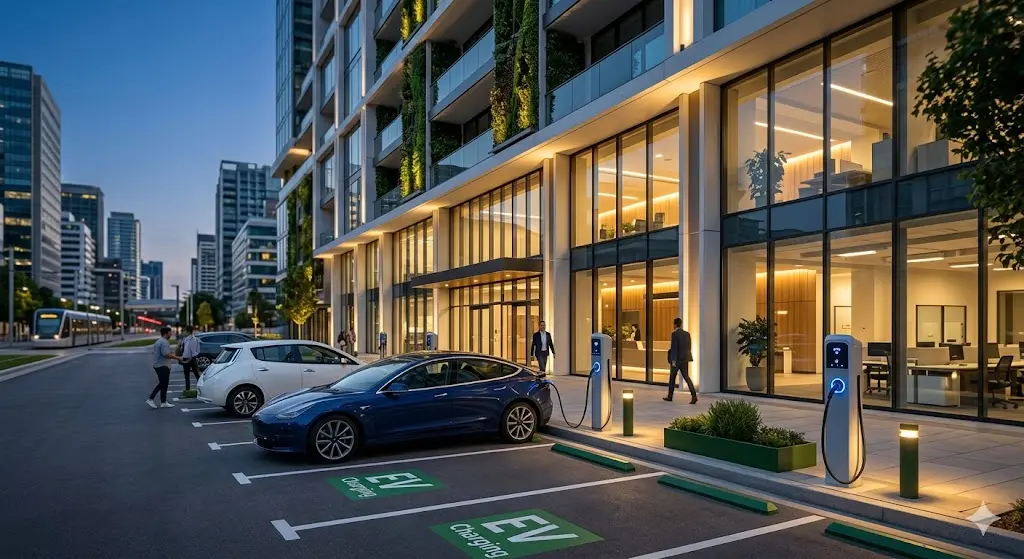
Electric mobility is reshaping real estate because buildings are becoming part of the transportation network. Developers who install EV charging, redesign parking, and plan for battery-powered transportation are attracting higher-value tenants, boosting property appeal, and future-proofing assets.
Why electric mobility is reshaping real estate comes down to one simple shift: where people live, work, and shop now needs to support electric vehicles. Properties with EV charging infrastructure, smart energy systems, and mobility-friendly design are seeing stronger demand, better tenant retention, and rising long-term value.
If you've been watching the property market closely, you've probably noticed that transportation and real estate are becoming deeply connected. That's exactly why electric mobility is reshaping real estate across residential, commercial, and industrial sectors.
As electric vehicles move from niche products to mainstream transportation, buildings are being forced to adapt. Parking garages are turning into charging hubs. Apartment complexes are marketing EV-ready amenities. Shopping centers are using chargers to attract customers and keep them on-site longer.
In my experience, this is one of the most practical shifts in property development we've seen in years. It's not hype. It's infrastructure meeting consumer behavior.
What Is Electric Mobility?
Electric Mobility: The movement of people and goods using vehicles powered primarily by electricity, including electric cars, buses, scooters, trucks, and delivery fleets.
Electric mobility includes much more than passenger cars. It covers ride-sharing fleets, logistics vehicles, electric two-wheelers, and public transportation. All of these require charging access, grid capacity, and physical space.
That need is transforming how real estate is designed and valued.
When buyers ask whether a property is "future-ready," EV charging infrastructure is increasingly part of the answer.
Why Electric Mobility Is Reshaping Real Estate in 2026
In 2026, electric vehicle adoption is accelerating in both developed and emerging markets. Governments are offering incentives, automakers are expanding EV lineups, and businesses are electrifying fleets.
Real estate sits right in the middle of this transition.
Here's the thing: every electric vehicle needs a reliable place to charge. And people overwhelmingly prefer charging where they already spend time—at home, at work, or while shopping.
That means property owners who can provide charging access have a significant advantage.
Residential Properties
Homebuyers and renters increasingly view EV charging as an expected amenity rather than a luxury. Multi-family developments with charging stations often command stronger occupancy and greater tenant satisfaction.
Commercial Buildings
Office complexes with EV charging help employers attract talent and support sustainability goals. Employees can charge during the workday, which adds real convenience.
Retail Centers
Charging stations encourage drivers to stay longer, often increasing spending. A 30-minute charging session can translate into more time in stores and restaurants.
Industrial Facilities
Warehouses and distribution centers are preparing for electric delivery fleets. This requires upgraded electrical infrastructure and carefully planned charging layouts.
Expert Tip: If you're evaluating property investments, ask about transformer capacity and electrical upgrades. Many investors focus on visible chargers but miss the underlying infrastructure that determines scalability.
Why EV Charging Infrastructure Increases Property Value
The strongest reason why electric mobility is reshaping real estate is simple: charging infrastructure creates utility, and utility creates value.
Properties equipped with EV charging tend to benefit in several ways.
Higher Tenant Demand
Renters and commercial tenants are actively seeking EV-ready locations. As EV ownership grows, this preference becomes more pronounced.
Better Tenant Retention
Residents and businesses are less likely to relocate when a property offers amenities that fit their lifestyle and operational needs.
Premium Pricing Potential
Developers may justify higher rents or sale prices when charging capabilities are available.
Competitive Differentiation
In crowded markets, EV infrastructure can help a property stand out.
Stronger ESG Appeal
Institutional investors increasingly prioritize sustainability and carbon reduction. EV-ready assets align with those objectives.
What most people overlook is that charging stations themselves are not always the main profit driver. The real benefit is improved asset desirability and reduced obsolescence risk.
How to Prepare a Property for Electric Mobility Step by Step
If you want to capitalize on this shift, here's a practical process.
1. Evaluate Electrical Capacity
Review transformer size, panel capacity, and available load. Without adequate power, expansion becomes expensive.
2. Identify User Demand
Estimate how many residents, employees, or visitors currently own EVs and how adoption may grow.
3. Choose the Right Charger Type
Residential buildings often need Level 2 chargers, while retail and highway sites may benefit from faster charging solutions.
4. Integrate Smart Energy Management
Load balancing software can reduce costs by distributing electricity efficiently.
5. Plan for Expansion
Install conduit and reserve panel space even if you begin with only a few chargers.
6. Promote the Amenity
Highlight EV charging in listings, brochures, and leasing materials.
Expert Tip: In my experience, pre-wiring additional parking spaces during construction costs far less than retrofitting later.
Common Mistake: Assuming One Charger Is Enough
A lot of developers install a token charger just to check a box.
That approach usually falls short.
Tenants expect reliable access, not symbolic infrastructure. A single charger for a 200-unit apartment building quickly becomes a source of frustration. Real planning means matching infrastructure to actual demand and future growth.
Real-World Example: EV Charging and Apartment Leasing
Consider a newly built 300-unit apartment community in a fast-growing suburb.
Initially, the developer planned only two charging stations. After market research showed rising EV ownership among prospective tenants, they increased the number to 20 and pre-wired another 40 spaces.
Within a year, leasing agents reported that EV-ready amenities became one of the most frequently mentioned features during tours. Occupancy exceeded nearby competitors.
That doesn't mean chargers alone filled the building. But they helped signal that the property was built for the future.
Retail Case Study: Charging That Drives Spending
Imagine a shopping center adding several fast chargers near its main entrance.
Drivers stop to charge for 25 to 40 minutes. During that time, many grab coffee, shop, or dine.
The unexpected point? Some retail owners aren't focused on charging revenue at all. Their real goal is increasing foot traffic and dwell time.
That's a smart move. In many cases, the indirect economic benefit is larger than the electricity margin.
What Types of Real Estate Benefit Most?
Electric mobility touches nearly every property category, but some sectors stand to gain more quickly.
Multifamily Housing
Apartment residents often lack private garages, making shared charging highly valuable.
Office Buildings
Corporate tenants want to support employee commuting and sustainability initiatives.
Retail and Hospitality
Hotels, malls, and restaurants can use charging to attract visitors and encourage longer stays.
Logistics and Industrial
Fleet electrification is driving significant demand for power-intensive facilities.
Mixed-Use Developments
Combining residential, retail, and office uses creates multiple charging opportunities.
Expert Tip: Mixed-use properties may achieve the best economics because chargers serve residents overnight, office workers during the day, and shoppers in the evening.
Challenges Developers Need to Consider
Electric mobility presents opportunities, but implementation isn't always simple.
Upfront Costs
Electrical upgrades, installation, and permitting can require substantial investment.
Utility Constraints
Some locations lack sufficient grid capacity for large-scale charging.
Technology Changes
Charging standards and software continue to evolve.
Space Planning
Parking layouts may need redesign to accommodate equipment and access.
Operational Management
Billing, maintenance, and customer support require ongoing attention.
Still, most of these challenges are manageable with proper planning.
Expert Tips and What Actually Works
I've seen many property trends come and go. Some get headlines but never meaningfully affect valuations.
Electric mobility feels different.
Why? Because it's tied to physical behavior. People need to charge vehicles, and they prefer doing it where they live and work. That's not speculative. It's practical.
My hot take is that EV charging will become as standard as broadband internet. At first, it appears optional. Then, almost overnight, people begin to assume it should already be there.
The owners who act early usually benefit from lower installation costs and stronger market positioning.
People Most Asked About Why Electric Mobility Is Reshaping Real Estate
Will EV charging become a standard building amenity?
Yes, especially in multifamily and commercial properties. In most markets, it's moving from a premium feature to a basic expectation.
Does EV charging directly increase property value?
It can improve marketability, occupancy, and tenant retention, which often supports higher valuations.
Which properties should invest first?
Apartment complexes, office buildings, retail centers, and logistics facilities are typically the strongest candidates.
Is installation expensive?
Costs vary widely depending on electrical capacity and charger type. Planning during construction is usually far more affordable than retrofitting.
Can older buildings add charging stations?
Absolutely, although some may need panel upgrades or utility coordination.
How does electric mobility affect industrial real estate?
Warehouse operators are preparing for electric delivery fleets, increasing demand for high-capacity power infrastructure.
Will non-EV owners care about this feature?
Maybe not today, but market expectations are changing quickly. Future buyers and tenants likely will.
Why electric mobility is reshaping real estate so rapidly?
Because transportation and buildings are becoming interconnected. Properties that support charging are better aligned with how people and businesses operate.
What is EV charging infrastructure in real estate?
It includes chargers, electrical panels, transformers, software, and parking design needed to power electric vehicles.
Do EV chargers generate revenue?
Sometimes, but the bigger value often comes from improved occupancy, retention, and customer traffic.
Is electric mobility relevant in smaller cities?
Yes. Adoption may vary, but infrastructure demand is spreading well beyond major metropolitan areas.
Our network helps businesses gain high authority backlinks, stronger brand visibility, and better SEO ranking through PR Wires and Rank Locally UK. With professional press release distribution services, digital marketing services, and local SEO services, you can secure wider media coverage, instant publishing, and steady organic traffic. Trusted by agencies, startups, bloggers, and SEO professionals, our solutions are built to boost online authority and long-term search performance.