

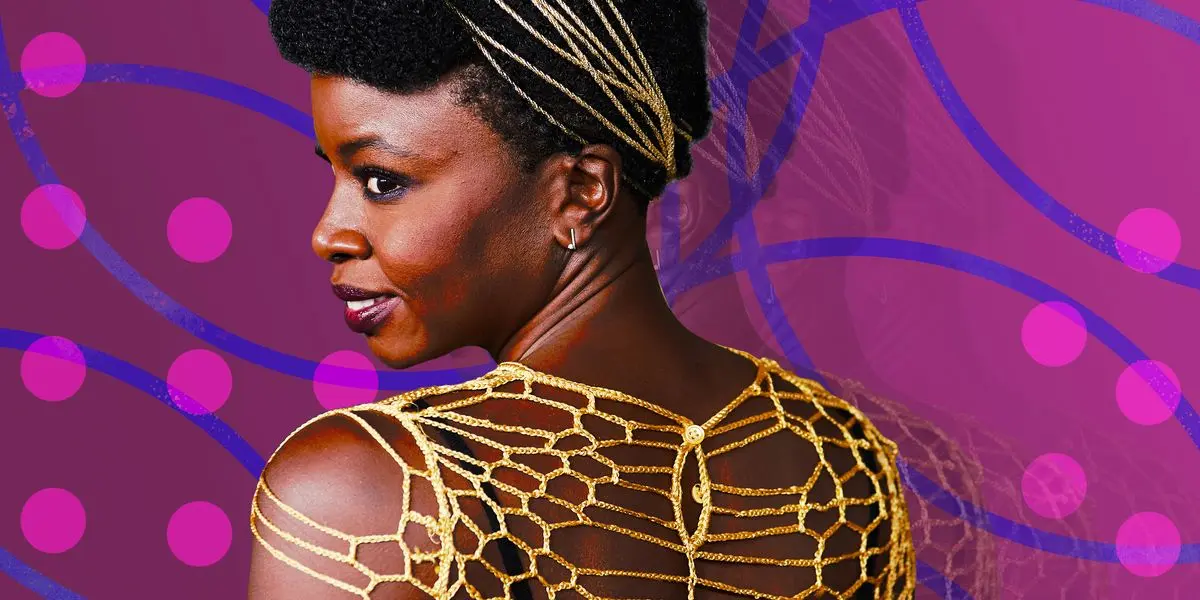
Danai Gurira hasn’t processed everything it took to make “Black Panther: Wakanda Forever” just yet. The Marvel Studios sequel has dominated the box office for five consecutive weekends, grossing over $400 million domestically. While its commercial success was expected, the true impact lies in how the film honors the late Chadwick Boseman, who died in 2020 before production began. The movie serves as a triumphant tribute, a collective homegoing for fans and cast alike.
Gurira, who plays the Dora Milaje General Okoye, admits that the film’s purpose was clear from the start: to celebrate Boseman’s legacy. “We had a very clear purpose in mind to honor our brother with this film,” she said. “That was the purpose. It was about bringing his beautiful legacy to the people again. And so if that happened, if people are receiving it, that is everything to us.”
In “Wakanda Forever,” Okoye faces a new challenge. After failing to protect Shuri (Letitia Wright) from capture by the Talokanil, she is stripped of her title as general. For the first time in the Marvel Cinematic Universe, audiences see Okoye in a vulnerable state. Gurira believes this was a vital narrative choice. “It was important for them to see her fail,” she explained. The character’s grief over King T’Challa’s death further complicates her usual strength. Gurira noted that the filmmakers deliberately freed themselves from the “strong Black woman” archetype.
“That’s what we’ve been denied storytelling-wise in this world as a whole,” said the American-Zimbabwean actress. “We don’t get to show our complexity. We get put in a box: ‘You’re a strong, Black woman. Be strong. Shut up.’ But the idea of saying, ‘No, we’re going to fail and we’re going to be vulnerable and we’re going to be in pain.’ And those are things that we should be allowed to be. And to do that to Okoye, I think, was a very smart move of Ryan’s, because she is such a quintessential strong woman in some ways.”
The film’s production was emotionally demanding. Gurira had to balance intense physical training with the ongoing grief of losing Boseman. She recalled feeling displaced and disoriented, paralleling Okoye’s own journey. “Stepping back into Okoye does always feel new, because she is very physically demanding as a role,” she said. “And the staff, it’s very different from the sword that Michonne uses, so it does feel brand-new.”
Gurira highlighted the collaborative support on set. She and Letitia Wright leaned on each other, with Wright recovering from an accident during filming. Angela Bassett, who plays Queen Ramonda, provided an anchoring presence. Director Ryan Coogler also played a crucial role, helping actors navigate their grief. “Ryan was really great with talking you through whatever you were experiencing that day, the grief of it or the struggle of the day, and he was dealing with a lot himself,” Gurira said.
The theme of failure and recovery resonated deeply with many Black women who watched the film. Gurira acknowledged that society rarely allows Black women space to be vulnerable. “We don’t allow ourselves that room, but the world doesn’t allow us that room either,” she said. “We don’t get to be vulnerable very easily, so we don’t expect to have a soft place to fall.” Portraying Okoye’s fall and subsequent healing is something Gurira hopes will continue in future installments.
Beyond the film, Gurira is focused on her production company and storytelling ambitions. She has an overall deal with ABC Signature and is writing for television and film. Her goal is to bring more African stories into the mainstream, a mission she previously pursued in theater. “My key focus is bringing African stories into the mainstream in various ways, innumerable ways, because as they should be,” she said. “I’m in the labor pains.”
Gurira’s career began on stage; she is an acclaimed playwright known for works like “Eclipsed” and “The Convert.” She gained widespread fame as Michonne on “The Walking Dead,” a role that also challenged stereotypes. Now, she sees a similar opportunity in the Marvel universe. “I think there’s more story to tell in there in the future,” she said of Okoye. “Not just in terms of her recovery, but in terms of her own grief process too. The fact that we don’t see that as much as I think we could is something that I am thankful for.”
Reflecting on Boseman’s lessons, Gurira emphasized his discipline and generosity. “He was such a disciplined person. He was very anchored in the work, how much he would live in the accent of T’Challa all day. Didn’t matter if he was shooting or not,” she recalled. “His commitment and his discipline, also, in terms of how he worked physically, in terms of how he worked on the script, it was something so powerful.”
For Gurira, “Wakanda Forever” is more than a movie; it’s a testament to community and resilience. As she looks ahead, she remains committed to telling stories that reflect the complexity of Black experiences. “There’s a lot I’m doing that I don’t talk about, because I don’t like to talk about things as they incubate,” she said. “But at the end of the day, it’s that push through to the finish line where something lives and all can see it.”
This interview has been edited for clarity and brevity. The conversation covered not only the film but also Gurira’s personal journey, her thoughts on the franchise’s future, and the importance of showing a broader range of emotions for characters of color. Her insights underscore a growing movement in Hollywood to break free from limiting archetypes and offer audiences more authentic, multifaceted portrayals.
Source: Yahoo Entertainment News