

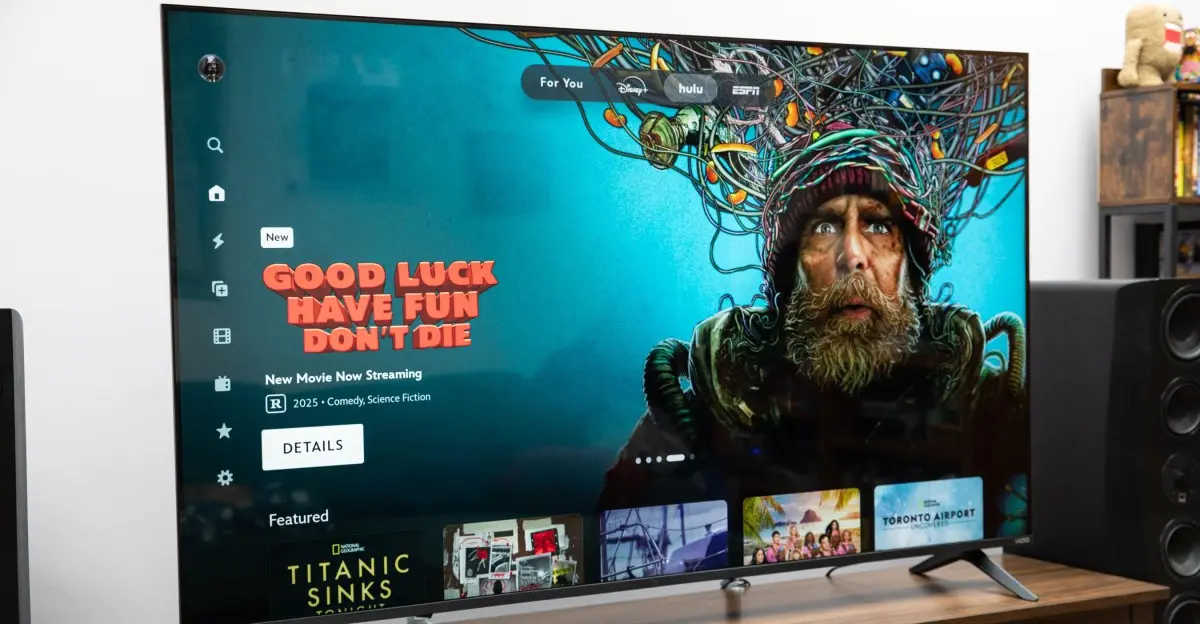
When Vizio, under Walmart ownership, released the Mini LED Quantum TV, the initial impression was that the brand was making a strong comeback with a quantum-dot TV for under $400. However, the real story is that this TV accidentally became the best dumb TV on the market, offering a unique escape from the pervasive data tracking that plagues modern smart TVs.
Walmart's Acquisition and Data Concerns
Walmart acquired Vizio primarily for its advertising business, which generated all of Vizio’s profits at the time. The TV’s operating system is the vehicle for that ad revenue, and Walmart now requires users to agree to extensive data collection to access streaming apps. The TV asks for a Walmart account and activity data policy acceptance, which enables the smart features. However, users can skip this entirely, effectively turning the TV into a dumb display.
During setup, users are prompted to sign in or create a Walmart account. If they skip, they are warned about missing out on managing payments and subscriptions. Further, declining the activity data policy leads to another warning that skipping means missing out on apps like Netflix and YouTube. But after one more decline, the TV becomes a dumb TV with no OS active and three HDMI ports awaiting an external signal. To ensure no data is sent to Walmart, users can disconnect from Wi-Fi entirely.
Performance and Value
For a $400 dumb TV (65-inch model), the Vizio Mini LED Quantum performs remarkably well. It uses a mini LED backlight with quantum dots, delivering high brightness and accurate color. In Calibrated mode, it reaches 936 nits in HDR, excellent for a budget TV. The Calibrated Dark mode is best for dark rooms. However, the IPS panel means black levels are not as deep as VA panels, and there is noticeable blooming in dark scenes. Motion handling is decent but shows some blur with fast-moving content.
The TV supports Dolby Vision, HDR10+, and HDR10, plus Dolby Atmos and DTS:X audio. Gaming features include 4K/60Hz and 1080p/120Hz on larger sizes. The panel is reflective, which can be distracting in bright rooms. Build quality reflects cost-cutting: plastic back, limited cable management, and only three HDMI 2.0 ports. The remote is small and cheap but functional.
How to Use It as a Dumb TV
To avoid Walmart's tracking, users can skip connecting to Wi-Fi at setup, which immediately switches to HDMI input. Even if connected, declining the activity data policy allows the TV to function without the OS. However, firmware updates may be missed. Adding an external streaming device like a Fire TV Stick ($40) provides apps while keeping the Vizio OS inactive. Even then, Vizio and Walmart still scan the HDMI port for viewing data, but the privacy policy suggests that with the OS inactive, data collection is minimized.
It's important to note that using the TV fully (with Vizio OS) requires accepting seven main agreements: Walmart account creation (with email and phone), Walmart Terms of Use, Privacy Notice, Mobile Alerts Terms, Vizio Terms of Service, Privacy Policy, Activity Data, and Viewing Data. Bypassing all these turns the TV into a true dumb display.
Comparison to Other Budget TVs
Most budget smart TVs, like those from TCL or Hisense, force users to accept data collection for basic functionality. The Vizio Mini LED Quantum stands out because it offers a genuine out for privacy-conscious consumers. Its quantum-dot display outperforms many similarly priced models, especially in brightness. The trade-offs are limited connectivity and a glossy screen, but for the price, it's hard to beat.
The 65-inch model costs $398, the 75-inch is $498, and the 85-inch is $768. These prices undercut most competitors. The TV includes an ATSC 1.0 tuner for over-the-air broadcasts, but no ATSC 3.0. The audio is mediocre, as with most budget TVs, so a soundbar is recommended.
Historical Context
Vizio was once known for affordable TVs with decent quality, but its focus shifted to ad revenue after the Walmart acquisition. This TV represents a hybrid approach: a cheap hardware platform that can still be used as a display without the software ecosystem. This is rare in 2026, as most manufacturers tie smart features to the core experience.
The ability to skip all agreements makes it a unique product for those who want a large, high-quality screen without the privacy baggage. However, there is a risk that future firmware updates could force data sharing. For now, the Vizio Mini LED Quantum remains the best dumb TV on the market, assuming users are willing to accept its limitations in connectivity and build quality.
In practice, the TV's picture quality is impressive for its class. Watching World Cup matches or streaming shows from Apple TV reveals a bright, colorful image that holds up well in ambient light. The black levels are not perfect, but for everyday viewing, the flaws are easy to overlook. The motion handling is acceptable for most content, though fast sports like Formula 1 show slight blur.
The TV's operating system, when used, is somewhat sluggish and features an AI-generated screensaver that plays WatchFree+ channels with ads. It's not ideal, but users can bypass it entirely by using an external device. The HDMI inputs lack eARC on all ports, but the single eARC port is sufficient for a soundbar.
For those who prioritize privacy over convenience, this TV is a breakthrough. It proves that budget displays can exist without mandatory data collection. But buyers should be cautious: software updates could close this loophole. Until then, the Vizio Mini LED Quantum is a compelling choice for anyone looking for a large, affordable TV that respects their privacy—at least for now.
Source: The Verge News