

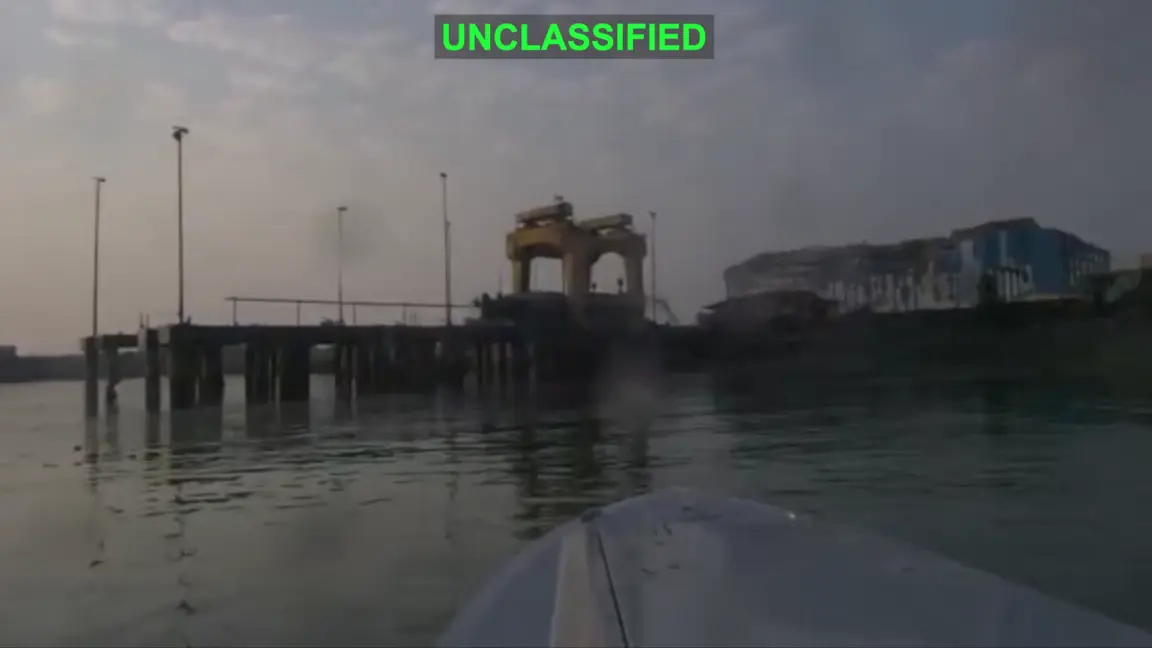
For the first time in its history, the US military sent explosive-laden drone boats into combat by attacking an Iranian midget submarine and naval port. The unprecedented use of such kamikaze sea drones by the United States comes nearly a decade after Iranian and Houthi forces first demonstrated such weapons.
The US military shared a video showing three “one-way attack surface drones” exploding after approaching an Iranian midget submarine and ship maintenance facility at Iran’s Bandar Abbas Naval Base on the night of July 12. US Central Command, the US military combat command responsible for Middle East operations, described the strikes in a social media post as the “first time American forces have employed sea drones in combat operations.”
The US drone boats were able to “make a low-speed, uncontested approach” to their targets before exploding, according to USNI News, a news service from the nonprofit US Naval Institute. USNI News also identified one of the targets as an Iranian Ghadir-class midget submarine that was out of the water while being suspended from a gantry.
The technology behind the strikes involved Saronic Corsair autonomous surface vessels developed by Saronic Technologies, a defense company based in Austin, Texas. The company’s website describes the drone boat as being 24 feet in length and capable of carrying up to 1,000 pounds over 1,000 nautical miles at a top speed surpassing 34 knots.
Such Corsair drone boats supposedly have the capability to operate autonomously without direct human control, including long-range navigation and patrol missions along with regulating power consumption and engine use to loiter at a specific position, according to a Saronic blog post. They are designed to perform a wide variety of missions and were likely equipped with explosives for this specific strike.
This marks the second notable US military use of drone boats during the war, which began with the United States and Israel attacking Iran on February 28, 2026. The US military already used a Corsair sea drone to rescue two US Army helicopter pilots in the waters off the coast of Oman on June 8, after their US Army AH-64 Apache helicopter was taken down by a cheap Iranian Shahed drone.
A history of drone boat violence
The United States is far from the first country to have used exploding drone boats, also colloquially described as kamikaze or suicide drone boats. The first confirmed use of such weapons occurred on January 30, 2017, when the Houthi faction based in Yemen struck the Royal Saudi Naval frigate Al Madinah using an uncrewed remote-controlled boat. A US Navy commander told Defense News that the Houthi weapon was likely developed with the technical assistance of Iran, which has long supported the Houthis.
In more recent years, the Ukrainian military has also developed and deployed drone boats for asymmetric warfare at sea since Russia launched a full-scale invasion of Ukraine in February 2022. Despite lacking a traditional navy, Ukraine has used a combination of flying drones and explosive drone boats to strike Russian warships and tankers, forcing Russia to withdraw its Black Sea Fleet to bases farther from Ukraine and cutting off vital Russian shipping routes.
Ukrainian drone boats have also achieved several milestones in military history by using missiles to shoot down Russian helicopters and acting as surface platforms to deploy small flying drones to strike Russian air defenses. Most recently, a Ukrainian drone boat even deployed an armed ground robot onto contested coastal territory in an unprecedented amphibious operation.
It’s unclear how the US military may continue deploying drone boats as President Donald Trump once again ramps up the war with Iran following the collapse of a supposed ceasefire. The US drone boat strikes came as part of a broader attack by conventional US military forces on Iranian targets in recent days, including strikes by US fighter aircraft and warships.
The US military has also been using one-way aerial attack drones for the first time during its war with Iran—LUCAS drones based in large part on Iranian-developed Shahed drones. Along with the drone boats, the United States is following the example of less powerful countries or factions that have used inexpensive drone weapons to pursue asymmetric warfare. The US military is currently trying to procure a new generation of cheaper surveillance and strike drones, especially after losing dozens of costly hunter-killer Reaper drones collectively worth more than $1 billion in the war against Iran.
The use of drone boats represents a significant tactical evolution. Unlike manned vessels, these drones can be sent on high-risk missions without endangering human lives. Their relatively low cost allows for mass deployment, overwhelming enemy defenses. The Corsair drone boat, for instance, is estimated to cost a fraction of a conventional patrol boat, making it an attractive option for budget-constrained forces. Saronic Technologies, the manufacturer, highlights that the drone’s autonomous capabilities reduce the need for constant satellite communications, making it resilient to jamming and electronic warfare.
The attack on the Ghadir-class submarine is particularly notable. These midget submarines are used by Iran for covert operations in the Persian Gulf, often deploying naval mines or special forces. Hitting one while it was suspended on a gantry suggests careful intelligence and precision timing. The strike likely destroyed not only the submarine but also the maintenance facility, dealing a significant blow to Iran’s naval infrastructure.
The broader context of the US-Iran war involves a complex array of drone and missile exchanges. Since the war began in February 2026, both sides have used a variety of unmanned systems. Iran has attacked US bases with Shahed drones and cruise missiles, while the US has responded with airstrikes and now drone boats. The conflict has also seen the introduction of directed-energy weapons, with reports of US warships using lasers to down Iranian drones.
From a historical perspective, the US adoption of drone boats mirrors earlier military revolutions. Just as drones transformed air warfare, sea drones are now reshaping naval combat. The US Navy has been experimenting with unmanned surface vessels for over a decade, but operational use has been slow due to legal and ethical concerns. The current war has accelerated these deployments, as commanders seek any tactical advantage.
One of the key challenges for drone boats is navigation and target recognition. The Corsair uses a combination of GPS, inertial navigation, and optical sensors to find its way. In a contested environment, GPS can be jammed, so the drone must rely on other methods. Saronic claims their boats can operate in GPS-denied environments using visual odometry and pre-loaded maps. The July 12 strike appears to have involved a predetermined course, with the drones making a slow approach to avoid detection.
The psychological impact of drone boats should not be underestimated. For Iranian sailors, watching an unmanned boat steadily approach and detonate can be demoralizing. It signals that the US is prepared to use expendable assets in a way that conventional ships cannot. This can shift the balance of naval power in regions like the Persian Gulf, where Iran has long invested in small fast-attack craft and submarines.
Looking ahead, the US military is likely to integrate drone boats more broadly. The Pentagon’s Replicator initiative, which aims to field thousands of autonomous systems by 2027, includes maritime drones. The success of the Corsair in both rescue and strike roles will likely lead to increased orders. Other nations, including NATO allies, are also investing in similar technology, suggesting that drone boats will become a permanent feature of naval arsenals.
In conclusion, the US military’s first combat use of explosive drone boats marks a milestone in naval warfare. It demonstrates that the United States is willing to adopt tactics pioneered by its adversaries and adapt them to its own needs. As the war with Iran continues, these unmanned systems will play an increasingly central role, potentially reshaping how future conflicts are fought at sea.
Source: Ars Technica News