

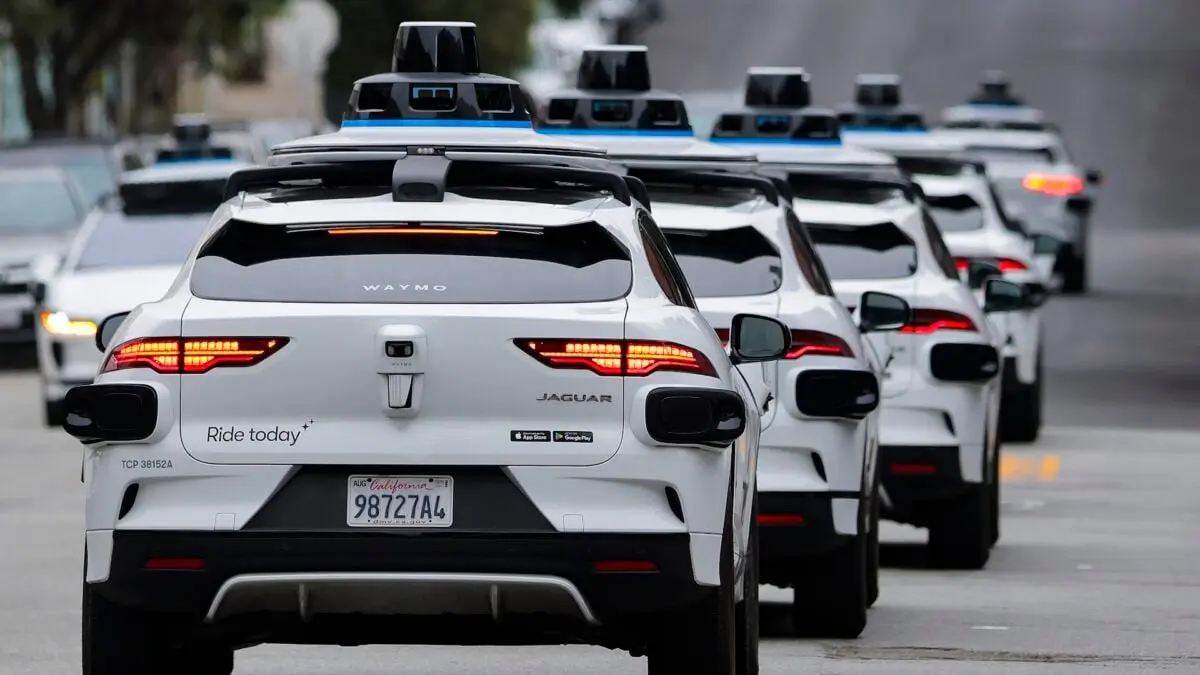
More affordable lidar sensors from China are looking increasingly appealing to American automakers. But a Department of Energy lab is reportedly looking into whether the technology could pose national security risks.
TechCrunch reports, citing two unnamed sources familiar with the matter, that the Idaho National Laboratory is investigating whether Chinese-made lidar sensors could pose cybersecurity risks if they become widely used in vehicles in the United States. The sources told TechCrunch that the review is being funded by a company or group of companies in the electric and autonomous vehicle industry. It's not currently clear which companies are behind the effort.
The tests are looking for potential cybersecurity vulnerabilities and could help settle growing concerns in Washington over whether Chinese-made lidar poses a security risk, according to TechCrunch's sources.
The Idaho National Laboratory did not immediately respond to a request for comment; however, a spokesperson for the lab previously told TechCrunch that “this isn't a project that we're at liberty to discuss with reporters.”
What Is Lidar and Why Does It Matter?
Lidar sensors use pulses of laser light to measure distances and create detailed 3D maps of their surroundings. The technology is widely used by companies developing self-driving vehicles. Unlike cameras, which rely on ambient light and complex algorithms to interpret visual data, lidar generates precise, real-time depth information that can be used to detect objects, pedestrians, lane markings, and other vehicles with high accuracy.
The term “lidar” stands for Light Detection and Ranging. It operates on the same principle as radar but uses light waves instead of radio waves. By firing rapid pulses of laser light at surfaces and measuring the time it takes for the reflections to return, lidar systems can build a dynamic, three-dimensional point cloud of the surrounding environment. This capability is particularly valuable for autonomous driving, where split-second decisions must be made based on accurate spatial data.
In recent years, lidar has become a critical component in the development of advanced driver-assistance systems (ADAS) and fully autonomous vehicles. Automakers and tech companies alike have invested heavily in reducing the cost and size of lidar units while improving their range and resolution. Velodyne, Luminar, Hesai, Innovusion, and other manufacturers have raced to produce sensors that can be integrated into mass-market vehicles.
China's Dominance in Lidar Manufacturing
One notable exception to the lidar trend is Tesla. Elon Musk has long argued that autonomous driving can be achieved with cameras and AI instead. Musk has publicly stated that lidar is a “fool's errand” and that “anyone relying on LiDAR is doomed.” Tesla's approach, known as “Tesla Vision,” relies on eight cameras and neural networks to interpret the driving environment, avoiding the cost and complexity of lidar systems.
Still, lidar has gotten dramatically cheaper in recent years, driven in large part by Chinese companies. Sensors that once cost tens of thousands of dollars can now cost just a few hundred dollars. That has made the technology increasingly attractive to American automakers. Chinese lidar makers such as Hesai, RoboSense, and Innovusion have achieved significant economies of scale, enabling them to produce high-performance sensors at prices that Western competitors find difficult to match.
The cost reduction has been remarkable. In 2017, the first generation of high-end lidar sensors used in autonomous vehicle testing cost upwards of $75,000. By 2023, solid-state lidar sensors from Chinese manufacturers were being sold for around $500 to $1,000, and prices have continued to fall. This dramatic drop has opened the door for broader adoption in consumer vehicles, not just robotaxis and commercial fleets.
Several Chinese lidar companies have also established global partnerships with major automakers. For example, Hesai has supplied sensors to NIO, Li Auto, and Xpeng, as well as to international companies like Bosch and Ford. RoboSense has partnered with Hyundai, Geely, and Lucid, among others. Innovusion has worked with NIO and Faraday Future. These partnerships have helped validate the reliability and performance of Chinese lidar technology.
But the growing reliance on Chinese components has raised alarms in Washington. Lawmakers and security officials have expressed concern that sensors installed in millions of American vehicles could collect sensitive location data, imagery, or other information and transmit it back to China. There are also fears that such devices could be exploited remotely to disable vehicles or disrupt infrastructure.
The Idaho National Laboratory Investigation
According to TechCrunch, the Idaho National Laboratory is conducting a review of Chinese-made lidar sensors specifically to identify potential cybersecurity vulnerabilities. The lab, which is part of the U.S. Department of Energy, has extensive experience in testing critical infrastructure and energy technologies for security risks. The project is reportedly funded by a consortium of companies from the electric and autonomous vehicle industry, though the identities of those companies have not been disclosed.
The investigation is said to focus on whether lidar sensors could be hacked, whether they contain hidden backdoors, whether they improperly transmit data, and whether they could be used to launch broader cyberattacks on vehicle systems. The results of the tests could either allay or escalate concerns about Chinese-made lidar, and could influence future regulations and buying decisions by automakers.
The fact that a U.S. government laboratory is involved adds a layer of authority to the review. The Idaho National Laboratory is known for its cybersecurity research, including work on Industrial Control Systems, critical infrastructure protection, and vulnerability assessments. Its findings would likely carry significant weight in Washington and could inform federal policy on Chinese auto components.
However, it is also notable that the review is being funded by private industry rather than by the government itself. This arrangement suggests that automakers and technology companies are seeking independent, objective data to guide their sourcing decisions. It also indicates that some companies are genuinely uncertain about the risks and want to avoid both the dangers of deploying vulnerable technology and the costs of shunning a highly competitive supply chain.
Industry Responses and Strategic Considerations
Rivian CEO RJ Scaringe told Reuters earlier this year that the company was considering producing lidar sensors in the U.S. using Chinese technology, potentially through a joint venture. Scaringe told Reuters that when it comes to lidar sensors costing just a few hundred dollars, “all the real choices are coming out of China.” He also said other automakers were involved in discussions about potentially building up production outside China.
“A number of different car manufacturers are thinking about how they could do that either together, or at least through a shared alignment to say, hey, let's develop production capacity in the United States for this, or at least outside China,” Scaringe said.
This sentiment reflects the broader dilemma facing the American auto industry. On one hand, Chinese lidar offers a compelling combination of performance, price, and reliability. On the other hand, escalating geopolitical tensions and national security concerns have led to calls for decoupling from Chinese technology, particularly in areas that affect critical infrastructure and public safety.
Some automakers have already moved to hedge their bets. Ford, for example, invested in the lidar startup Velodyne and later spun off its own lidar division. General Motors invested in the lidar company Ouster. Pony.ai and other autonomous vehicle developers have used sensors from multiple suppliers to avoid over-reliance on any single source. But these Chinese suppliers remain dominant in the low-cost segment, and achieving the same price-performance ratio from American or European manufacturers would require significant time and investment.
Congressional Actions and Legislative Proposals
But some lawmakers have said not so fast. Congress has already proposed at least two bills that would ban Chinese-made lidar in the U.S. The Commerce Department has separately placed restrictions on Chinese- and Russian-connected car tech.
In 2024, the Biden administration proposed a rule that would ban the use of Chinese and Russian software and hardware in connected vehicles on U.S. roads, citing national security risks. The proposed rule targeted not only lidar but also other components such as vehicle-to-everything (V2X) communication systems and certain sensors. The rule was seen as a direct response to concerns that Chinese-made technology could be used to track American drivers or disrupt traffic systems.
In 2025, a bipartisan group of lawmakers introduced the “Safe and Secure Vehicles Act,” which would require the National Highway Traffic Safety Administration to assess the security of automated driving systems and prohibit the use of components from foreign adversaries. Similarly, the “Prohibiting Dangerous Data Collection in Vehicles Act” was introduced in the Senate to restrict data flows from vehicles to countries like China and Russia.
These legislative efforts have created a cloud of uncertainty for automakers. While no outright ban on Chinese lidar has been enacted, the threat of future restrictions is influencing corporate strategy. Some companies are diversifying their supply chains, while others are lobbying for clearer rules that would allow them to continue using Chinese components without fear of legal repercussions.
Security Concerns and Technical Realities
Lawmakers and security officials have raised concerns that the sensors could collect sensitive information and send it back to China or potentially be exploited to remotely disable vehicles that rely on them. Lidar sensors, like any connected vehicle component, could theoretically be compromised by malicious actors. If a hacker gained access to a lidar unit, they might be able to feed false data to the vehicle's control systems, causing it to brake suddenly, veer off course, or fail to detect obstacles.
In theory, a backdoor in the lidar hardware or firmware could allow an attacker to disable the sensor remotely, making the vehicle effectively blind. Such an attack could be catastrophic if it occurred across a large fleet of autonomous vehicles. However, no credible evidence has been publicly presented to date that Chinese-made lidar actually contains backdoors or is more vulnerable than any other lidar.
TechCrunch notes that “concerns about widespread disabling of Chinese lidar remain just that — concerns.” The article points out that there is no known case of a Chinese lidar manufacturer engaging in cyberattacks or data exfiltration. Moreover, lidar systems are typically isolated from a vehicle's steering, braking, and acceleration systems by multiple layers of security, making remote exploitation difficult.
Still, the lack of concrete evidence has not quelled political anxieties. In an era of intense strategic competition with China, policymakers are often unwilling to take risks with American national security, even when those risks are speculative. The Idaho National Laboratory's review could help provide the technical foundation needed to establish whether these concerns are justified.
What the Future Might Hold
The outcome of the Idaho National Laboratory's tests could have significant implications for the automotive industry. If the sensors are found to be secure, it would likely pave the way for broader adoption of Chinese lidar in American vehicles, enabling automakers to offer advanced safety features at lower prices. This could accelerate the rollout of autonomous vehicles and make roads safer by reducing human error.
If, on the other hand, the tests reveal serious vulnerabilities, automakers would face pressure to abandon Chinese suppliers and seek alternatives, even at higher cost. They might invest in domestic lidar manufacturing or partner with non-Chinese companies, but that would take time and increase vehicle prices. In the worst case, a ban on Chinese lidar could delay the introduction of affordable self-driving cars by several years.
For now, the industry is in a waiting game. The private funding of the review suggests that automakers and tech companies are eager for clarity. They want to know whether they can continue to rely on Chinese parts or whether they need to develop alternate supply chains. The review also indicates that the government is taking the issue seriously, even as it remains officially neutral.
Rivian's proposal to produce lidar in the U.S. using Chinese technology offers a potential middle ground. By licensing designs and manufacturing domestically, American companies could potentially bypass security concerns while still benefiting from Chinese innovation. However, such arrangements would also expose U.S. production lines to Chinese intellectual property and could be criticized by lawmakers who want a complete break.
As the investigation unfolds, automakers will be watching closely. The decision to use Chinese lidar is not just a business decision; it is now a geopolitical one. The intersection of technology, security, and trade policy is becoming increasingly complex, and the outcome of this review could set a precedent for how other critical vehicle components are treated. For now, the only certainty is that the debate over Chinese lidar is far from over.
Source: Gizmodo News