

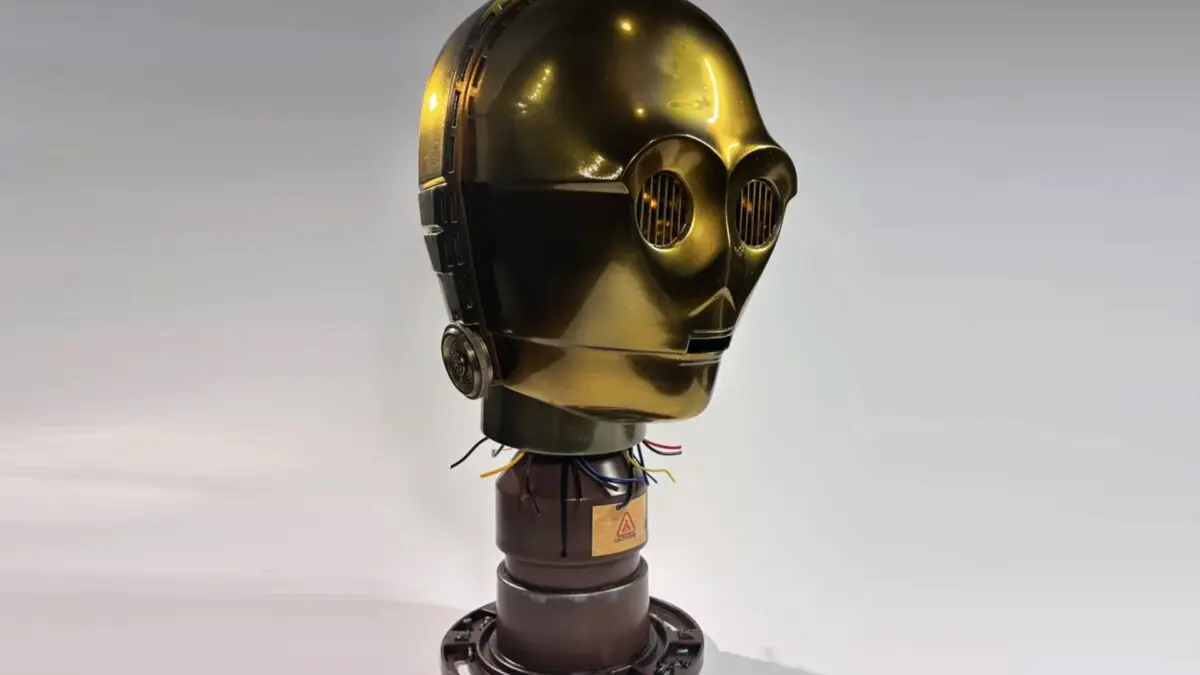
May the fourth be with you, and all that. For Star Wars Day, we focus on one of the franchise's most iconic yet underappreciated characters: C-3PO, the shiny golden protocol droid known for his fussy personality and impeccable grammar. Now, thanks to a student project, you too can have a conversation with a C-3PO head that talks back in the character's trademark voice.
Samuel Potozkin, a student at Chapman University in Orange County, California, recently shared a video detailing how he built a DIY C-3PO head that holds real-time conversations. The head uses a Raspberry Pi 5, a custom large language model (LLM) trained to mimic C-3PO's personality, and sophisticated text-to-speech (TTS) software. The result is a lifelike interactive prop that lets users feel like they are communicating with the droid—or, as the project hilariously puts it, experience what it's like to be R2-D2.
The Origins of C-3PO
C-3PO, alongside his astromech companion R2-D2, has been a staple of the Star Wars universe since the first film in 1977. Designed as a protocol droid fluent in over six million forms of communication, Threepio often serves as comic relief, his anxiety and politeness providing a contrast to the heroes' bravado. The character was brought to life by actor Anthony Daniels, who voiced and performed the role in all main saga films. The original head prop from The Empire Strikes Back recently sold for over $1 million at auction, underscoring the enduring collectibility of Star Wars memorabilia.
But while owning an original prop is out of reach for most fans, Potozkin's project makes a functional replica accessible—if you have some technical skill and a 3D printer.
How the Talking Head Works
The pipeline for the talking C-3PO head is elegantly simple, yet relies on cutting-edge technology. A microphone picks up the user's speech, which is sent to a Raspberry Pi 5. The small computer runs a real-time speech-to-text converter, transcribing the user's words into text. That text is then fed as a prompt to a custom LLM that has been fine-tuned to adopt C-3PO's distinctive personality—prissy, formal, and slightly exasperated. The LLM generates a response in text, which is then passed through a text-to-speech system designed to emulate Anthony Daniels' vocal delivery.
Potozkin encountered early challenges with the audio output. He noted that the initial TTS voice lacked the metallic, resonant tone associated with C-3PO. To fix this, he applied a series of audio post-processing effects: a short delay line to create tight temporal reflections, and a chorus effect that modulates the time and pitch of duplicated signal paths to create layered vocal resonance. This careful engineering produces a voice that is instantly recognizable as Threepio, even without the visual of the gleaming gold head.
The entire setup is detailed in a paper Potozkin published on his GitHub page. He explains the hardware choices, the LLM training data (likely scraped from scripts and fan transcripts), and the software stack. This open-source approach encourages other makers to replicate or improve upon the design.
Why This Matters: AI and Fandom
Potozkin's project is a testament to how far AI and hobbyist electronics have come. Just a few years ago, creating a conversational interface with a fictional character's personality would have required expensive servers and expert programming. Now, a Raspberry Pi—a $35 credit-card-sized computer—can run a local LLM with enough fidelity to convincingly mimic a beloved character.
This project also taps into the growing trend of "digital companions" and interactive memorabilia. Fans have long created replica props, but adding conversational AI transforms them from static collectibles into dynamic experiences. The C-3PO head isn't just a display piece; it's a sounding board for jokes, trivia, or even arguments about the probability of successfully navigating an asteroid field.
The use of LLMs in fandom is expanding rapidly. From chatbots that mimic historical figures to voice assistants that speak like video game characters, the boundary between fiction and reality is blurring. Potozkin's work is a prime example of how DIY creators are pushing these boundaries at a grassroots level.
Expanding the DIY Droid Community
Potozkin is not the first to attempt a talking droid head. The maker community has produced various R2-D2 recreations, BB-8 models, and even functioning protocol droids. However, few have managed to integrate natural language processing with such convincing vocal modulation. His project stands out because it prioritizes the auditory experience, ensuring that the voice sounds like it belongs in the Star Wars galaxy.
The project also opens doors for future improvements. For instance, adding computer vision could allow the head to track speakers, or integrating a motorized neck could enable realistic head movements. Potozkin has provided a solid foundation that others can iterate upon.
For those interested in building their own, the GitHub repository includes a bill of materials, wiring diagrams, and code. The total cost is estimated at around $200 for the electronics, plus the cost of the 3D-printed head. Many makers will already have a Raspberry Pi and a 3D printer, making the project even more accessible.
The Broader Context of AI in Entertainment
Potozkin's project arrives at a time when AI is revolutionizing entertainment. Studios use generative AI for visual effects and script analysis, while fans use it to create fan content. The ability to make a fictional character "real" through conversation is both thrilling and thought-provoking. What does it mean to talk to a machine that sounds like C-3PO? For many, it's a way to deepen the connection to a beloved universe.
The project also highlights the importance of open-source AI. By sharing his models and methods, Potozkin contributes to a growing library of character-specific LLMs. Future makers can adapt his work for other characters—imagine a talking Yoda head dispensing wisdom, or a sarcastic K-2SO from Rogue One.
The C-3PO head is not just a novelty; it's a glimpse into a future where our favorite characters can be brought to life in our living rooms, albeit as plastic and metal creations driven by software.
For now, Potozkin's creation is a delightful celebration of Star Wars Day. It combines nostalgia, technical prowess, and a sense of fun. If you've ever wanted to argue with Threepio about the odds of success on a dangerous mission, this project offers exactly that. And if you prefer to be the beeping, bleeping R2-D2, the head is your perfect conversation partner.
The next time May 4th rolls around, you could have your own talking C-3PO head as the centerpiece of the festivities. All it takes is some soldering, a few hours of coding, and a deep love for the galaxy far, far away.
Source: Gizmodo News