

Shortwave radio has always held a peculiar allure for those fascinated by the invisible signals that crisscross the globe. Unlike the sanitized streams of the modern internet, shortwave remains raw, unpredictable, and often unsettling. Among its many quirks are signals that have sparked decades of speculation—mysterious beacons, coded broadcasts, and military transmissions that seem to come from nowhere. The best part? Anyone with an internet connection can listen to them right now using freely available online software-defined radios (SDRs).
Diving Into the World of WebSDRs
To explore these signals, you don't need a license, an expensive transceiver, or a backyard full of antennas. Public WebSDR, KiwiSDR, and OpenWebRX receivers are scattered around the world, accessible via a browser. These receivers pick up the high-frequency (HF) band, roughly 3–30 MHz, where shortwave transmissions travel thousands of miles by bouncing off the ionosphere. By hopping between receivers in different time zones and locations, you can dramatically improve your chances of catching rare signals.
UVB-76: The Buzzer That Never Sleeps
The most famous of these is UVB-76, commonly called the Russian Buzzer. Transmitting on 4625 kHz using upper sideband (USB) mode, it emits a monotonous buzzing sound that resembles a ship's horn. This signal has been active since at least the 1970s, and its purpose remains officially unknown. Occasionally, the buzzing stops and a Russian voice reads short phrases or numbers. Some believe it is a dead-hand system or a military communication channel, while others see it as a digital relic kept alive by unknown forces. To hear it, tune a KiwiSDR or WebSDR to the frequency and listen for the steady buzz. Note that some receivers near the suspected origin point in Russia block the frequency to prevent abuse.
The Pip and the Squeaky Wheel
Two other curious Russian signals accompany the Buzzer. The Pip (5448 kHz by day, 3756 kHz at night) repeats a short, high-pitched tone at regular intervals, occasionally interrupted by voice messages. The Squeaky Wheel (5367 kHz daytime, 3363.5 kHz night) produces a two-tone squeak that quickly becomes grating. Both are believed to be part of the same network as UVB-76. Their rhythmic patterns add to the eerie atmosphere of the shortwave spectrum.
Skyking: A Phrase From Military Communications
Another widely discussed signal is the phrase "Skyking, Skyking, do not answer," which emanates from the United States High Frequency Global Communications System (HFGCS). This network supports military aircraft and ground stations with encrypted voice and data traffic. The phrase indicates a high-priority message that should not be acknowledged on air. You can catch it on frequencies such as 4724, 8992, 11175, and 15016 kHz (USB mode). While rare, recordings of Skyking transmissions have circulated online for years, adding to the mystique of military shortwave.
Number Stations: Voices From the Shadows
Perhaps the most bone-chilling category of shortwave signals is number stations. These broadcast strings of numbers, letters, or code groups, typically read by a calm, synthesized or human voice. The conventional explanation is that they are one-way transmissions to intelligence agents, but the actual content remains encrypted. Two prominent examples are HM01 (a Cuban station transmitting in Spanish on AM at frequencies like 9330 and 11435 kHz) and E11, also known as Oblique (an English-speaking station with a rotating schedule). HM01 mixes voice numbers with digital bursts, while E11 features a woman reading groups at scheduled times. The routine nature of these broadcasts—precise timings, flat affect, and cryptic content—is deeply unsettling.
Using the Waterfall to Spot Signals
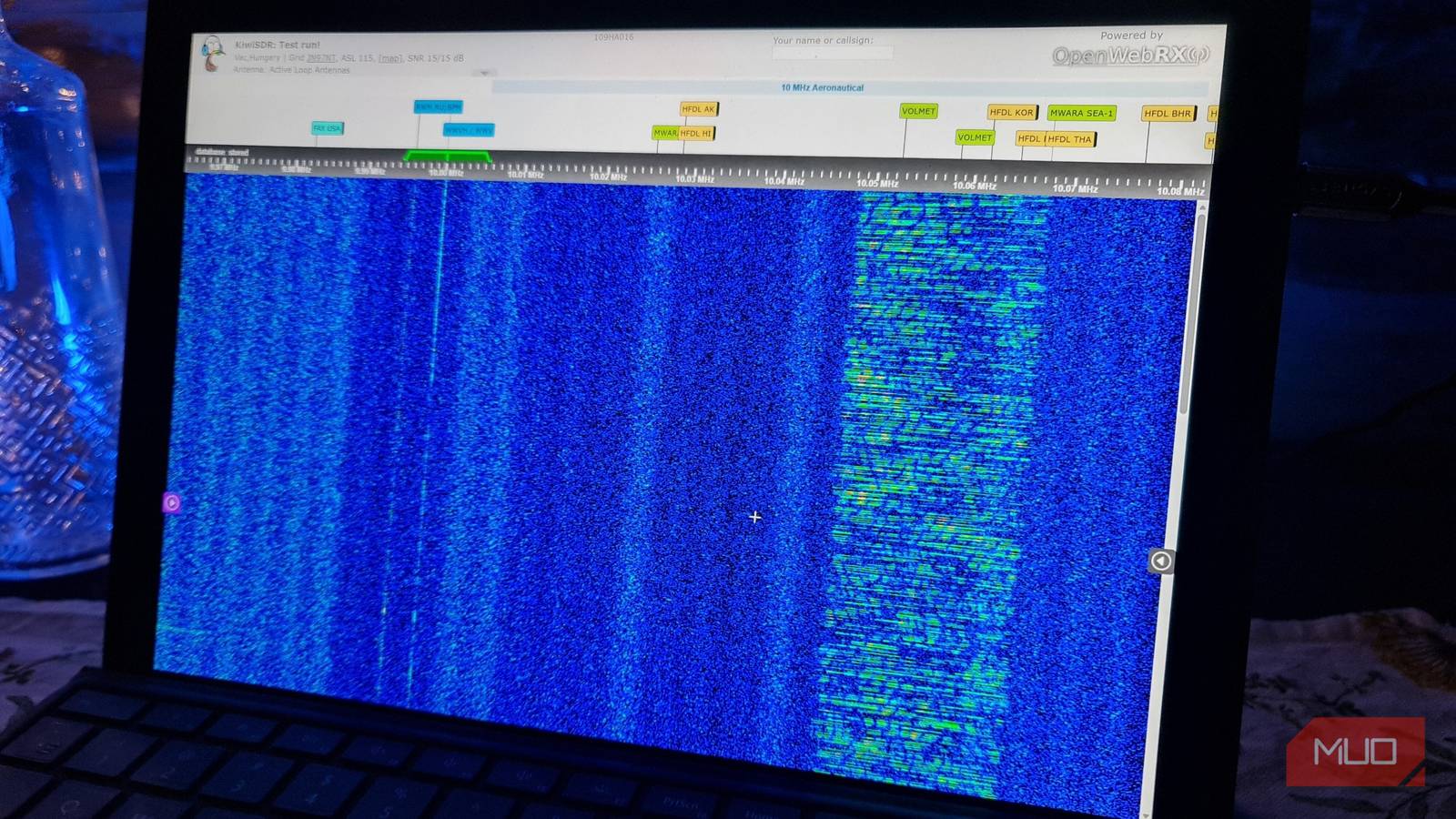
Online SDRs display a real-time spectrogram called the waterfall, which visualizes frequencies as colors. This makes it easy to identify signal patterns: buzzing, pinging, or pulsing. Once you learn to recognize the signatures of known stations, you can quickly find live activity. Sites like rx-tx.info offer a map of receivers, color-coded by type (KiwiSDR, OpenWebRX, WebSDR), making it simple to jump between locations for the best reception.
Time Signals: The Boring but Essential Guide
Not all shortwave signals are mysterious. Time stations like WWV (USA) and CHU (Canada) broadcast precise spoken time and ticking sounds on multiple frequencies. WWV operates on 2.5, 5, 10, 15, and 20 MHz in AM mode. CHU uses 3330, 7850, and 14670 kHz. While unexciting, they serve as excellent practice for spotting the differences between utility broadcasts and the truly weird. Once you can distinguish a steady time signal from a Buzzer, your ear will be tuned for the oddities.
Technical Deep Dive: Propagation and Why SDRs Matter
Shortwave propagation depends on the sun, the ionosphere, and time of day. Nighttime generally improves long-distance reception because the D layer of the ionosphere weakens, allowing signals to refract from higher layers back to Earth. This is why most serious shortwave listening occurs after dark. WebSDRs remove the geographical limitation: a receiver in South Africa can pick up a European signal even if your local conditions are poor. The KiwiSDR, with its wide bandwidth and networked features, is a favorite among hobbyists. OpenWebRX offers more customization but can be noisier with cheap RTL-SDR dongles. WebSDR receivers are typically high-end and reserved for scientific use.
The Ongoing Fascination
What makes these signals so compelling is that they are live, active, and only partially understood. The Russian Buzzer changes callsigns occasionally. Number stations update their schedules. Military nets transmit emergency action messages in real time. Organizations like Priyom carefully track these transmissions, documenting schedules and decoding some digital modes. For the listener, the reward is not just hearing a weird sound, but participating in a global, decades-old mystery that remains unresolved. The signals are out there, waiting to be discovered on the dial.
Source: MakeUseOf News