

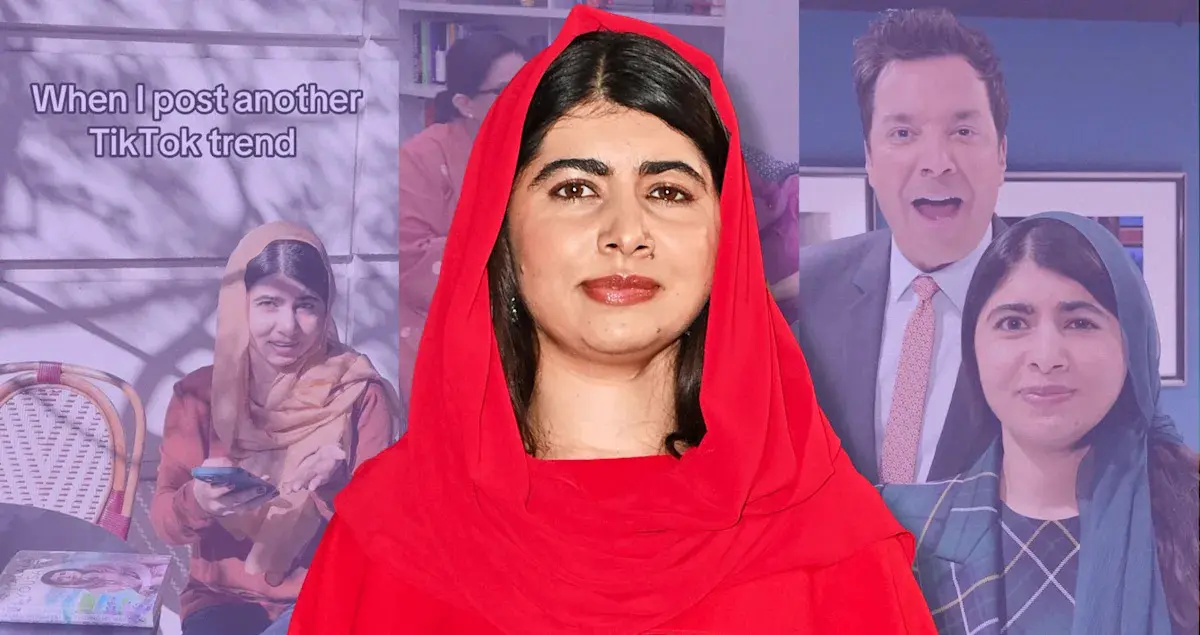
If you’ve been on social media this week, you’ve seen the viral “What’s Up?”/“Beez in the Trap” mashup. Two people stand back-to-back. One person lip-syncs Linda Perry’s vocals from the '90s 4 Non Blondes hit, then the camera swings to the other one, who starts mouthing Nicki Minaj’s R-rated rap. Sabrina Carpenter’s done it. So have Great British Baking Show contestants and the kids from The Sandlot. But the world was really not prepared to see Malala Yousafzai rapping, “Bitches ain’t shit, and they ain’t say nothing.”
Yes, that Malala. While the activist and author stops short of mouthing the word “motherfer” — she is a Nobel Peace Prize laureate, ahem — she gamely nails Minaj’s other lyrics in her version with Jimmy Fallon. The resulting video, coinciding with Yousafzai’s visit to the Tonight Show this week, has about 5 million views … and a whole lot of stunned comments.
“If I had 1,000 guesses for who’d be doing Nicki’s part, [Yousafzai] would’ve never been one of them,” one commenter wrote. “A historical figure rapping to Nicki Minaj, WHAT A TIME TO BE ALIVE,” mused another.
But Yousafzai is a Gen Z-er, after all — and this is part of her efforts to remind people of that.
“The first thing I want to tell people is my age. I’m 28,” she tells Fallon during her Tonight Show interview. “I still see kids on social media commenting that they thought I was a figure from the 18th century, or that I’m, like, dead. I also meet people who are shocked that I’m not 15 years old anymore.”
That’s because for more than a decade, Yousafzai has been seen as more of a symbol than an actual flesh-and-blood young woman. When she was 15, she survived an assassination attempt by the Taliban for advocating for girls’ education. She published her first book, I Am Malala, at 16. And at 17, she became the youngest-ever Nobel Peace Prize recipient.
Yousafzai represented courage, intellect and a seriousness beyond her years. Who she wants to be seen as now, however, is a 20-something who is just as silly, sporty and unsure of herself as her Gen Z peers. Social media is letting her shine.
The lore of Malala
To understand how radical it feels for Yousafzai to switch up her image, it helps to first remember how it was built in the first place.
Yousafzai has primarily been known as a Pakistani activist for girls’ education since she began anonymously blogging at 11 years old for the BBC about life under Taliban rule in her native district, Swat Valley. As girls were being banned from school, Yousafzai spoke out about the importance of education and eventually gained international attention through television and documentary appearances on the topic. But it was when she survived a gunshot to the head in 2012 that her name took on a meaning of its own.
Jess Rauchberg, assistant professor of communication technologies at Seton Hall University, describes that as the moment that Yousafzai was placed on a pedestal, as people around the world started using the name Malala synonymously with the fight for universal access to education for young girls. “She became so visible because she was this symbol that could be used in Western media to advance narratives that aligned with feminist ideas of empowerment that are becoming really, really popular during this time,” says Rauchberg. “That wasn't necessarily how Malala was portraying herself. She was also a teenager when this happened; she [was] still a minor.”
Yet, she played the part. Yousafzai gave a speech at the United Nations and was followed by ABC News for a segment with Diane Sawyer. She was only 16, but with accolades and life experiences that gave a different impression. And so did other aspects of her identity, according to Rauchberg.
“She wears a hijab, she is known to dress more modestly and has had this very particular guarded appearance,” says Rauchberg, who notes that race plays a part in people perceiving a young Yousafzai as an adult. “She is shown as this very uptight, modest, perfect person who does not engage in debauchery or hijinks or shenanigans, whatever have you.”
Yet, now Yousafzai is actively pushing against that.
In her influencer era
Yousafzai’s Instagram has long shown different aspects of her life, including activism, achievements (like her 2021 British Vogue cover), her relationship with husband Asser Malik and even her love of sports. It wasn’t until she posted a photo raving about the Barbie film and calling her partner “just Ken” that people started to recognize her humor. As she promotes her newest memoir, Finding My Way, she’s making it so people can’t miss those other sides of her.
The activist launched her TikTok account in August, reintroducing herself to a new social media audience. There, she started to lean into popular formats like “get ready with me” videos and outfit trends. Yousafzai has even made light of the comments she received from people who thought she was dead. “Ironically — I’m also Gen Z,” she captioned one video, which received praise. “Can't keep a diva down,” read one comment.
More mainstream content, like her trending video with Fallon or her therapy skit with Indian comedian Zarna Garg, has been met with similar adoration, as well as some confusion. For every comment praising Yousafzai for “coming out of her shell,” there are others who frame it as a negative development. One commenter accused her of “[losing] her personality.”
Rauchberg says that these reactions are a result of the assumptions people have made about “how Muslim women move” in general and how they should appear in the media. “She's not even doing anything that's bad or even subversive. She's just, you know, acting her age.”
A multifaceted Malala
Yousafzai’s new memoir tells a story about a young activist who is growing up in the very same world as other Gen Z-ers. She’s fallen in love. She’s tried smoking out of a bong. She’s gone to therapy. She’s stressed about school.
But you don’t need to read a book to see this side of her. That’s what social media is for.
“The humanity in the social media posts invites people into her life,” media psychologist Pamela Rutledge tells Yahoo. “She is taking charge of her own identity, making her more relatable and human. It broadens her appeal by showing that her identity has many dimensions.”
It also doesn't dilute her activism; instead, it makes it accessible to even more people. “It strengthens her message by blurring the boundaries around her advocacy, making it one part of her experience that also includes trauma, romance, family dynamics and mental health,” says Rutledge.
Seeing the “perfect” activist lean into her imperfections (and humor, and curiosity) is working, adds Rauchberg. “It feels authentic,” she says. “We're so enamored with her now because we actually get to hear from Malala herself.”
And that, friends, is what’s going on.
Beyond the viral moments, Yousafzai’s journey from a young blogger in Pakistan’s Swat Valley to a global icon of resilience and advocacy is remarkable. After the Taliban shot her in 2012, she was airlifted to the United Kingdom for medical treatment. Her recovery was swift, and she soon became a voice heard around the world. In 2013, she co-founded the Malala Fund, an organization dedicated to ensuring every girl has access to 12 years of free, quality education. The fund has invested in education projects in countries like Pakistan, Afghanistan, Nigeria, and Syria, supporting local educators and activists.
Her education continued at the University of Oxford, where she studied Philosophy, Politics, and Economics, graduating in 2020. During her time at Oxford, she maintained a relatively low profile, focusing on her studies and personal growth. However, she remained a symbol for countless girls fighting for their right to learn. Her marriage to Asser Malik in 2021, a manager at the Pakistan Cricket Board, made headlines for its simplicity and joy.
Now, at 28, Yousafzai is embracing a new chapter. Her presence on TikTok and Instagram is not just about entertainment; it’s a deliberate act of reclaiming her narrative. She often shares behind-the-scenes looks at her book tours, her love for cricket and football, and her thoughts on pop culture. This approach has drawn praise from younger audiences who see her as relatable and authentic.
“She’s showing that you can be a Nobel laureate and still enjoy the same memes as everyone else,” says media analyst Priya Patel. “It humanizes her in a way that traditional media never could.”
Yousafzai’s humor and willingness to laugh at herself have also been evident in her interactions with other celebrities. In a recent video, she comically discussed therapy with comedian Zarna Garg, touching on the pressures of expectations. The video went viral, with viewers appreciating her honesty about mental health.
“It’s refreshing to see someone so accomplished talk about their struggles,” commented one viewer. “She’s just like us.”
This trend of authenticity is not without its critics. Some argue that her playful posts detract from the seriousness of her cause. But Yousafzai and experts disagree. “She can be both a serious activist and a fun-loving 20-something,” says Rauchberg. “These identities are not mutually exclusive. In fact, showing her full range makes her advocacy more effective because people feel they know the real person behind the cause.”
As Yousafzai continues to navigate her public life, she remains committed to her mission. Her Malala Fund recently announced new partnerships to support girls in Afghanistan following the Taliban’s return to power. She continues to speak at global forums, but now she does so with a lightness that invites others in.
“I want people to see me as I am,” Yousafzai has said. “I’m not just a girl who was shot. I’m a woman who loves life, who laughs, who makes mistakes. And if that inspires someone, then that’s wonderful.”
Source: Yahoo Life News