

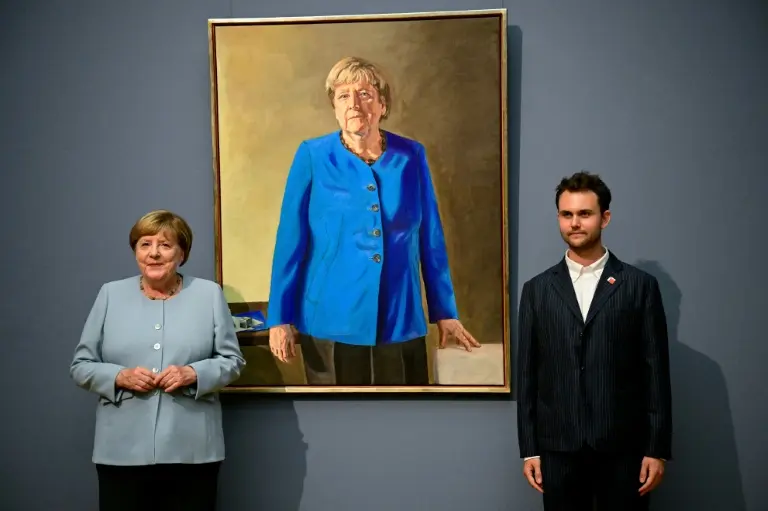
Former German chancellor Angela Merkel on Tuesday unveiled her official portrait in a ceremony at Berlin&8217;s Bode Museum, marking another milestone in the post-chancellorship phase of her long political career. The painting, created by French-German artist Jeremie Queyras, will eventually hang in the chancellery building among those of her male predecessors, a tradition that stretches back to the founding of the Federal Republic.
Merkel cut a ribbon to reveal the large-scale portrait before an audience that included current government officials, cultural figures, and members of the press. The Bode Museum, part of Berlin&8217;s renowned Museum Island, will host the painting until October, after which it will be permanently installed in the chancellery.
A portrait in trademark blazer
The portrait shows Merkel wearing one of her trademark blazers and a simple necklace, her expression calm and direct. According to the German weekly Die Zeit, Merkel sat for the portrait over several months in a temporary studio set up in Berlin specifically for the project. Queyras, known for his expressive style, combined classical portraiture with modern elements to capture what he described as Merkel&8217;s &8220;quiet authority.&8221;
&8220;It&8217;s strange when you slowly become history,&8221; the 71-year-old former chancellor told Die Zeit in an interview published ahead of the unveiling. &8220;Then I&8217;ll just be hanging there,&8221; she added, striking a typically pragmatic and self-deprecating note that endeared her to many during her long tenure.
Sixteen years at the helm of Europe&8217;s top economy
Merkel served as chancellor from 2005 to 2021, a period of extraordinary change for both Germany and the wider world. She was the first woman to hold the office and became the country&8217;s longest-serving chancellor after Konrad Adenauer and Helmut Kohl. Her calm, unflappable leadership style was often contrasted with the more volatile personalities she encountered on the international stage, from Barack Obama to Vladimir Putin.
During her tenure, Germany navigated the 2008 financial crisis, the eurozone debt crisis, the 2015-16 migrant crisis, and the early stages of the COVID-19 pandemic. She also oversaw the phase-out of nuclear power after the Fukushima disaster, a decision that reshaped Germany&8217;s energy policy.
Controversial legacy
Since stepping down in 2021, Merkel has faced criticism, particularly for her policy toward Russia. Critics argue that her government&8217;s reliance on Russian natural gas and its reluctance to confront Moscow earlier emboldened the Kremlin. The Nord Stream 2 pipeline, which she championed, became a symbol of that policy. With the outbreak of war in Ukraine in 2022, Merkel&8217;s legacy in this regard was sharply reevaluated, and she herself acknowledged mistakes during a rare public address in 2022.
Her open-door policy during the 2015-16 migrant crisis also sparked deep political divisions. More than one million asylum seekers entered Germany during that period, a decision that initially won her international praise as a moral leader but later fueled the rise of the far-right Alternative for Germany (AfD) party. Merkel&8217;s famous line, &8220;Wir schaffen das&8221; (&8220;We can manage this&8221;), became both a rallying cry and a lightning rod for criticism.
The portrait tradition
The chancellery portrait series dates back to the mid-20th century and includes paintings of Konrad Adenauer, Ludwig Erhard, Kurt Georg Kiesinger, Willy Brandt, Helmut Schmidt, Helmut Kohl, and Gerhard Schröder. Each portrait is commissioned by the Federal Ministry of Finance, and the finished works are displayed in the chancellery&8217;s corridors and meeting rooms. Merkel&8217;s portrait will take its place alongside these earlier leaders, providing a visual record of Germany&8217;s post-war political history.
The choice of Queyras, a relatively young artist born in 1984, was notable. The artist is known for blending traditional oil painting techniques with contemporary themes, and he has previously painted portraits of figures such as philosopher Peter Sloterdijk and conductor Daniel Barenboim. In preparing the portrait, Queyras said he sought to capture not only Merkel&8217;s physical appearance but also her intellectual and emotional presence. &8220;She is not someone who expresses herself loudly,&8221; he told Die Zeit. &8220;The portrait had to reflect that restraint.&8221;
A museum setting before the chancellery
The Bode Museum, which houses a vast collection of sculptures, coins, and Byzantine art, provided an elegant backdrop for the unveiling. The museum&8217;s director described the temporary exhibition as an opportunity for the public to view the portrait up close before it enters the more restricted space of the chancellery. &8220;It&8217;s fitting that Angela Merkel&8217;s portrait should be seen by the people she served for so long,&8221; the director said.
Merkel herself seemed at ease during the event, chatting with Queyras and members of the audience. She made no formal speech, but in her interview with Die Zeit she reflected on the transition from active politics to historical figure. &8220;You become part of a line, and then the next generations see you as a painting, not as a person,&8221; she said. &8220;That is a strange feeling.&8221;
The portrait is part of a broader effort to preserve the visual memory of Merkel&8217;s chancellorship. In 2023, a life-size bronze statue of Merkel was installed in the garden of her former district office in Templin, the town in Brandenburg where she grew up. Unlike that statue, which was funded by private donations, the official portrait is a state commission and will become part of the chancellery&8217;s permanent collection.
As Europe continues to grapple with the consequences of the policies Merkel shaped, her legacy remains a subject of intense debate. Yet even her critics acknowledge that she dominated German and European politics for more than a decade. Her portrait, now unveiled, will ensure that future visitors to the chancellery are reminded of the woman who once led Europe&8217;s largest economy through some of its most turbulent times.
Source: Yahoo News News