
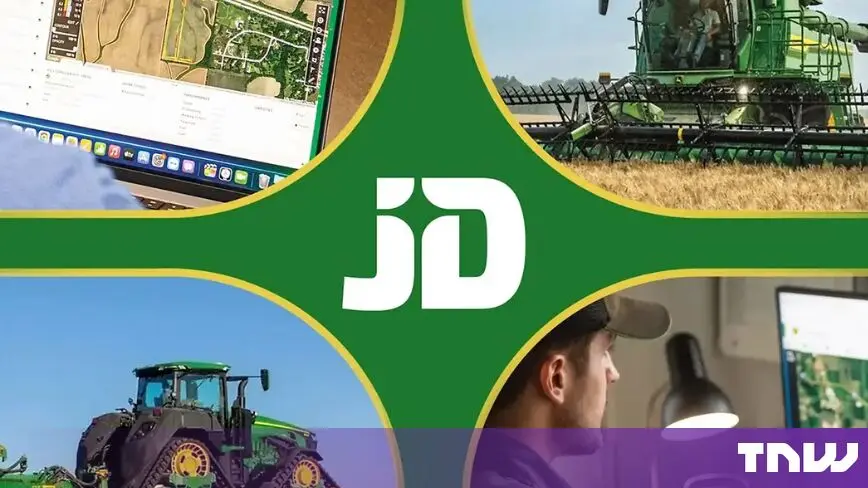
John Deere has launched JD, an AI assistant designed to answer plain-language questions using the data generated by a farm’s own machines and fields. The assistant is embedded in Operations Center, the company’s farm management platform, and gives growers an alternative to sorting through spreadsheets, maps, and telematics screens. Instead of asking a technician or manually searching for historical records, a grower can ask JD to compare fuel use during tillage across years, show how planting singulation varied between fields, or identify which sprayer operator covers the most acres per hour.
Key facts at a glance
- John Deere has introduced JD, an AI assistant inside Operations Center that uses a farm’s own machine and field data.
- The assistant answers plain-language questions, with examples such as comparing tillage fuel use across years, checking planting singulation by field, and measuring sprayer productivity.
- JD is initially being offered to selected US customers, with registration at the Farm Progress Show in Iowa and wider availability expected later this year.
- John Deere accompanied the launch with a ten-point voluntary Farmer Data Commitment covering farmer control, no sale of data, and the ability to stop third-party data flows.
- In Europe, many of those protections are legal rights under the EU Data Act, which has applied to connected products since 12 September 2025.
- John Deere has not confirmed whether the JD assistant will be available in Europe.
In the announcement, chief technology officer Jahmy Hindman said: “JD changes the experience from navigating through a sea of data to simply asking it a question.” The company framed the release as an effort to make precision-agriculture data more accessible. Deere has long invested in sensors, machine connectivity, and analytics, and Operations Center serves as the hub where many of those data streams converge. Adding an artificial-intelligence assistant to that hub is a logical extension of that strategy, although John Deere has not disclosed the technical details or model choices behind JD.
The examples chosen by the company are practical rather than abstract. A fleet manager might want to know whether a newer tillage implement has delivered the expected fuel savings, or a farm operator might want to compare the planter performance of different fields after changing a downforce setting. Those are queries that require combining machine telemetry with field boundaries and historical records. JD is designed to handle that combination without requiring the user to build a custom report. In effect, the system translates a natural-language request into database queries and produces an answer from the grower’s own datasets.
That framing matters for the broader market. Precision agriculture has produced an enormous volume of data, but many farmers have found it difficult to turn raw data into action. Machines collect information on engine performance, GPS position, seed placement, sprayer pressure, weather, and yield. Yet the value of that data depends on how easily it can be queried and interpreted. John Deere’s pitch is that JD removes much of the friction between a question and the answer, and that it does so from within the platform a farm already uses.
Ten-point Farmer Data Commitment
The launch was accompanied by a data pledge with ten principles. John Deere says farmers control their farm data, that Deere does not sell the data, and that farmers can switch off the flow of data to third parties at any time. The broader commitment covers transparency, security, portability, and accountability, although Deere has not published the full language in the announcement covered by this article. The principles are intended to reassure growers who worry that data generated by their machines could be used for purposes they did not anticipate.
John Deere points to a record on this front. It says it was the first agricultural equipment manufacturer to receive Ag Data Transparent certification, in 2018. That programme, run by the American Farm Bureau Federation and the National Farmers Union in the US, was created to help farmers understand exactly who can access their agricultural data and how it can be used. Certification is intended to signal that a company has published clear policies and has committed to independent review. Deere’s public emphasis on this certification suggests that trust is central to its data strategy.
Still, voluntary commitments vary in strength. Some are legally binding contracts; others are public statements that can be changed. Deere presents the ten principles as commitments to its customers, but US farmers do not have the same statutory protections as EU farmers. The contrast has become sharper since the EU Data Act began to apply to connected products.
The European data-rights backdrop
In Europe, many of the protections that John Deere lists as commitments are already legal rules. The EU Data Act, which began to apply to connected products on 12 September 2025, gives users of connected devices rights over data generated by their use. A farmer or farm business can obtain data free of charge in a structured, machine-readable format, and can require the manufacturer to pass that data to a third party. Those rights are not voluntary. They are enforceable under EU law.
The Data Act sits close to Deere’s own list in several ways. It addresses access, portability, transparency, and the sharing of data with parties chosen by the user. For a farm equipment maker, that means a tractor operator can request the data generated during an operation and transmit it to an agronomy service, an insurance provider, or another software platform. The business model implications are significant because machine data is increasingly valuable to agricultural analysis, financing, and compliance.
One clause has no counterpart in Deere’s ten principles. Article 4(13) of the Data Act forbids a data holder from using the data to derive insights about a user’s economic situation, assets, or production methods. That is an unusual limitation. It is normal for a service provider to analyse sensor data to improve a product, but using the same data to calculate what a farm is worth is different. If a manufacturer can see a farm’s yields, fuel bills, planting records, and machine hours, it can estimate the farm’s profitability and purchasing power. The clause is meant to prevent data holders from exploiting that visibility to gain an unfair commercial advantage.
The provision was written for a machine like JD, or at least for the ecosystem in which JD would operate. A farmer asks JD to compare fuel use and planting performance; the underlying data could also reveal whether the farm is struggling financially or whether it is likely to buy new equipment. In the US, nothing in Deere’s voluntary pledge explicitly addresses that kind of derived insight. In the EU, Article 4(13) draws a line around it.
Another obligation in the Data Act is focused on how connected products are designed. From 12 September, connected products placed on the EU market must be built so that data generated by their use reaches the user by default. That is a design requirement, not just an access right after the fact. It is intended to prevent manufacturers from keeping data trapped in proprietary systems and to enable independent service providers to build applications for farmers. A startup such as PerPlant in Copenhagen