
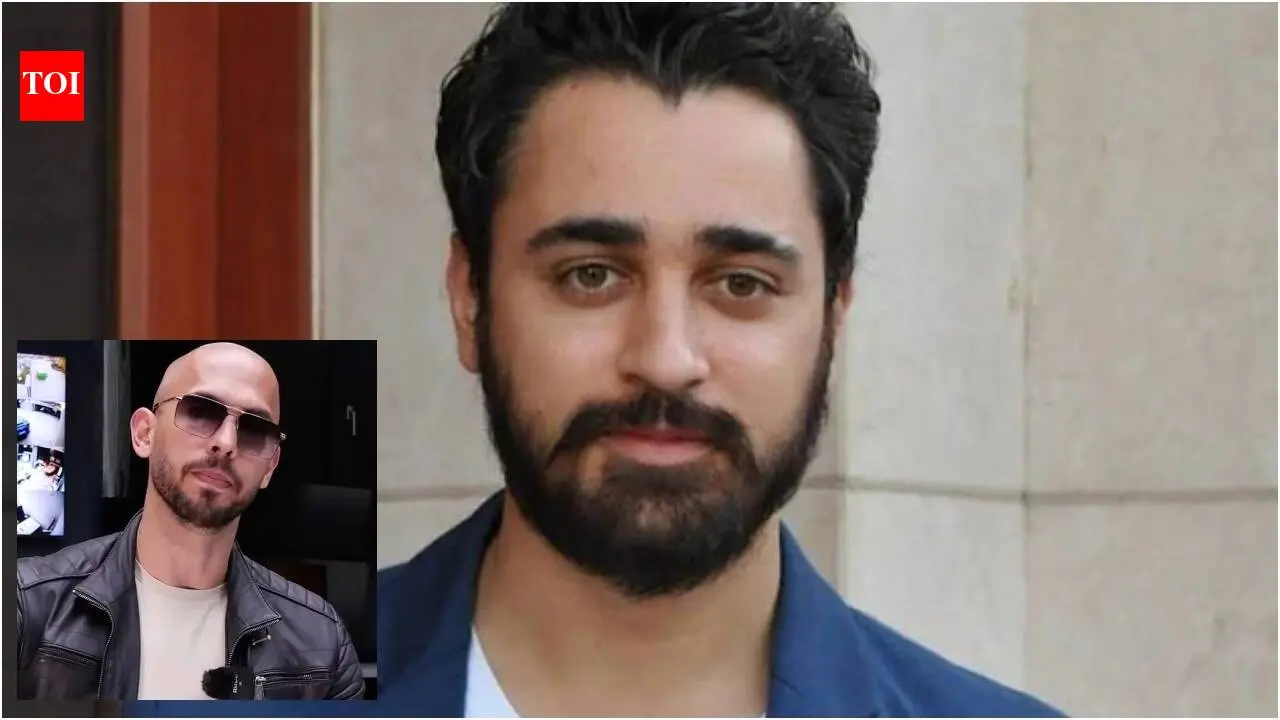
Bollywood actor Imran Khan has publicly criticized controversial internet personality Andrew Tate, accusing him of preying on vulnerable young boys who are desperately seeking male role models. In a candid conversation on the podcast ‘Decoding Quirks’, Imran delved into the psychology behind why figures like Tate gain such massive followings, especially among disaffected youth. He argued that many men grow up believing that wealth, achievement, and material success will guarantee happiness, and when that promise falls short, they feel directionless—making them susceptible to those who claim to have all the answers.
The allure of a simplistic male power fantasy
Imran Khan pointed out that Andrew Tate represents what he calls a “simplistic male power fantasy.” Tate, a former kickboxer and self-proclaimed misogynist, has built a global brand around hyper-masculinity, financial domination, and the subjugation of women. His rhetoric often includes phrases like “show women their place” and “become a man by dominating others.” Imran observed that this narrative appeals to boys who are lost and seeking direction. “Into this, there come people who are subverting these men,” Imran said. “Andrew Tate is possibly one of the most famous of these. But there are men like these who are preying on vulnerable boys seeking male role models. They are seeking direction, and into this come these guys saying, I'll tell you how. And they sell these men a simplistic male power fantasy. In this vulnerable space, young boys believe these narratives.”
Imran’s remarks come at a time when Andrew Tate’s influence has been a subject of intense debate worldwide. Schools, governments, and mental health organizations have warned about the harmful effects of Tate’s teachings on young minds. Tate, who was arrested in Romania on charges of human trafficking and rape, continues to maintain a significant online following even as he awaits trial. His content is known for promoting extreme gender stereotypes and encouraging men to view relationships as transactional power struggles. Imran’s critique adds a voice from the Indian film industry, which rarely engages with such global social media phenomena.
Imran Khan’s own journey with positive role models
In the same podcast, Imran Khan revealed that he was fortunate to grow up surrounded by men who modeled a very different version of masculinity. He credited his mother, along with the men in his life—his father, stepfather, and uncles Mansoor and Aamir Khan—for shaping his worldview. “All of these men were positive male influences in my life,” Imran said. “These are men who, for themselves, respected women and taught me the same. Not in a belittling way, in an actual, equitable, human way.”
Imran’s uncle, Aamir Khan, is one of Bollywood’s most respected actors, known for socially conscious films like ‘Taare Zameen Par’, ‘Rang De Basanti’, and ‘Dangal’. Aamir has often spoken about gender equality and has supported his wife Kiran Rao’s feminist initiatives. Imran’s father, Anil Pal, and stepfather also contributed to a household where women were treated as equals. This upbringing, Imran believes, immunized him against the kind of toxic masculinity promoted by figures like Andrew Tate.
Imran also emphasized that the lack of strong male role models in many homes is a societal crisis. “Many boys today are raised primarily by single mothers or in broken families, with no consistent male presence,” he explained. “They then look online for guidance, and the algorithm feeds them Andrew Tate’s brand of machismo because it’s sensational and gets clicks. It’s a cycle of vulnerability.”
Imran Khan’s acting career and personal life
Imran Khan made his Bollywood debut in 2008 with the romantic comedy ‘Jaane Tu... Ya Jaane Na’, co-starring Genelia D’Souza. The film was a critical and commercial success, immediately establishing him as a promising young star. He followed it up with hits like ‘I Hate Luv Storys’, ‘Break Ke Baad’, ‘Ek Main Aur Ekk Tu’, and the cult favorite ‘Delhi Belly’. The latter, a dark comedy produced by Aamir Khan, remains one of Imran’s most celebrated performances. The film’s success was followed by a series of less successful ventures, including ‘Gori Tere Pyaar Mein’, ‘Katti Batti’, and ‘Lucky Kabootar’.
After ‘Katti Batti’ in 2015, Imran effectively went on a hiatus from acting. He later revealed that he had become disillusioned with the film industry’s focus on box office numbers rather than artistic satisfaction. During this break, he focused on personal growth, fitness, and spending time with his family. In recent years, he has made a gradual return to the public eye. He appeared in a cameo role in Vir Das’s ‘Happy Patel: Khatarnak Jasoos’, a film produced by Aamir Khan. He has also been active on social media, sharing candid thoughts on a range of topics from politics to mental health.
Imran Khan’s relationship timeline
On the personal front, Imran married his childhood sweetheart Avantika Malik in 2011 after a long courtship. The couple had a daughter but chose to separate in 2019. Their divorce was finalized amicably, with both parties focusing on co-parenting. Imran has since been in a relationship with actress and artist Lekha Washington. The couple has been open about their bond, often sharing glimpses of their life together on Instagram. Lekha is known for her work in films like ‘Ayan’ and ‘Sawaari’, and she is also a painter and jewellery designer.
Imran’s current relationship marks a new chapter in his life. He has often spoken about the importance of emotional maturity and mutual respect in partnerships—values he says were instilled in him by his mother and uncles. In interviews, he has stressed that he wants to be a role model for his daughter, teaching her that men can be gentle, vulnerable, and strong all at once.
The broader issue: why are young men drawn to Andrew Tate?
Imran Khan’s critique of Andrew Tate touches on a larger societal phenomenon. Over the past few years, Tate’s popularity has skyrocketed, especially among teenage boys. His videos, which are often short, aggressive, and filled with black-and-white advice, have been shared millions of times on TikTok, YouTube, and Instagram. Educational groups and parenting forums have raised alarms about kids quoting Tate’s lines in schools and adopting his misogynistic attitudes. Some psychologists argue that Tate’s appeal lies in his certainty. In a world where young men are often told to be sensitive but also to be providers, to be strong but also to show emotion, Tate offers a simple answer: just be dominant. That simplicity, combined with Tate’s own flamboyant lifestyle of luxury cars, private jets, and multiple girlfriends, creates a powerful image of success.
Imran Khan’s response is particularly noteworthy because it comes from a Bollywood celebrity, a demographic not usually known for wading into global social media controversies. By using his platform to advocate for healthier masculinity, Imran adds a new voice to the conversation. He challenges other public figures to speak up against harmful influencers and to promote role models who prioritize respect and equality over power and control.
In the same podcast, Imran also discussed the need for media literacy among young people. “If you give a boy a phone and unlimited access to social media without teaching him how to filter information, he’ll fall for the loudest voice,” he said. “That’s why we need fathers, uncles, teachers, and coaches to step up and have these conversations.” He emphasized that the solution is not censorship but exposure to diverse, positive examples of manhood.
Imran further revealed that he often talks to his young daughter about these issues, using age-appropriate language to explain concepts of respect and equality. He noted that parenting in the digital age requires constant vigilance but also a willingness to engage with your child’s world. “You can’t just ban things,” he said. “You have to understand what draws them to these figures and then offer a better alternative.”
Imran Khan’s journey from Bollywood heartthrob to outspoken advocate for positive masculinity may seem unexpected, but it reflects a broader trend among celebrities using their fame for social critique. By targeting Andrew Tate, Imran has positioned himself as a counterweight to the rising tide of online misogyny, reminding his audience that true strength lies in compassion and equality.
Source: The Times of India News