

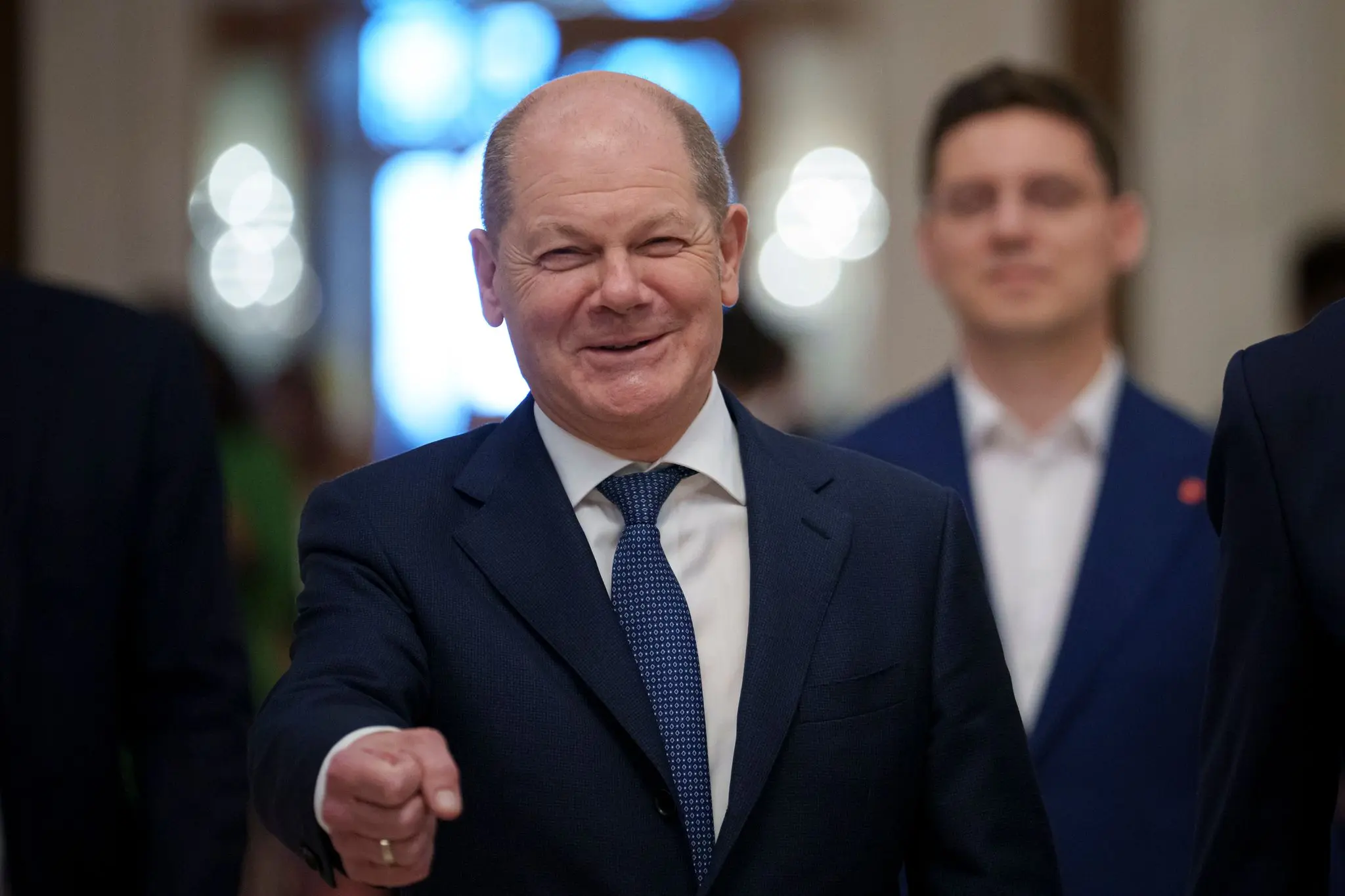
German Chancellor Olaf Scholz arrived in China on Sunday, April 14, 2024, beginning a three-day visit shaped by mounting economic tensions between Europe's largest economy and its top trading partner, as well as sharp differences over Russia's invasion of Ukraine.
Scholz's first stop was the industrial hub of Chongqing, a vast city in southwestern China that serves as a production base for the country's automotive and other manufacturing industries. He was accompanied by a delegation that included German ministers and senior business leaders, reflecting the high stakes of a relationship that has generated billions in trade but has become increasingly fraught.
In Chongqing, the chancellor visited a hydrogen motor production facility operated by German engineering company Bosch. The site is partially funded by German investment and illustrates the kind of advanced manufacturing cooperation that both countries say they want to preserve. Scholz also toured parts of the city with young architects and later went on a boat cruise along the Yangtze River, one of two major waterways that surround the hilly metropolis.
From Chongqing, Scholz traveled to Shanghai, China's financial capital, before flying to Beijing. In Beijing, he met with Chinese leader Xi Jinping at the Diaoyutai State Guesthouse on Tuesday. He was also scheduled to be received with military honors by Premier Li Qiang at the Great Hall of the People, the seat of China's largely ceremonial legislature in the heart of the capital. Further talks and meetings were planned before his departure late Wednesday night.
This is Scholz's second trip to China since becoming chancellor in late 2021. His previous visit, in November 2022, was essentially a one-day affair because of the strict COVID-19 restrictions still in force at the time. The current visit is his first since the German government presented its China strategy in 2023, a policy document that was met with criticism in Beijing and signaled a more cautious approach to the economic relationship.
The visit comes at a delicate moment for German industry. Major companies such as BMW and Volkswagen are highly reliant on the Chinese market, both as a sales destination and as a production base. China's demand for German manufactured goods, from automobiles to chemicals and machinery, has long been a pillar of Germany's export-oriented economy. But those ties have frayed as Chinese companies have become more competitive and as Beijing has tightened regulations affecting foreign businesses.
German business groups have argued that they face unfair market barriers in China, ranging from data-localization rules and technology-transfer requirements to restrictions on access to certain sectors. Separate concerns about political interference have also been cited as a reason for a sharp drop in foreign direct investment. In response, the German government has pushed for a policy of "de-risking" that is meant to reduce the economy's reliance on Chinese markets and suppliers without cutting ties altogether.
The concept of de-risking has become central to German and European Union discussions about economic security. German officials insist they are not seeking "decoupling" from China, but they hope to diversify supply chains and protect critical infrastructure. Scholz's delegation included leaders from major industrial sectors, a sign that Berlin still sees cooperation with China as vital despite the growing caution.
Trade data underline the scale of the relationship. China remained Germany's top trading partner for the eighth consecutive year in 2023, with 254.1 billion euros, or about $271 billion, in goods and services exchanged between the two countries. That was slightly more than Germany traded with the United States, but it represented a 15.5% contraction from the previous year. German exports to China totaled 97.3 billion euros, or roughly $104 billion, according to Germany's Federal Statistical Office. Economists note that the figures can vary depending on exchange-rate fluctuations and rounding, but the overall trend suggests that the boom years of German-Chinese trade have cooled.
Beyond economics, the Ukraine conflict is another major source of friction. Before landing in China, Scholz posted on the social platform X that he had discussed the "massive" Russian air attacks on civilian energy infrastructure with Ukrainian President Volodymyr Zelenskyy on Saturday. He declared that Berlin will "stand unbreakably by Ukraine's side."
China, by contrast, has refused to criticize Russian aggression. It has maintained trade relations with President Vladimir Putin's government and has aligned many of its foreign-policy positions with Moscow in opposition to the U.S.-led liberal order. Beijing has also promoted its own authoritarian one-party system as a model that it says offers an alternative to Western democracy. Those positions have made it harder for European leaders to separate commercial cooperation from geopolitical rivalry.
Chinese state broadcaster CCTV showed Scholz descending from his plane in Chongqing and leaving in a motorcade, but it did not carry any comments he made to the welcoming delegation. The lack of public remarks at the airport was in keeping with the carefully choreographed nature of high-level visits to China, where transparency is often limited.
The visit is taking place amid broader international debates about trade and technology. The European Union has been examining Chinese subsidies and considering measures to protect European industries, particularly in clean-technology sectors such as electric vehicles and batteries. German automakers, which have large production operations in China and depend on access to the Chinese market, are watching these discussions closely. Scholz's meetings in Beijing are expected to address these issues, as well as ongoing concerns about market access and competition.
Scholz's itinerary also reflects an attempt to engage with different parts of China's economy. Chongqing is a major manufacturing center with strong links to the automotive industry, while Shanghai is a hub for finance, trade, and innovation. Beijing is the political center where strategic decisions are made. By visiting all three cities, the chancellor was seeking to signal that Germany wants a broad and resilient relationship with China, even as it tries to manage risks.
Premier Li Qiang and a delegation of senior Chinese officials visited Berlin in June, part of a series of high-level exchanges between the two countries. That visit was seen as an effort to maintain dialogue despite the tensions. The German government's China strategy, published last year, had drawn sharp criticism from Beijing, which accused Berlin of applying double standards and interfering in China's internal affairs. The strategy called for closer coordination with European partners and for a stronger focus on human rights and rule-of-law issues.
Analysts say Scholz faces a difficult balancing act. On one hand, he must respond to domestic pressure to reduce Germany's strategic vulnerabilities and to take a firmer line on China's trade practices and its support for Russia. On the other hand, he cannot easily ignore the economic reality that China remains indispensable to many German companies. The visit was expected to produce few major announcements, but it is an important opportunity for both governments to manage a relationship that has grown more complex and contested.
Source: The Asahi Shimbun News