
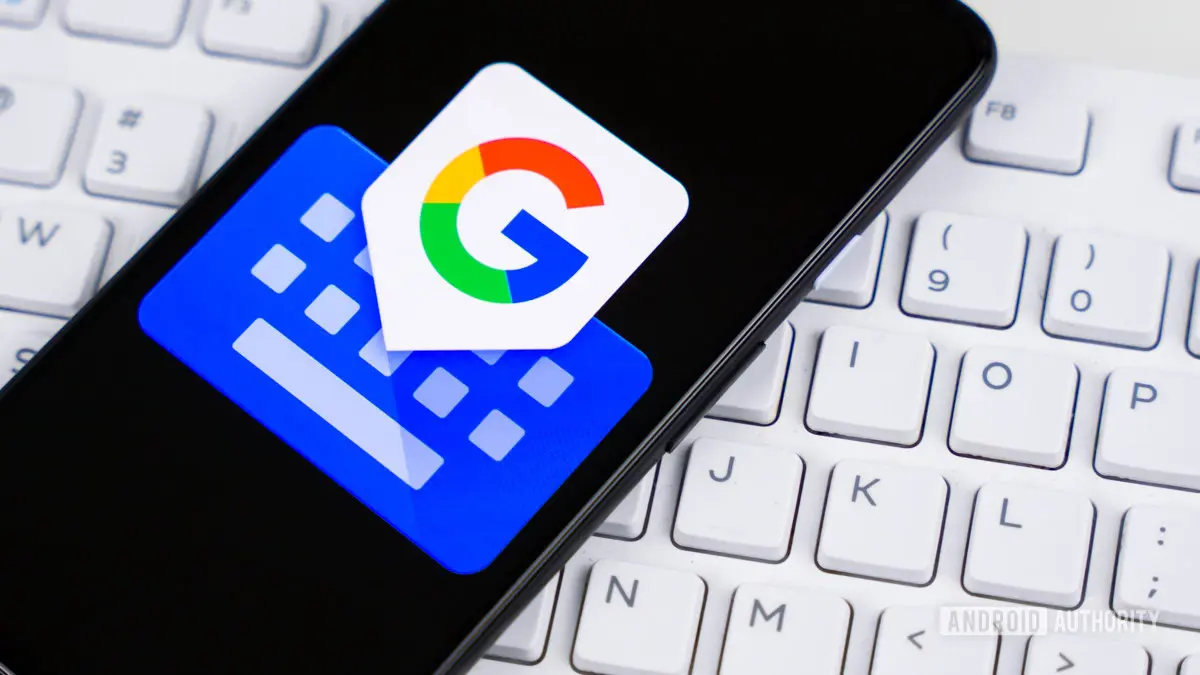
Google's Gboard keyboard is already a powerhouse of input methods, from the classic tap typing to the fluid Glide swipe input and the convenience of voice typing. Now, the search giant appears to be adding one of the most ambitious input methods yet: the ability to understand sign language through your phone's camera. If this feature, identified as 'Sign-to-Text' in the latest Gboard beta, reaches public release, it could be the keyboard's biggest accessibility feature ever.
What the Teardown Reveals
APK teardowns are a common way to peek into future features, and version 17.8.3.939743344-beta-arm64-v8a of Gboard has revealed strings and UI elements pointing toward a sign language interpretation tool. While the feature is not yet functional in this early build, an introductory pop-up explains the core workflow: the phone's camera captures the user's signing, the video is processed locally to extract raw gesture data, and only that non-visual data is sent to Google's cloud servers for analysis and conversion into text.
This hybrid approach addresses major privacy concerns: the actual video never leaves the device, so sensitive footage of the user's environment and identity remains secure. Only the abstracted gestures are transmitted, a design choice that likely reduces bandwidth requirements and computational load on the phone. Google has previously emphasized privacy-by-default in its accessibility features, and this aligns with that ethos.
The Technology Behind Sign-to-Text
Last year, Google DeepMind unveiled SignGemma, a specialized AI model designed to interpret sign language. SignGemma builds on the company's larger General Model Architecture family but is fine-tuned on a massive dataset of signing videos. The model can recognize hand shapes, movements, and facial expressions—all crucial components of sign languages like American Sign Language (ASL). The Gboard integration appears to be one of the first consumer-facing applications of this model.
Sign language recognition has long been a holy grail of computer vision and AI. Early attempts relied on depth-sensing cameras or special gloves, but recent advances in neural networks have made it possible to interpret 2D video streams. Google's solution leverages the same kind of lightweight, on-device machine learning that powers features like Lens or live captioning. The gesture extraction process likely uses a pose estimation model to map hand and finger positions frame by frame, then compresses that data into a stream of coordinates and trajectories.
On the cloud side, sophisticated models can piece together these gestures into phrases, matching them against a vocabulary of signs. However, the latency of cloud processing could introduce delays, and Google may optimize for real-time or near-real-time performance. The beta teardown also hints at user guidance messages, such as 'Poor lighting. Try moving to a brighter spot,' indicating the tool's dependence on good camera conditions.
Potential Impact on Accessibility
For the estimated 466 million people worldwide with disabling hearing loss, according to the World Health Organization, a reliable sign language-to-text tool could be transformative. Many deaf individuals prefer to communicate in sign language but often face barriers when interacting with people who do not sign. A Gboard feature that translates signing into written text in real time could bridge that gap, enabling conversations without a human interpreter.
Moreover, the integration into Gboard means it is already present on over a billion Android devices. No additional hardware or separate app is needed—just a phone with a decent front-facing camera. This ubiquity could make sign language translation accessible to millions who previously lacked such tools.
However, questions remain about which sign languages will be supported. The teardown does not specify ASL, BSL, or any other variant. Given the diversity of sign languages—each with its own grammar, idioms, and regional variations—Google may launch with a limited set, possibly ASL first due to the availability of training data. The company has not commented on timelines or language coverage.
Challenges and Limitations
Even with advanced AI, sign language recognition poses immense challenges. Different signers have different styles, speeds, and hand shapes. The model must handle occlusions (e.g., hands passing in front of the face), varying lighting, and backgrounds. The on-device processing must be fast enough to not drain battery or cause lag, especially on older phones.
Another concern is accuracy: mistranslations could lead to frustration or misunderstandings. Google likely has strict quality benchmarks before releasing the feature widely. The cloud component may improve over time as the model learns from aggregated gesture data, but that also raises privacy implications. Google's current design sends only raw gesture data, but users might still be wary of any data leaving their device.
Additionally, the feature currently appears as a beta-only hidden string; there is no guarantee it will ship to the stable Gboard. Google has been known to test and then abandon features. Yet the investment in DeepMind's SignGemma suggests a serious commitment to the technology, and a keyboard integration is a logical next step.
Historical Context and Future Prospects
Sign language recognition research dates back to the 1980s, but only in the last decade have deep learning methods made consumer applications feasible. Companies like Microsoft and Facebook have also explored sign language translation, but none have integrated it into a mainstream input method. Google's attempt through Gboard could set a new standard.
If successful, Gboard's Sign-to-Text could evolve to support two-way communication: translating spoken or typed text into animated avatars or text-to-speech for the deaf user. The potential for real-time captioning of sign language in video calls is also intriguing. As 5G and edge computing advance, on-device processing may become capable enough to run the entire pipeline locally, eliminating cloud dependency altogether.
The broader implications for AI accessibility are profound. This feature demonstrates how machine learning can empower marginalized communities without requiring specialized hardware. It aligns with Google's mission to organize the world's information and make it universally accessible and useful.
For now, developers and testers will watch the Gboard beta for signs of the feature becoming active. Once it does, a hands-on preview will reveal its true potential. The excitement is palpable: a tool that turns a smartphone camera into a bridge between sign language and written language could change how millions interact with the digital world.
Source: Android Authority News