

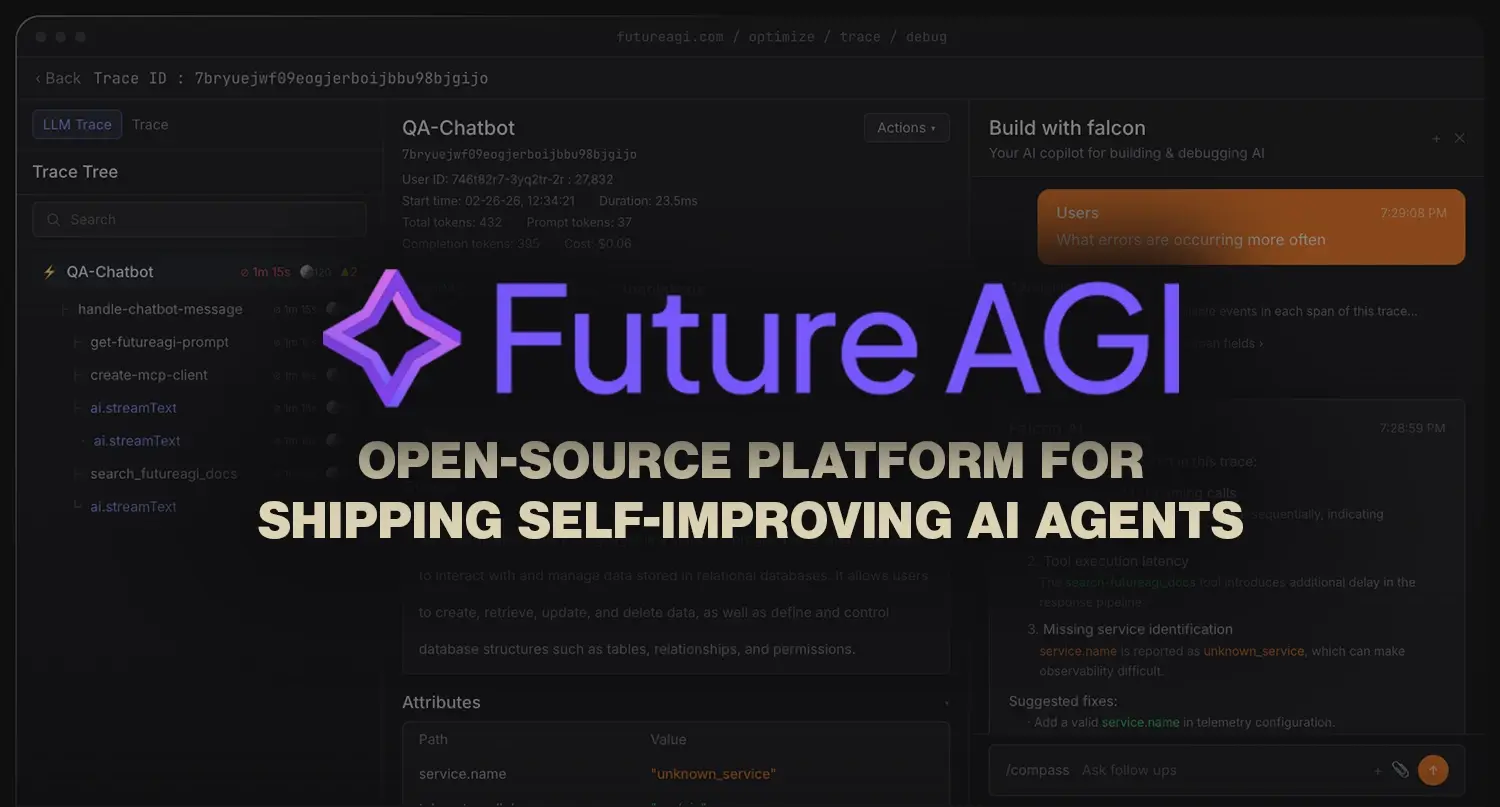
Future AGI has entered the open-source ecosystem as a platform designed for tracing, evaluating, simulating, and guardrailing large language model agents. The project, licensed under Apache 2.0, is self-hostable and aimed at teams that want to deploy AI agents with visibility into every step of the pipeline. Its release adds another option to a growing list of tools built to tame the complexity and risk of autonomous AI systems.
The platform’s positioning is straightforward: give developers a unified control plane for agent behavior, from development through production. It combines observability, evaluation, simulation, and security into a single stack that can run on-premises or in an air-gapped environment. While the feature set is broad, the project has also drawn attention for a less obvious aspect: its telemetry behavior on first boot.
First-boot registration and what it sends
When a self-hosted instance of Future AGI starts for the first time, it registers with the project’s servers. That registration happens before anyone signs in to the dashboard. The data transmitted includes an instance ID, a version string, a deployment type, and the email addresses and domains of active admin users. The registration fires once, but the timing matters. If an operator has not set the opt-out environment variable before the first start, the admin list has already left the network.
The opt-out mechanism is a single environment variable: FUTURE_AGI_TELEMETRY_DISABLED=1, placed in the .env file ahead of the initial launch. Missing that window means the data is sent. The project documentation is explicit about this behavior, and it advises operators who want full silence to turn networking off at the edge. Air-gapped and on-prem deployments are listed as supported and phone-home free, but only if telemetry is disabled or networking is blocked.
Even with telemetry disabled, the project says one census ping is still sent, carrying the instance ID, version, and deployment type, with email addresses withheld. Periodic heartbeats stop after that point. This is a nuance that operators should consider when evaluating the platform for sensitive environments.
Why telemetry in open-source infrastructure is contentious
Telemetry in open-source software is a delicate subject. Many projects collect anonymous usage statistics to understand adoption and prioritize development. But the line between anonymous telemetry and data leakage is often thin. Future AGI’s first-boot behavior, which captures admin emails before any explicit user consent, is reminiscent of other projects that have faced backlash for data collection. The fact that the registration fires before login and before the operator has a chance to configure settings makes the opt-out window particularly narrow.
For enterprises, this is a critical consideration. Self-hosting is often chosen precisely to keep data within the organization. If a platform sends admin email addresses and domains to an external server on first boot, that may violate internal policies or regulatory requirements. The project’s documentation acknowledges this by suggesting network-level isolation for complete silence. Still, the default behavior means that a careless deployment could leak organizational structure and personnel information.
The broader context is that AI agent platforms are increasingly embedding telemetry and cloud connectivity into their architecture. Some argue this is necessary for features like anomaly detection and collaborative learning, while others insist that self-hosted tools should be fully standalone by default. Future AGI’s approach is a middle ground: it defaults to telemetry but offers an easy opt-out for those who read the documentation before starting.
What the install contains
Behind the scenes, Future AGI assembles a set of established infrastructure components. The installer brings up ClickHouse, PostgreSQL, Redis, RabbitMQ, and Temporal, all fronted by a dashboard on localhost:3000. This is a modern stack for a data-heavy, event-driven application. ClickHouse serves as the analytics database where tracing spans land. Prompt text, model output, and tool calls all pass through the tracer on their way into that store.
The choice of ClickHouse is notable. It is a columnar database optimized for high-throughput ingestion and analytical queries, making it well suited for storing and querying trace data at scale. PostgreSQL provides relational storage, Redis handles caching and queueing, RabbitMQ manages message brokering, and Temporal orchestrates workflows. This is a robust architecture for a platform that promises to handle complex agent interactions and long-running tasks.
For developers, the localhost dashboard is the central point of interaction. It provides a view into the entire agent lifecycle, from individual spans to complete simulations. The inclusion of Temporal suggests a focus on durable execution, which is essential for agents that need to resume after failures or retries.
Instrumentation across fifty-plus frameworks
One of the platform’s selling points is broad instrumentation coverage. Future AGI supports more than 50 agent frameworks, including popular names like LangChain, LlamaIndex, CrewAI, and DSPy, through OpenTelemetry. OpenTelemetry is an open standard for observability, and its use here means that teams can capture traces from existing agents without switching frameworks. The tracer is designed to intercept prompt text, model output, and tool calls, providing a complete picture of each agent’s reasoning path.
This breadth is important because the agent ecosystem is fragmented. Teams often experiment with multiple frameworks, and a single observability layer that works across all of them reduces the overhead of integration. Future AGI positions itself as a neutral platform that sits above the framework layer, which is a strong value proposition for organizations that want to standardize their AI infrastructure.
The security implications of tracing are also worth noting. Because the tracer captures prompt text and model output, it has access to potentially sensitive information. The platform’s defender component inherits the access controls on the underlying database, meaning that only authorized users can view the traces. This is a sensible design, but it also means that securing the database is paramount. If an attacker gains access to ClickHouse, they could exfiltrate all recorded prompts and responses.
The gateway in front of everything
Future AGI includes a component called the Agent Command Center, which acts as an OpenAI-compatible proxy in front of more than 100 providers. This gateway centralizes access to various models, supporting routing strategies, semantic caching, virtual keys, MCP (Model Context Protocol), and A2A (Agent-to-Agent) communication. All provider credentials in a deployment terminate at this gateway, which is a security advantage. Instead of scattering API keys across services, teams can manage them in one place and control how they are used.
The OpenAI-compatible interface means that existing applications can switch to Future AGI’s gateway without significant code changes. For organizations with multiple AI projects, this can simplify procurement, billing, and access management. The gateway also enables advanced routing: different models can be selected based on cost, latency, or task complexity, and semantic caching can reduce duplicate API calls.
The inclusion of MCP and A2A points to a future where agents interact with external tools and each other. MCP is a protocol for connecting AI models to data sources and tools, while A2A is an emerging standard for agent-to-agent communication. By supporting these protocols natively, Future AGI positions itself as an interoperability hub, not just a monitoring tool. However, the gateway is also a potential attack surface. All provider credentials are stored there, and the routing logic determines which models process which requests. A compromise of the gateway could expose every model key used in the organization.
Built-in security scanners
The platform’s Protect module ships with 18 built-in scanners covering PII, jailbreak attempts, and prompt injection. These scanners can run inline in the gateway or as standalone components through the SDK. Inline scanning is the more convenient option, as it intercepts requests and responses in real time. The project’s benchmark harness reports P99 latency at or under 21 milliseconds for inline scanning, which is a low overhead for AI applications that often have response times in seconds.
In addition to the built-in scanners, Future AGI offers vendor adapters for Lakera, Presidio, and Llama Guard. This allows teams to plug in external security services if they have existing investments in those tools. The combination of built-in and external scanners gives operators flexibility. For example, Presidio is a Microsoft open-source library for PII detection, while Llama Guard is a meta-developed input-output safeguard model. Being able to integrate these without custom glue code is a practical benefit.
Prompt injection is one of the most pressing security challenges in AI agents. An attacker can craft input that manipulates an agent into performing unauthorized actions. Future AGI’s scanners are designed to catch these attempts before they reach the model or after the model produces output. The fact that the gateway sits in front of all providers means that scanning can be enforced uniformly, rather than relying on each application to implement its own protections.
Evaluation and simulation beyond tracing
The platform also supports evaluation and simulation workflows. Evaluation involves running agents through test cases and measuring performance against predefined metrics. Simulation goes further, allowing teams to create synthetic environments in which agents can be tested before deployment. The goal is to catch failure modes before they occur in production, which is especially important for self-improving agents. The project’s name, Future AGI, hints at a long-term vision where agents become more autonomous and capable, making safety testing all the more critical.
For teams building AI agents, the combination of tracing, evaluation, and guardrailing in a single platform is a significant time-saver. In the past, these functions required separate tools that did not always interoperate. Future AGI’s approach is to offer a unified dashboard where developers can monitor behavior, run simulations, and enforce security policies. The self-hosted nature of the platform also means that sensitive data can remain on-premises, which is a requirement for many regulated industries.
The open-source aspect is another important dimension. By releasing under Apache 2.0, Future AGI allows organizations to inspect the code, modify it, and contribute back. This transparency is valuable for security-critical infrastructure, as it enables independent audits. However, it also means that organizations must stay up to date with patches, as they would with any open-source software.
Future AGI is available for free on GitHub. The project’s documentation includes detailed setup instructions and a telemetry section that explains the first-boot registration and how to disable it. For teams that are comfortable with self-hosting and willing to carefully configure their environment, Future AGI offers a comprehensive toolkit for managing AI agents. But those who prioritize privacy should set the telemetry opt-out before the first launch.
Source: Help Net Security News