

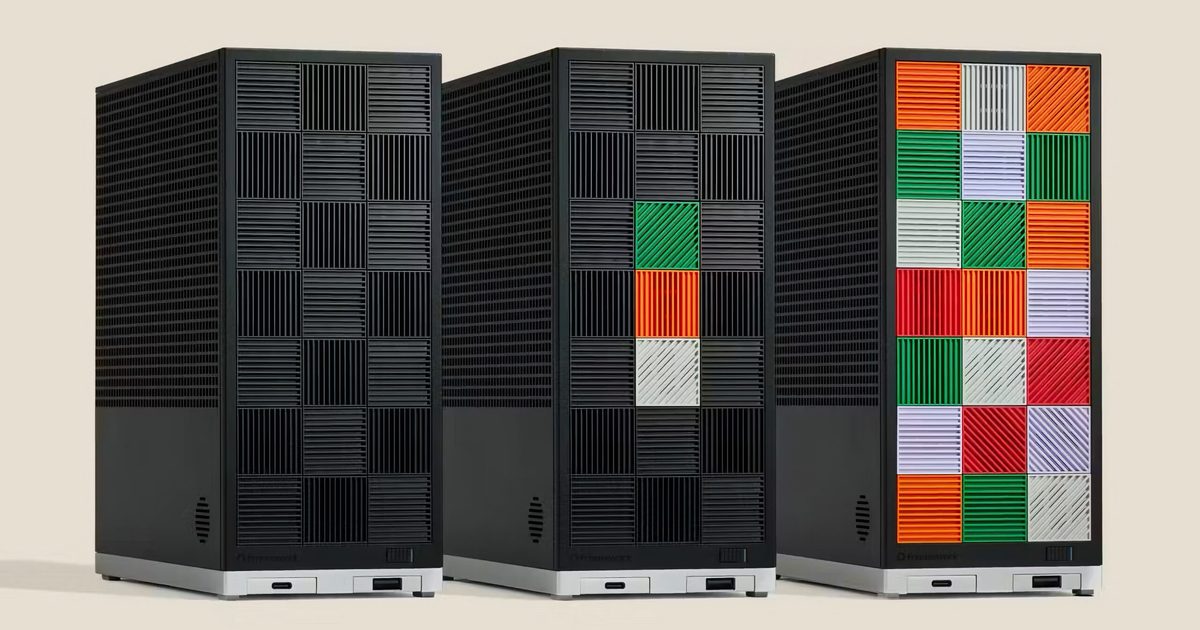
Framework has built a reputation for shipping products that other PC makers won't even attempt, and its latest teaser keeps that streak alive. At AMD's Advancing AI event, the company previewed a new version of its Framework Desktop, and this one is clearly built with one goal in mind: running large AI models locally on your computer. If you have been eyeing a way to run local AI without relying on cloud services, this could be the machine to watch.
The PC packs a Ryzen AI Max+ Pro 495 chip, which brings 16 full Zen 5 cores and a boost clock of 5.2 GHz. Paired with it is the Radeon 8065S, AMD's fastest integrated graphics chip yet, with 40 RDNA 3.5 compute units running at 3 GHz. Even without a dedicated GPU, this combo should handle AAA games at 1080p just fine, but the real headline feature is the massive 192GB of LPDDR5x RAM.
Framework says this much memory should let you run hefty models like DeepSeek V4 Flash locally, with room left over for context length. The ability to load large language models entirely in RAM eliminates the need for swapping or offloading to slower storage, which is critical for real-time inference and interactive AI applications. For context, many high-end AI workstations currently max out at 128GB, so this 50% increase represents a significant leap for local model experimentation.
The Ryzen AI Max+ Pro 495 is part of AMD's latest Strix Halo series, which combines CPU and GPU on a single die using the Zen 5 architecture and RDNA 3.5 graphics. The integrated Radeon 8065S is no slouch—it offers performance comparable to a mid-range discrete GPU, meaning users can also use this machine for creative workloads like video editing, 3D rendering, and AI image generation. The unified memory architecture allows the GPU to access all 192GB, which is particularly beneficial for large model training or inference where memory footprint is the primary bottleneck.
Framework has also included an open-ended PCIe x4 slot for bigger cards, such as additional storage, a discrete GPU, or a 50GbE networking card. In fact, Framework showed off a proof of concept where two of these desktops were connected using 50GbE networking cards, pooling together 384GB of memory across both machines. This setup is wild for something this compact, and it demonstrates how the desktop can scale for demanding AI tasks like distributed inference or model parallelism.
For software, buyers can get Windows or a pre-built with Linux already installed. Framework has historically been a champion of open-source and repairability, so the Linux option is no surprise. Users can also choose to build their own configuration, selecting RAM, storage, and operating system separately. The modular design allows easy upgrades and repairs, a hallmark of Framework's ethos.
Background and Market Context
The timing of this announcement is no accident. The demand for local AI processing has surged as enterprises and enthusiasts seek to reduce reliance on cloud APIs, improve data privacy, and avoid ongoing subscription costs. Models like DeepSeek V4 Flash, Mistral Large, and Llama 3 can run on consumer-grade hardware if enough memory is available, but until now, even the most powerful desktops topped out at 128GB of RAM. Framework's 192GB configuration directly addresses that gap.
AMD's Ryzen AI Max+ series is designed to compete with Intel's Core Ultra and Apple's M-series chips, offering a unified memory pool that simplifies AI development. The integrated NPU (Neural Processing Unit) handles lightweight AI tasks, while the GPU and CPU can be tapped for heavier workloads. However, the real advantage of the Framework Desktop is its expandability—the PCIe slot and networking capabilities allow users to cluster multiple units for even larger model capacity.
The price point, however, will be a barrier. Framework has warned that 192GB of RAM won't be cheap, and it will mark a big jump over current pricing. For context, the existing 128GB version with the Ryzen AI Max+ 395 costs $3,449 today, up from just $1,999 when it first launched back in February 2025, thanks to the rising RAM and storage costs. Given how RAM prices keep climbing—driven by demand from AI data centers and limited manufacturing capacity—don't be shocked if this new 192GB model crosses the $4,500 mark. Framework hasn't shared official pricing or a release date yet, so for now, this remains a very tempting preview.
Another factor is the cooling solution. A chip with 16 cores and integrated graphics consuming up to 120W requires robust thermal management. Framework has designed a custom heatsink and fan assembly that fits within the mini PC chassis. The company has also provided ventilation and a mounting bracket for water cooling kits, should users need even lower noise or higher performance. Early benchmarks from leaked engineering samples show that the Ryzen AI Max+ Pro 495 can maintain boost frequencies under sustained loads, a feat that many laptops struggle with.
Networking is another highlight. The inclusion of a 50GbE slot means that users can directly connect two Framework Desktops with a simple DAC cable, achieving memory pooling without additional switches or complex configurations. This setup could be used for collaborative AI model training, real-time rendering farms, or even high-performance computing tasks that benefit from shared memory. Framework demonstrated this capability live at the event, running DeepSeek V4 Flash across both systems seamlessly.
The mini PC form factor also means it can be hidden behind a monitor or placed on a desk without dominating the workspace. Framework offers the chassis in multiple colors and allows customization of the expansion card slots, providing a degree of personalization rarely seen in the workstation market.
For developers, the 192GB memory opens up possibilities that were previously limited to cloud instances. Running a 70 billion parameter model at 8-bit quantization consumes roughly 70GB, leaving ample room for context windows of up to 128K tokens. This is ideal for tasks like code generation, document analysis, or long-form conversation agents. With two units pooled, models up to 140 billion parameters become feasible—a size that rivals many commercial cloud offerings.
Framework has also confirmed that the desktop supports ECC (Error Correction Code) memory, though the LPDDR5x used here is not officially ECC? Actually, LPDDR5x does not support ECC in the traditional sense, but the integrated memory controller on the Ryzen AI Max+ Pro can detect and correct single-bit errors using on-die ECC, providing reliability similar to server-grade memory. This is critical for AI workloads where data integrity is paramount.
The product is expected to ship later this year, but exact dates remain unannounced. Given Framework's track record of delays due to supply chain issues, early adopters may need to be patient. Nonetheless, the company has a loyal fanbase that values its transparent communication and right-to-repair advocacy.
In summary, the Framework Desktop with Ryzen AI Max+ Pro 495 and 192GB RAM is a groundbreaking machine for local AI enthusiasts, developers, and researchers. Its combination of raw compute, massive memory, expandability, and networking capabilities makes it a versatile choice for anyone who wants to break free from cloud dependencies. Pricing will be steep, but for those who need the memory capacity, there is currently no equivalent product on the market.
Source: Digital Trends News