

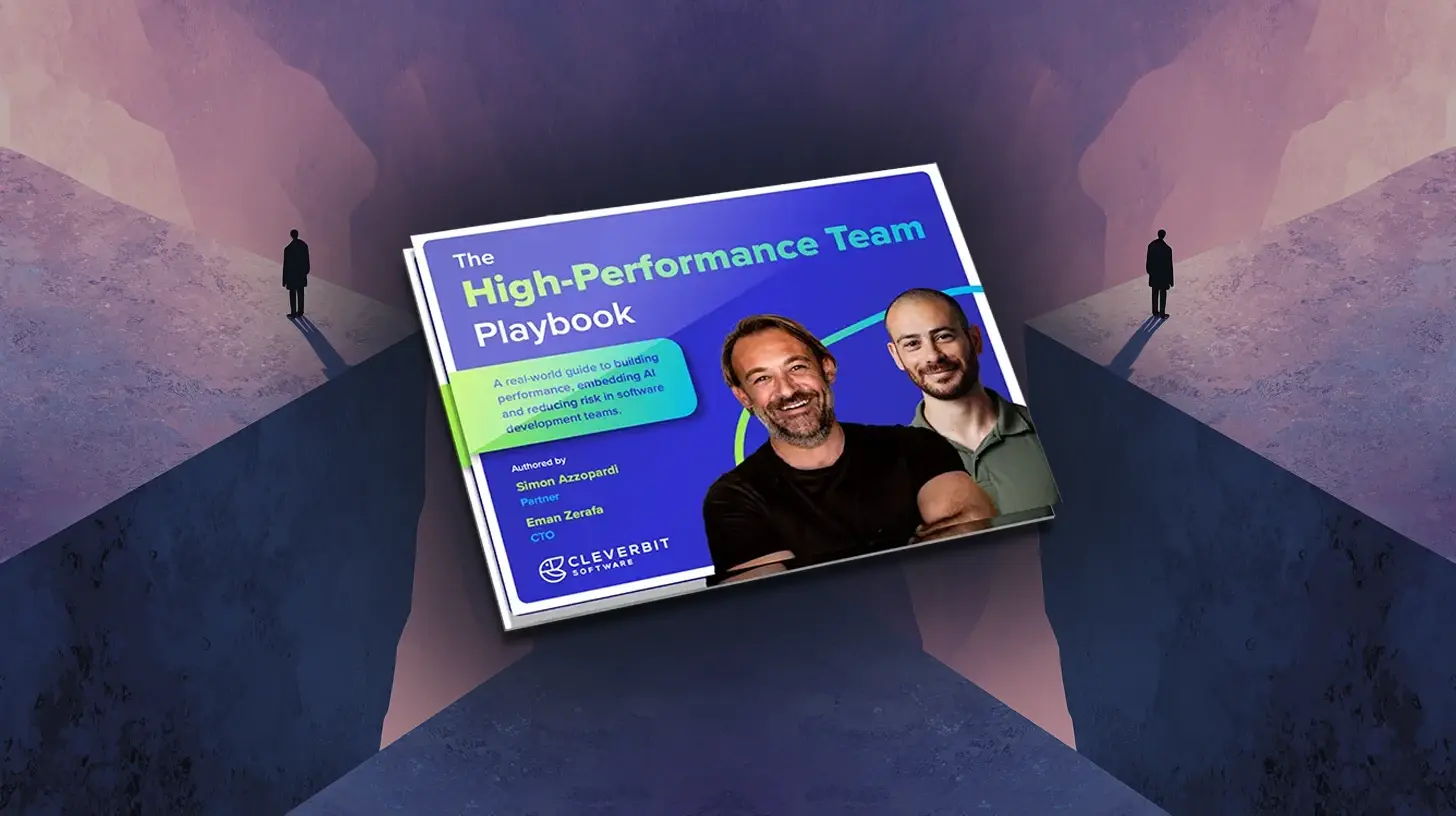
Most engineering teams don’t fail because of bad engineers. They fail because performance is assumed. That single observation lies at the heart of the High-Performance Team Playbook, a practical resource for leaders who want to move beyond hoping for results and start building them deliberately.
The playbook draws on the experience of teams that have built, scaled, and handed over engineering functions at enterprise level. It is not a collection of abstract theories. It is a set of tested, opinionated practices shaped by real delivery pressure. For engineering managers, CTOs, and team leads, it offers a clear path from fragmented effort to cohesive, high-performing organizations.
Why Performance Can’t Be Assumed
When an engineering team underdelivers, the instinct is often to blame the engineers. But the root cause usually lies in system design, leadership ambiguity, or a culture that rewards activity over outcomes. The playbook argues that high performance is not an accident. It must be engineered with the same rigor as the product itself.
Assumed performance shows up in subtle ways. Teams have vague goals, no clear decision rights, and little feedback about whether they are doing the right work. Individual developers may be doing excellent technical work while the team as a whole fails to ship value. The playbook’s premise is that clarity, ownership, and trust are foundational. Without them, even the most talented engineers will struggle to have an impact.
Building Ownership, Trust, and Clarity
The first pillar of a high-performance team is ownership. Engineers need to own outcomes, not just tickets. That means understanding the problem, being empowered to make decisions, and being accountable for results. Ownership is not about assigning blame when things go wrong; it is about creating an environment where people feel responsible for the success of the product.
Trust is the second pillar. Teams that trust each other communicate more openly, take intelligent risks, and resolve conflicts quickly. Trust is built through clear expectations, consistent behavior, and psychological safety. Leaders who model vulnerability and admit their own mistakes create space for others to do the same.
Clarity is the third pillar. High-performing teams know why they exist, what they are working toward, and how their work connects to the broader organization. Clarity includes well-defined roles, explicit success criteria, and transparent processes. When these are missing, teams spend energy on politics and guesswork instead of delivery.
Hiring and Retaining for Performance, Not Comfort
The playbook challenges conventional hiring wisdom. Too many organizations hire people who will fit in comfortably but do not stretch the team’s capabilities. High-performing teams hire for performance. That does not mean hiring aggressive personalities or creating a cutthroat culture. It means selecting people who raise the bar, challenge assumptions, and bring complementary skills.
Performance-based hiring looks for evidence of impact. It values candidates who can describe specific problems they solved, trade-offs they made, and results they produced. It also considers how a candidate will contribute to the team’s dynamics, not just their individual output. A single high-performing hire can transform a team, but only if the surrounding systems support them.
Retention is just as important. The best engineers stay when they are learning, challenged, and trusted. They leave when their work is treated as interchangeable and their growth is ignored. Retaining for performance means providing clear progression paths, meaningful feedback, and opportunities to work on hard problems. It also means removing low performers who drain energy and undermine trust. High-performance is not about being harsh; it is about being honest about standards.
Structuring Teams That Scale Without Bureaucracy
Scaling is a particular challenge for engineering organizations. The playbook emphasizes that structure must be intentional. Teams often grow by adding more people to existing groups, which slows communication and creates coordination overhead. A better approach is to form small, persistent teams with clear missions and the autonomy to execute.
A scalable structure mirrors the product architecture. Teams are aligned to value streams or product domains rather than to technical functions alone. This reduces dependencies and allows teams to move quickly. The playbook advises leaders to keep teams small enough to stay agile but large enough to have the expertise they need. It also warns against letting structure become rigid. As the business evolves, team boundaries must adapt.
Bureaucracy often creeps in through excessive processes, committees, and approvals. The playbook advocates for lightweight processes that provide essential coordination without killing velocity. It encourages leaders to ask whether each process step is adding value or slowing delivery. If a meeting or report does not lead to better decisions, it should be eliminated.
Using AI as a Force Multiplier Without Losing Control
Artificial intelligence is transforming how engineering teams work, but many leaders are struggling to harness it responsibly. The playbook treats AI as a force multiplier, not a magic solution. When applied well, AI can automate routine tasks, surface insights, and accelerate development. But it also introduces risks that need to be managed.
The playbook advises leaders to experiment with AI in targeted areas before scaling. Some of the most effective early uses include code review assistance, automated testing, and documentation generation. These applications free engineers to focus on higher-level design and problem solving. However, the playbook warns against blindly trusting AI outputs. Quality control, security, and ethical considerations must remain in human hands.
To use AI as a force multiplier without losing control, teams need clear policies and strong technical practices. That includes version control for code and prompt templates, monitoring for model drift, and human review of critical AI-generated changes. The playbook also emphasizes the importance of AI literacy across the organization. Everyone, from junior developers to senior leaders, needs to understand what AI can and cannot do.
Measuring What Actually Drives Long-Term Results
Measurement is a double-edged sword. The playbook argues that many teams measure the wrong things. Metrics like lines of code, number of commits, or hours worked are easy to track but do not reflect real performance. High-performing teams focus on outcomes, not outputs.
Useful measures include lead time, change failure rate, deployment frequency, and time to restore service. These are the core DORA metrics that correlate with software delivery performance. But the playbook goes further, encouraging teams to measure customer impact and business value. Are users adopting the feature? Is the product reducing costs or increasing revenue? These longer-term indicators show whether engineering effort is creating value.
Measurement should not become a control mechanism. The playbook advises leaders to use metrics as a diagnostic tool to identify bottlenecks and improve systems, not as a way to punish individuals. It also warns that any metric can be gamed, so teams should look at a set of measures in combination. A team can have a fast deployment pipeline but poor uptime. A team can add many features but increase complexity.
Another critical aspect of measurement is listening to engineers. High-performing teams have high trust and psychological safety, so people feel comfortable speaking up when something is wrong. Regular retrospectives, site surveys, and one-on-one conversations provide qualitative data that complements quantitative metrics. Leaders who pay attention to both signal and noise are better equipped to make adjustments before small issues become major problems.
Finally, the playbook emphasizes that long-term results require patience. Short-term performance can be influenced by crunch time or aggressive deadlines, but that approach is not sustainable. Sustainable high performance comes from many small improvements: better feedback loops, more accurate planning, cleaner code, and stronger relationships. Teams that invest in these areas compound their gains over time.
The High-Performance Team Playbook offers a practical blueprint for engineering leaders who want to build teams that deliver consistently. It is built on the belief that performance is a choice, made through deliberate decisions about people, structure, leadership, and technology. It does not promise easy answers. Instead, it provides tested guidance for the hard work of turning a group of individuals into a high-performance team. For anyone responsible for engineering delivery, that work is the highest-leverage investment available.
Source: Help Net Security News