

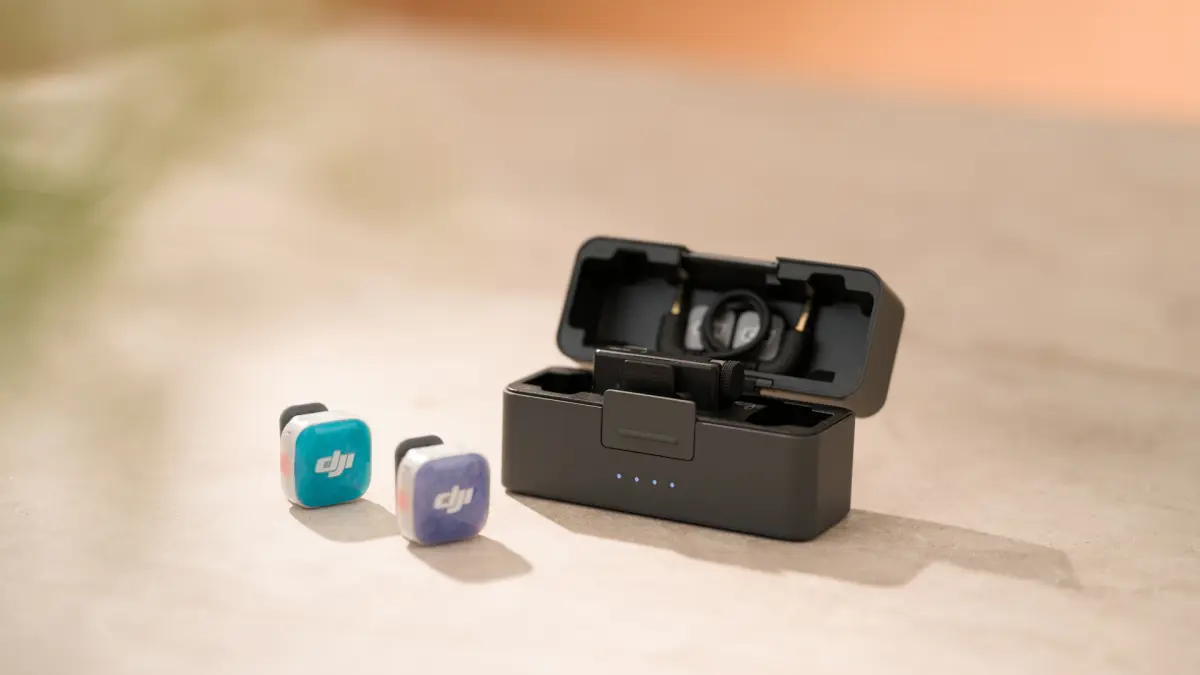
DJI has launched the Mic Mini 2S, an upgraded version of its Mic Mini 2 wireless microphone system that arrived in April. The new model keeps the compact form factor that made the series a favorite among content creators, but it brings several features down from the higher-end DJI Mic 3. The launch is not without caveats, however: the Mic Mini 2S is not available in the United States, and there is no indication that it will land there anytime soon.
An incremental but meaningful upgrade
The original DJI Mic Mini already established itself as a strong choice for vloggers, podcasters, and semi-professional producers who needed good audio without carrying bulky equipment. Its small profile and easy-to-use receiver made it a natural fit for mobile content creation, and it quickly became one of the company's most popular accessories. The Mic Mini 2 continued that trend by adding multicolored swappable covers and new voice presets, giving users more control over how their recordings sounded straight out of the box.
Now the Mic Mini 2S takes the series a step further by borrowing two of the most useful features from DJI's higher-end Mic 3 system. Each Mic Mini 2S transmitter can record internally in single-file 32-bit float audio. By default, the system records in 24-bit, which is already more than enough for most video work, but switching to 32-bit float opens up a much wider dynamic range. DJI has equipped each transmitter with roughly 14.5GB of internal storage, which is enough for about 22 hours of audio when recording in that setting.
Why 32-bit float matters for creators
32-bit float recording is not just a spec-sheet gimmick. It is a practical backup tool for people who record in unpredictable environments. Unlike older audio formats, 32-bit float captures a much larger dynamic range, which means quiet dialogue and loud transients can be captured without the same fear of clipping or hissing. If a guest speaks too softly or a prop slams too loudly, the audio is far more likely to be recoverable in post-production.
The Mic Mini 2S also includes two levels of adaptive gain control to help prevent problems before they happen. This is useful for creators who move between quiet and noisy locations, because the microphone can adjust its sensitivity on the fly. There are also two levels of AI noise cancelling, which can reduce background hum, wind, and room tone without requiring external processing.
For solo creators and interviewers, this combination is particularly valuable. Instead of constantly monitoring levels or hoping that a recorder is set correctly, users can focus on the conversation and rely on the safety track to fill in the gaps. The fact that the recording happens internally on each transmitter adds another layer of protection, because the audio is captured at the source rather than depending solely on the wireless connection to the receiver.
Four transmitters on one receiver
The other major addition to the Mic Mini 2S is support for up to four transmitters on a single receiver. The previous Mic Mini 2 was limited to two transmitters, which is enough for a simple two-person interview but not for larger panel discussions, group podcasts, or multi-person video shoots. With the Mic Mini 2S, a receiver can handle four microphones at once, allowing creators to record a full conversation without syncing multiple devices or running multiple recording apps.
This puts the Mic Mini 2S on the same level as last year's DJI Mic 3, which also supported four transmitters and 32-bit float onboard recording. However, the Mic 3 receiver only works with Mic 3 transmitters. It is not cross compatible with DJI's Mini microphone line. The Mic Mini 2S receiver, on the other hand, is backwards compatible with both the original Mic Mini and the Mic Mini 2. That means users can mix and match any of DJI's Mini mics and use up to four transmitters simultaneously.
For people who have already invested in Mic Mini or Mic Mini 2 transmitters, this is a significant advantage. They can buy a Mic Mini 2S receiver and add new transmitters as needed, rather than replacing their entire kit. It is a more sustainable way to expand a small audio setup, and it suggests that DJI is paying attention to the way creators actually build their gear collections over time.
Compatibility limits to keep in mind
There are limits to the new model's flexibility. The Mic Mini 2S receiver does not have cross compatibility with DJI's non-Mini microphones, such as the Mic 3. If you own both Mini and non-Mini DJI mics, you cannot use them together through the Mic Mini 2S receiver. DJI's mobile receiver can still connect to two transmitters at a time and can work with both product lines, but it cannot handle four transmitters the way the Mic Mini 2S receiver can.
This means the Mic Mini 2S is best suited for creators who are firmly in the Mini ecosystem or are willing to standardize on it. For those who need to mix higher-end Mic 3 transmitters with Mini transmitters in a single set-up, a different workflow is still required. It is a minor complication, but it is worth considering before making a purchase.
Design and positioning
The Mic Mini 2S shares the same basic design language as its predecessors. It is small, lightweight, and easy to clip onto a collar, lapel, or hat. The receiver sports a clear display and simple controls, and the system is designed to be used straight out of the box. For semi-professional producers, it offers many of the same features as larger professional systems, but with less complexity and at a lower price point.
DJI has not changed the core form factor, which is a reasonable decision given how well the design was received. Instead, the company is focusing on adding features that directly improve audio quality and workflow flexibility. The 32-bit float internal recording is particularly useful for anyone who has ever returned from a shoot only to discover that an audio track was unusable because of clipping or low levels.
The addition of AI noise cancellation is another sign that DJI is trying to stay ahead of competitors in the consumer and prosumer audio market. Many smartphones and cameras offer some form of noise suppression, but having it built into the microphone transmitter gives creators more consistent results regardless of the recording device.
Pricing and global availability
DJI has not announced official U.S. pricing for the Mic Mini 2S, largely because the product is not being sold through official channels in the United States. UK pricing starts at £79, which is approximately $106, for a set that includes either one transmitter with a receiver or one transmitter with a mobile receiver and charging case. There is also a bundle with two Mic Mini 2S transmitters, a receiver, and a dual charging case for £169, or approximately $227.
These prices make the Mic Mini 2S an affordable entry point for creators who want advanced audio features without moving up to a full professional system. The two-transmitter bundle is especially attractive for interviewers and small podcast teams, since it covers most standard recording scenarios at a price that is significantly lower than the DJI Mic 3.
As with many DJI products, availability varies by region. The company has repeatedly said that it is committed to serving global markets, but its options in the U.S. are limited by ongoing political and regulatory issues. The U.S. government has taken a hostile stance toward DJI, and that has made it difficult for the company to import products for direct sale. Several recent DJI releases, including the Osmo Mobile 8 phone gimbal, the Avata 360 drone, and the Osmo Pocket 4 gimbal camera, are not available through DJI's official U.S. website.
U.S. customers who want the Mic Mini 2S will likely have to buy it through a third-party importer or reseller. That can introduce higher prices, longer shipping times, and uncertainty about warranty support. It also means buyers need to be careful about whether the product is authentic and whether it will receive future firmware updates. DJI has made some of its products available through U.S. retailers in the past, but the official situation remains unsettled.
What this means for U.S. creators
For American content creators, the launch of the Mic Mini 2S is a frustrating reminder of the broader issues surrounding DJI's presence in the U.S. The hardware itself is clearly designed for a wide audience, and the price is competitive, but access remains a major problem. Some users will be willing to buy through international sellers, while others will look for alternatives from other microphone manufacturers.
It is also possible that the Mic Mini 2S will eventually appear in the U.S. through a distribution deal or after the regulatory climate changes. DJI has continued to release new products despite the restrictions, and its existing U.S. customers are still able to use their gear. But until the legal and political situation shifts, official U.S. availability will remain uncertain.
For the rest of the world, the Mic Mini 2S offers a compelling mix of features and value. It builds on a proven design, adds a useful safety-net recording format, and opens up the Mini series to four-person recordings. The backwards compatibility with earlier Mini transmitters makes it an easy upgrade for current owners, and the affordable UK pricing suggests it will appeal to budget-conscious creators as well.
The Mic Mini 2S is not a radical redesign, but it does not need to be. It is a focused update that addresses two of the biggest limitations of the previous model while keeping everything that made the series popular. For creators who have been waiting for DJI to bring more professional recording tools into its compact microphone line, the Mic Mini 2S is a welcome addition, even if it is not officially available everywhere.
Source: Mashable News