

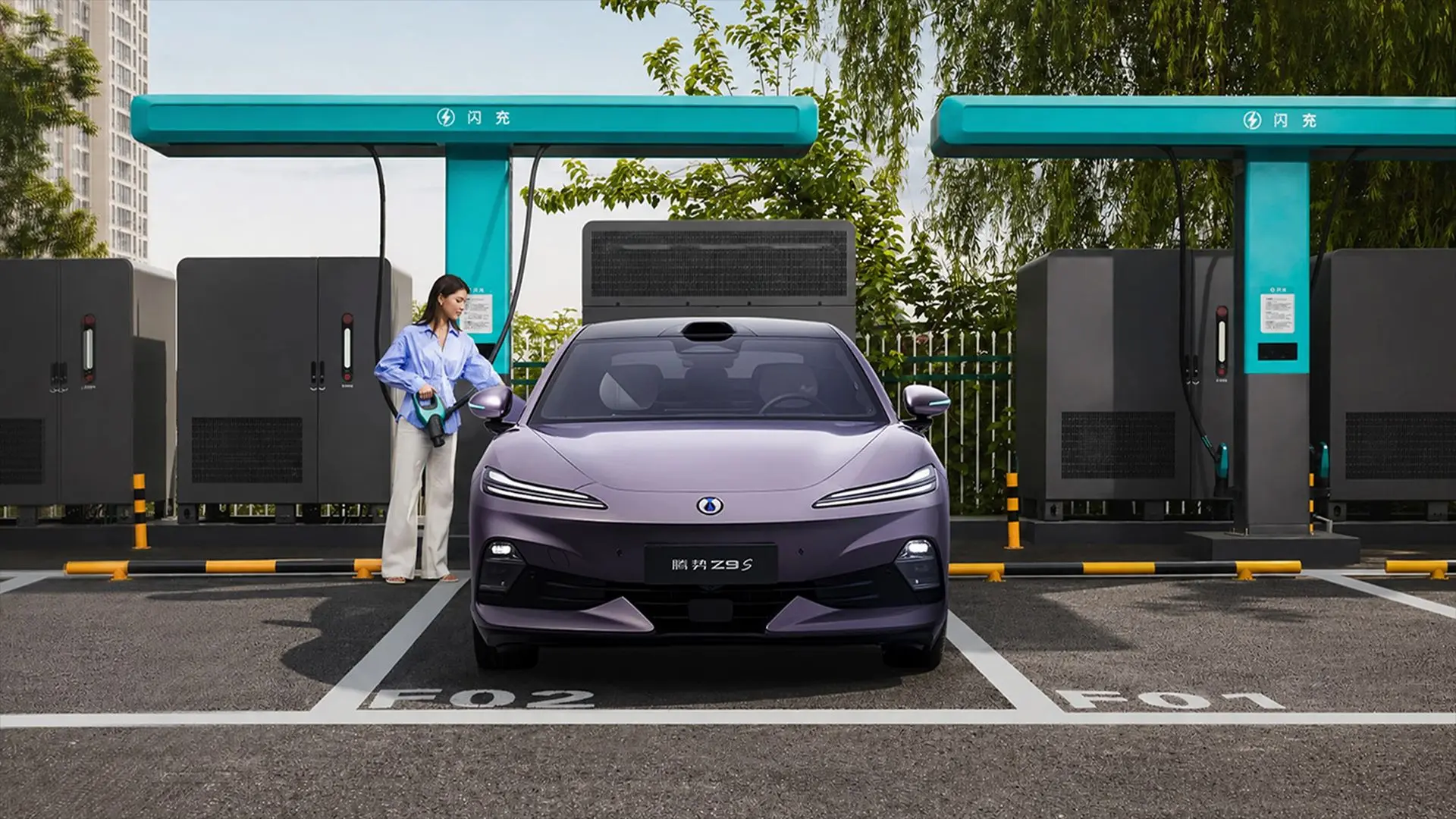
Denza, the premium electric vehicle brand backed by Chinese automaker BYD, has made a bold claim: its upcoming Z9S sedan offers the world’s longest production electric range. According to the company, the Z9S can cover the roughly 615-mile journey from New York City to Detroit, Michigan on a single charge, with enough reserve to spare. If true, this would place the Z9S ahead of every current production EV in terms of sheer driving distance.
A Landmark Claim in EV Endurance
The headline figure is staggering. While most modern EVs offer ranges between 250 and 350 miles, the Denza Z9S is reportedly targeting more than 1,000 kilometers (621 miles) under the CLTC test cycle, which is the Chinese equivalent of the EPA or WLTP ratings. That would comfortably eclipse the current long-range champions, such as the Lucid Air Grand Touring (EPA-rated at 516 miles) and the Tesla Model S Long Range (405 miles). The New York-to-Detroit analogy is a clever marketing hook: a drive that would normally require at least one stop for gasoline in an internal combustion vehicle would be achievable in the Z9S without ever plugging in.
But range numbers can be misleading. Test cycles vary significantly by region. The CLTC test is generally more optimistic than the EPA’s methodology, meaning the U.S.-equivalent range would likely be lower. Still, even a conservative EPA estimate of around 500 miles would be class-leading. Denza has not yet released official EPA or WLTP figures, and it remains to be seen whether the Z9S will even be sold outside of China.
The Technology Beneath the Z9S
To achieve such a range, Denza is leveraging BYD’s latest generation of blade battery technology. BYD’s lithium-ion phosphate (LFP) chemistry is known for its safety, longevity, and energy density improvements over older LFP cells. The Z9S is expected to use a high-capacity version of the blade battery, possibly with a pack size exceeding 150 kilowatt-hours. For context, most long-range EVs use batteries between 80 and 110 kWh.
The Z9S also benefits from advanced aerodynamics, with a drag coefficient reportedly as low as 0.19. This is among the lowest of any production car, trailing only the Mercedes-Benz EQXX concept and the Lucid Air’s 0.197. A sleek silhouette helps reduce energy consumption at highway speeds, where aerodynamic drag dominates. Combined with a highly efficient electric motor and energy-recuperation system, the Z9S aims to squeeze every possible mile from its battery.
Another key component is the vehicle’s thermal management system. Efficient cooling and heating of the battery are crucial for maintaining range in extreme temperatures. Denza claims its new heat pump system can extend range in cold weather by up to 20 percent compared to conventional resistive heating, a feature vital for owners driving on routes like the snowy stretch between New York and Detroit.
Real-World Range and Testing
Independent real-world range tests will be essential to validate Denza’s claims. In the past, some manufacturers have used generous test cycles that do not reflect typical driving conditions. The New York-to-Detroit route includes varied terrain, highway speeds, and potential traffic delays, all of which affect energy consumption. If the Z9S can complete that drive in EPA-like conditions, it would be a major engineering achievement.
Denza has not provided a detailed breakdown of test conditions, but it says the Z9S underwent extensive validation across different climates and driving scenarios. The company specifically mentions highway loops, city driving, and high-temperature desert tests. It also notes that the Z9S can achieve fast charging at up to 350 kW, allowing drivers to add roughly 300 miles of range in just 15 minutes. This combination of extreme range and rapid charging could effectively eliminate range anxiety for most users.
Denza and BYD’s EV Leadership
Denza is a joint venture between BYD and Mercedes-Benz, though BYD now holds majority control. The brand has traditionally focused on premium MPVs and SUVs, but the Z9S marks its entry into the flagship electric sedan segment. BYD has already become the world’s largest EV maker by volume, surpassing not only Tesla but also every other competitor in 2023 and 2024. The Z9S is a statement of intent: it is not content with selling affordable EVs; it wants to dominate the luxury end of the market as well.
BYD’s vertical integration gives it an advantage. The company controls most of its supply chain, from battery cells to semiconductor chips. This allows it to innovate quickly and bring new technologies to market at scale. The blade battery, first introduced in 2020, has been praised for its safety and has since been adopted by other automakers, including Tesla. The Z9S likely uses a next-generation version of this battery with higher energy density, possibly achieved through a new structural cell-to-pack design that eliminates traditional modules and increases the active material within the same footprint.
What This Means for the EV Market
If the Z9S delivers on its range claim, it will put pressure on other luxury EV manufacturers. Lucid and Mercedes-Benz have long been the benchmark for efficiency, but a Chinese rival surpassing them by a significant margin would shift the conversation. It would also raise the bar for battery progress: 620 miles of range was previously thought to be a decade away for most automakers.
However, there are trade-offs. A battery that large inevitably adds weight, which can impact handling, tire wear, and energy consumption. The Z9S is expected to weigh around 2.5 tons, roughly the same as a large SUV. It is also likely to be expensive, with prices potentially starting at over $100,000 in China. And although the range is impressive, most drivers do not need 600 miles on a daily basis; a more modest range with faster charging might be more practical for many consumers.
Still, the emergence of a 1,000-km EV is a psychological milestone. It challenges the assumption that electric vehicles are only suitable for short commutes and city driving. It also gives road-trippers a new freedom, opening up long-distance routes that were previously out of reach for EVs without a convenient charging network. The New York-to-Detroit corridor is particularly interesting because it includes rural stretches in Pennsylvania and Ohio where charging infrastructure remains sparse.
Charging Infrastructure and Usability
Even with a 615-mile range, owners will eventually need to charge. Denza is expanding its own network of ultra-fast charging stations in China, but the Z9S is expected to support standard CCS and maybe NACS adapters for North American compatibility. The 350-kW charging capability is on par with the best of current technology, allowing the Z9S to recover a significant amount of range during a coffee break.
The vehicle also features smart navigation that can pre-condition the battery before arrival at a charging station, ensuring optimum charging speed. Furthermore, the Z9S comes equipped with bidirectional charging, enabling owners to power their homes or other electrical devices using the car’s battery. This makes the Z9S not just a long-distance cruiser but also a mobile power source, a feature many EV enthusiasts value.
A New Flagship for the Premium Segment
The Z9S is not just about range; it is also a showcase of Denza’s design and technology ambitions. Inside, the sedan boasts a minimalist cabin with a large central touchscreen and a secondary display for the front passenger. High-end materials, including Nappa leather and sustainable wood trim, are used throughout. The car also features an advanced driver-assistance system, with lidar and multiple cameras for Level 2+ semi-autonomous driving.
Denza will initially launch the Z9S in its home market, with plans to expand to Europe, Southeast Asia, and Latin America later. A North American launch is uncertain, partly due to tariffs and regulatory hurdles. The Biden administration has imposed a 100 percent tariff on Chinese-made EVs, which would make the Z9S prohibitively expensive in the U.S. unless it is manufactured locally. For now, the New York-to-Detroit range claim remains a symbolic benchmark rather than an actual commute for most Americans.
Looking Ahead
Denza has not yet confirmed a specific launch date for the Z9S, but industry insiders expect it to reach dealerships in China by the third quarter of 2025. Pre-orders have reportedly exceeded expectations, with early adopters drawn to the vehicle’s extreme range and advanced technology. The reaction from competitors has been largely silent, though several legacy automakers are known to be accelerating their own solid-state battery programs in response to such advances.
Whether the Z9S truly delivers on its promise remains to be seen. But if it does, it will mark a major turning point in the EV industry, proving that long-distance electric travel is not just a niche feature but a mainstream expectation. For now, the title of “world’s longest range” belongs to Denza, and the rest of the automotive world is watching.
Source: TechRadar News