

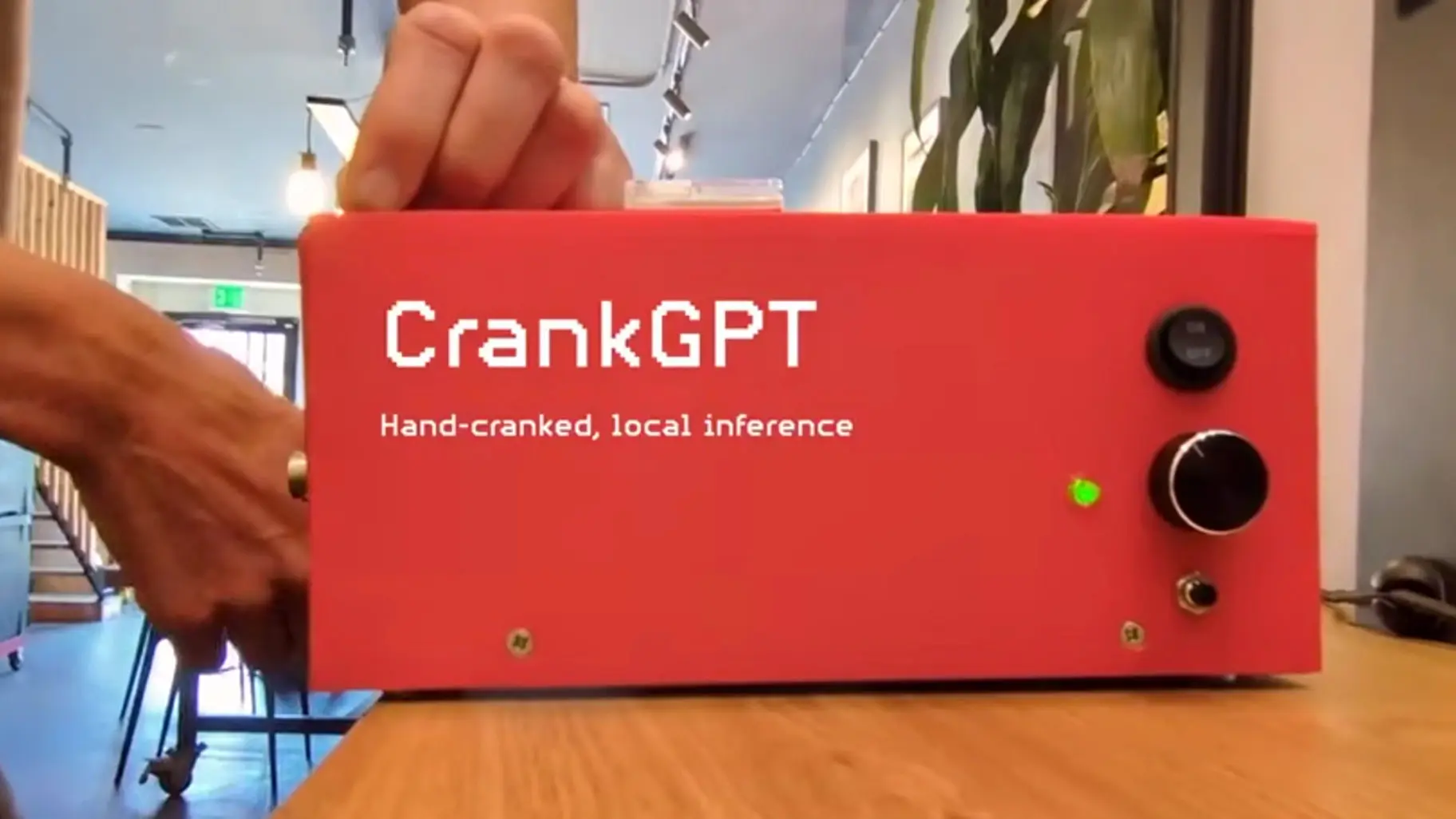
CrankGPT is a novel concept that reimagines how we interact with artificial intelligence. Instead of relying on massive data centers and cloud servers, this tiny device is powered entirely by the user's physical effort—a hand crank. Created by a Europe-based company, the gadget aims to address growing concerns about energy consumption and privacy in the age of AI chatbots.
How CrankGPT Works
At its core, the CrankGPT uses a 20W hand-crank generator connected to a stock Raspberry Pi 5 with 8GB of RAM. The user turns the crank to generate electricity, which powers the system on the fly. There is no battery; the device runs only while the crank is being turned. This design ensures that the AI is completely offline and under the user's control at all times.
The chatbot runs fully local small language models. The creators recommend using models such as the 350 million or 1.2 billion parameter variants of Liquid AI LFM2, or Gemma 1B. These lightweight models are capable of handling everyday queries—like answering questions, generating simple text, or even basic coding—without the need for cloud connectivity. The audio output is delivered via the Piper voice model, and a cooling fan keeps the Raspberry Pi from overheating during operation.
Energy Efficiency and Environmental Impact
The motivation behind CrankGPT is rooted in sustainability. Training and running large AI models consume enormous amounts of electricity and water, contributing to carbon emissions. The creators note that it offended their “European small-practical-car sensibilities” to see people using massive models for tasks that could be accomplished by much smaller, more efficient models. CrankGPT is a proof of concept that generative AI can be both accessible and environmentally friendly.
However, it is worth noting that even small models require training, which itself demands significant resources. The CrankGPT does not solve the training problem, but it does offer a way to run inference with minimal ongoing energy cost. For users who value privacy and energy independence, this hand-cranked approach could be a game-changer.
Privacy and Local Control
Perhaps the most compelling feature of CrankGPT is its complete privacy. Because all processing happens on the device, no data ever leaves the user's hands. This contrasts sharply with mainstream chatbots like ChatGPT or Google Gemini, which send queries to remote servers where they may be logged, analyzed, or even used for model training. For sensitive conversations or proprietary information, a local-only device offers peace of mind.
The CrankGPT also ensures that the user has full control over the software and hardware. Since it is built on a Raspberry Pi, knowledgeable users can customize the models, tweak the code, or even replace the casing. The device is open by design, aligning with the principles of the maker community and right-to-repair advocates.
Limitations and Practical Considerations
As the demonstration video shows, the CrankGPT is not silent. The hand crank produces a mechanical whirring sound, and the cooling fan adds to the noise. Additionally, the crank becomes significantly harder to turn when the device is simultaneously running speech synthesis and language model inference. This means users may need to exert considerable physical effort for complex queries.
The device is also best suited for small, everyday tasks. While the creators have experimented with generating images, poetry, and code, the output quality and complexity are limited by the small model sizes. Users expecting the capabilities of GPT-4 or Gemini Ultra will be disappointed. However, for quick factual answers, reminders, or simple creative prompts, the CrankGPT can suffice.
Broader Implications for AI Sustainability
CrankGPT arrives at a time when the environmental cost of AI is under increasing scrutiny. Data centers consume vast amounts of energy, and the water used for cooling is becoming a pressing issue in drought-prone regions. Innovations like hand-cranked chatbots may seem niche, but they represent a broader trend toward edge computing and low-power AI.
Edge AI—running models directly on local devices—reduces latency, saves bandwidth, and enhances privacy. CrankGPT is an extreme example, but it demonstrates that even with minimal hardware, useful AI is possible. As model distillation and quantization techniques improve, we may see more devices that operate off-grid. This could be particularly valuable in remote areas, disaster zones, or for users who prefer not to depend on internet connectivity.
The Future of CrankGPT
Currently, CrankGPT is not available for purchase. The company is accepting requests for demonstrations, and there is no announced price or launch date. Whether it becomes a commercial product or remains a clever prototype, it serves as an important reminder that convenience should not come at the cost of sustainability. The concept may inspire other developers to explore human-powered computing, or to integrate smaller models into everyday objects.
As AI continues to permeate our lives, finding ways to reduce its ecological footprint will become more critical. CrankGPT offers one possible path forward—a device that respects both the environment and the user's autonomy. While it may not replace cloud-based chatbots for heavy tasks, it proves that ingenuity can thrive even within tight power budgets.
The hand-cranked chatbot also raises interesting questions about the relationship between effort and reward. In a world where instant gratification is the norm, requiring someone to physically exert themselves to get an answer might seem counterintuitive. Yet for those who value self-sufficiency and mindful technology use, the act of cranking could become a meditative practice. It also ensures that users only ask questions they truly need, thereby conserving energy and computation.
From a technical standpoint, the integration of a hand-crank generator with a modern single-board computer is a feat of engineering. The 20W generator must provide stable power for the Raspberry Pi 5, which can draw up to 27W under load. The cranking speed and consistency must be maintained to avoid brownouts. The developers likely embedded capacitors or power conditioning circuitry to smooth out fluctuations. This level of detail suggests that the concept is well beyond a mere weekend hobby project.
In summary, CrankGPT is a fascinating glimpse into a future where AI can be both powerful and sustainable. It challenges the assumption that bigger is always better and shows that user-controlled, local AI is not only possible but potentially practical. As the world grapples with the environmental toll of digital technology, innovations like this warrant attention. They push the conversation beyond efficiency ratings toward fundamental redesign of how we generate and consume computing power.
Source: Android Authority News