

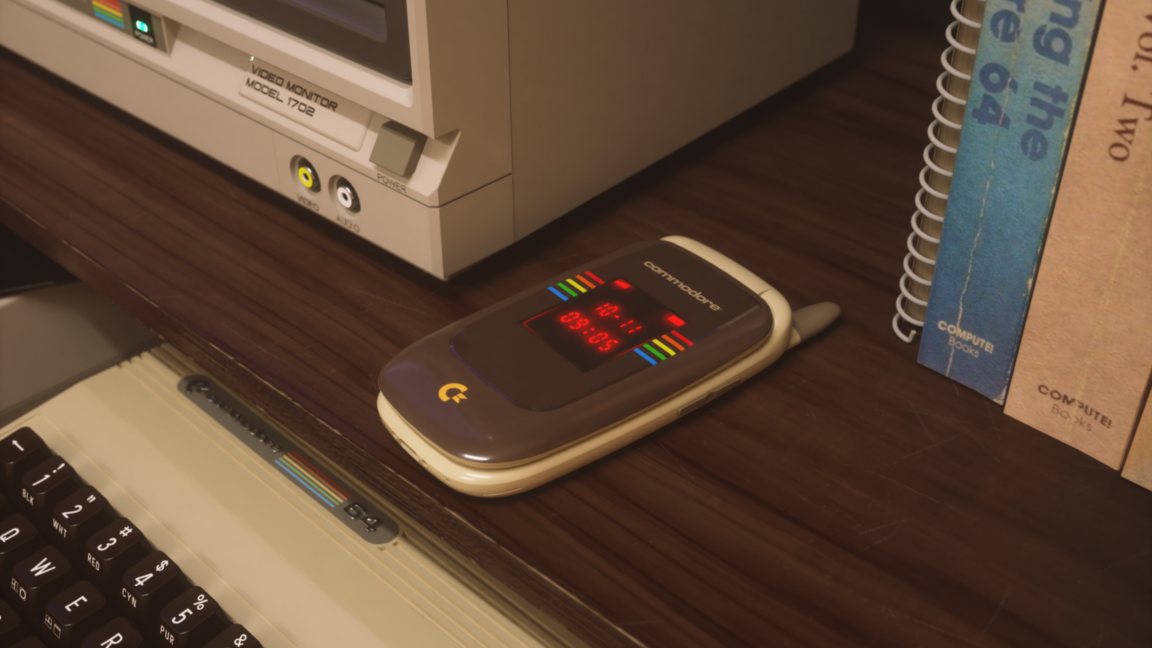
The next gadget to bear the storied Commodore branding will be a flip phone. The Commodore Callback 8020 takes advantage of reinvigorated interest in dumb phones, but with a twist: it blocks web browsers and social media at the system level using patent-pending technology. The phone supports other Internet-based capabilities, like maps and QR codes, but explicitly prevents access to platforms that drive doomscrolling.
Commodore, the name behind the bestselling desktop PC in history, came back about a year ago. Christian “Peri Fractic” Simpson, best known for running the Retro Recipes (now known as Retro Recipes x Commodore) YouTube channel, acquired the Commodore Corporation and “100 percent of the original and official trademarks that defined the Commodore name since 1983,” per a July 2025 press release. Simpson said the price was “in the low seven figures.” Since the acquisition, the brand released the Commodore 64 Ultimate and the Commodore 64X PC, a mini PC housed in a chassis that resembles the Commodore 64.
The Callback 8020 is a big step for the new Commodore brand and demonstrates an interest in creating new products with a nostalgic feel, rather than re-releasing retro devices. With the flip phone, the brand may be seeking a middle ground that embraces newer technology while maintaining some principles from the start of modern mobile computing.
A New Commodore
Commodore’s announcement points to a “growing number of consumers, parents, and policymakers … questioning the cost of never-ending connectivity” and aims for the Callback 8020 to represent a “return to technology’s original promise: tools that serve their users” and “where the customer is not the product.” It also claims that the phone doesn’t “collect personal data without consent,” monetize data, track cookies, or “monitor activities.”
Fractic told Ars Technica that Commodore’s app store, Commostore, uses a whitelisting principle, and “social media and browsers will never get that whitelisting.” He added: “We’ve also developed patent pending technology that will prevent these apps—and only these apps—from being sideloaded on the device. … Users can sideload nearly anything else they want if it isn’t available on the Commostore, but we’ve drawn a firm line in the sand around any apps that drive doomscrolling. On the off-chance somebody finds a way around that, we’ve also blocked access at the DNS level. So even if you manage to get TikTok installed, you’re not going to be able to reach its servers.”
When asked about community forums, Fractic said that old school bulletin board systems are permitted, but Reddit is not. “We’re determined to approach this in a way that’s fair and safe for everyone, and we’ll be consulting with the Callback community over the next few months to make this determination,” he said.
Specs and Features
The Callback 8020 runs the Linux-based operating system Sailfish OS, which is made by Jolla, a mobile company created by Nokia employees in 2012 that also makes phones. Sailfish OS is known for its gesture-based interface and privacy-focused design. Per Commodore, its phone will support “over 99 percent of Android apps” through Sailfish OS’s Android runtime app compatibility layer, including Spotify, Signal, and WhatsApp. Commodore also equipped the phone with some Commodore 64-era games, leveraging the nostalgia factor.
To minimize distractions, the phone uses a dome-shaped LED light that lights up when you have a message. Commodore thinks this will be less distracting than pop-up messages, but it's debatable whether a lit-up phone draws attention too. The former Nokia 3360/3595 owner inside of many is highly interested in another attention-grabbing design feature: the ability to swap phone covers and attach a stringed charm to the case.
Additionally, the flip phone’s exterior screen is designed to resemble 1970s Commodore calculators and has a red tint, as seen in the Commodore 776M calculator from 1975. For audio, the Callback 8020 uses an 8-bit SID music player, an app for playing music created for the SID (sound interface device) chip in the original Commodore 64. The phone also has what Commodore claims is a high-end, on-board DAC, an integrated FM radio, and a 3.5mm jack, and it comes with a pair of in-ear monitors.
Historical Context and Market Positioning
Commodore’s return to the consumer electronics market is part of a broader trend of retro-inspired devices. The company that once dominated the home computer market with the Commodore 64 is now tapping into the growing demand for feature phones, also known as dumb phones. These devices offer limited functionality compared to smartphones but appeal to those seeking to reduce screen time and digital distractions.
The Callback 8020 is priced between $500 and $640, depending on which of the five colorways is chosen. The most expensive version, the Founders Edition, has a 24K gold-plated “C=” button and is $640. This price point is cheaper than the latest Motorola Razr flip/foldable-screen phone, which starts at $800, and is in the midrange for other premium phones aimed at minimizing distractions, like the WisePhone II ($400), Light Phone III ($699), Light Phone II ($299), and Boring Phone (NZD $499, or about $291). Commodore is targeting shipping for Q4.
With a name that evokes computing history and a feature set designed to combat smartphone addiction, the Commodore Callback 8020 aims to carve out a niche in a market that increasingly values digital wellness. However, it remains to be seen whether consumers will pay a premium for nostalgic simplicity and retro branding when the device launches later this year.
As the technology industry continues to grapple with issues of screen time, data privacy, and the ethics of social media, Commodore’s approach offers a unique solution: a device that embraces connectivity while drawing firm boundaries around certain types of content. Whether the Callback 8020 will succeed or remain a niche product is yet to be determined, but it undoubtedly adds a compelling option for those seeking a break from the always-on, always-distracting world of modern smartphones.
Source: Ars Technica News