

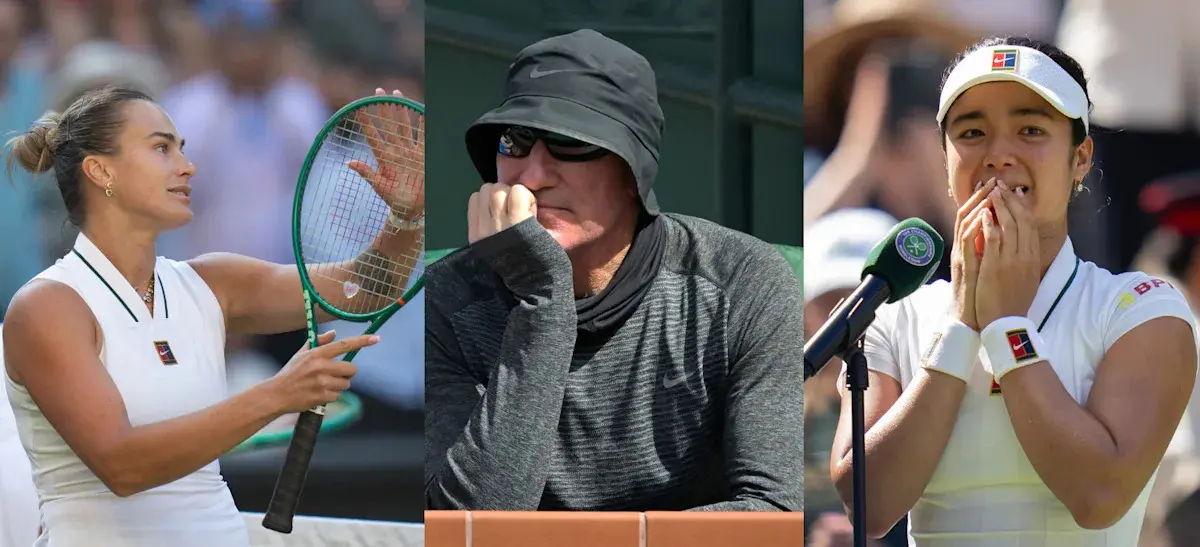
Brad Gilbert, the former coach of Coco Gauff and a longtime tennis analyst, has sparked debate with his latest prediction for the 2026 US Open. Appearing on The Big T Podcast, Gilbert argued that the women’s draw has become far more unpredictable than in previous years. He specifically pointed to the recent struggles of world No. 1 Aryna Sabalenka and No. 2 Iga Swiatek, suggesting that their aura of invincibility has faded, opening the door for a first-time Grand Slam champion at Flushing Meadows.
“I feel like at the US Open we will have another surprise winner and maybe another first-time winner because I do think that Sabalenka’s and Iga’s levels have come down,” Gilbert said on the podcast. “Other players are now sort of taking advantage, and it’s a ‘show me League.’ If all of a sudden, you’re not appearing as invincible, players feel like, ‘you know what? You are beatable for the first time.'”
Gilbert’s comments come on the heels of a shocking Wimbledon campaign for both top seeds. Swiatek, a four-time major champion, was eliminated in the third round by rising star Alexandra Eala, a result that sent shockwaves through the tennis world. Sabalenka, the two-time Australian Open champion, fared only slightly better, reaching the round of 16 before falling to former world No. 1 Naomi Osaka in straight sets. For Gilbert, those early exits are not anomalies but rather symptoms of a broader shift in the women’s game.
“Unlike the men’s, there’s a massive difference between Sinner at 1 and the player at 5, let alone 15,” Gilbert explained. “But right now, Sabalenka is at No. 1, and you go down to 20, and the separation is very small.” That competitive parity, he argued, empowers lower-ranked players to believe they can win, something that was rare during the peak dominance of Serena Williams or even the recent stranglehold of Swiatek and Sabalenka on hard courts.
Why Swiatek and Sabalenka’s Dip Matters
Iga Swiatek’s reign atop the WTA rankings has been defined by consistency and an almost robotic ability to dismantle opponents on clay and hard courts. However, her grass-court struggles have become a recurring theme. The 2024 Wimbledon loss to Yulia Putintseva was followed by this year’s exit to Eala, a 19-year-old Filipino wild card who played fearless tennis. Swiatek’s trademark spin-heavy forehand seems less effective on the slick grass, and her return game has occasionally faltered against big serves and flat hitters. At the same time, Sabalenka’s power game has encountered its own hurdles. After a dominant start to 2026, including a title in Indian Wells, her serve, once a formidable weapon, became erratic in the later rounds at Wimbledon. Against Osaka, Sabalenka committed 32 unforced errors and failed to convert key break points.
Brad Gilbert has seen this pattern before. During his coaching stints with Andre Agassi, Andy Roddick, and most recently Coco Gauff, he learned that confidence and momentum can shift rapidly in tennis. Gauff herself experienced a slump after winning the 2023 US Open, but she rebounded with a second major title in 2025. Gilbert believes that the current top two are now in a similar vulnerable phase, and the rest of the pack is sensing blood.
“I think that other players are now sort of taking advantage,” Gilbert repeated. “It’s not that they’ve suddenly become bad players, it’s that the gap has shrunk. Players who once thought they had no chance are now walking onto the court believing they can win. That mental shift is huge.”
The Rising Contenders for the US Open
So who might be the “surprise winner” Gilbert speaks of? Several names emerge from the current top 20. Naomi Osaka, the four-time major champion, has shown flashes of her old brilliance after returning from maternity leave. Her win over Sabalenka at Wimbledon was her first victory over a top-two player since 2023, and she has the hard-court pedigree to thrive in New York. Then there is Coco Gauff, Gilbert’s former protégé. Though she struggled earlier in 2026 with consistency, Gauff’s resilience and athleticism make her a perennial threat on the fast US Open courts. Gilbert himself has praised her ability to “win ugly” and grind out results when not playing her best.
Another name to watch is Jessica Pegula, who reached the US Open final in 2024 and remains one of the most consistent performers on hard courts. Pegula’s return game and tactical acumen could trouble both Swiatek and Sabalenka if they meet. Similarly, Madison Keys, a former finalist at Flushing Meadows, possesses the raw power to blow through a draw. Her 2026 season has been up and down, but a deep run at Wimbledon, where she fell in the quarterfinals to Elena Rybakina, suggests she is finding her rhythm.
Among the younger generation, Alexandra Eala has announced herself on the global stage. The Filipino teenager’s victory over Swiatek at Wimbledon was no fluke; she backed it up with a fourth-round appearance, displaying a mature all-court game that seems tailor-made for the hard courts. Emma Raducanu, the 2021 US Open champion, is recovering from a stress fracture and may not be at full fitness, but if she can string together wins, she has the talent to surprise. And don’t overlook Ons Jabeur, the three-time Grand Slam finalist, who has been working her way back from injury and loves the energy of the New York crowd.
Gilbert, however, is careful not to dismiss Sabalenka entirely. “I still think Sabalenka could find her best form and bring it to the court soon,” he said on the podcast. “She’s too powerful and too mentally tough to stay down for long. But right now, she’s human, and that’s all the other players need.”
Historical Context: Surprise US Open Winners
The US Open has a rich history of unexpected champions, particularly in the women’s game. In 2021, Emma Raducanu, then an 18-year-old qualifier, stormed through the draw without dropping a set, becoming the first qualifier in history to win a Grand Slam. In 2015, Flavia Pennetta, a 33-year-old Italian who had never been past the quarterfinals at any major, defeated Roberta Vinci in an all-Italian final. And in 2009, Kim Clijsters returned from retirement as a wild card to win her second US Open, beating a field that included Serena Williams and Venus Williams.
If Gilbert’s prediction holds, 2026 could add another chapter to that lore. The combination of vulnerable top seeds, a deep field of confident challengers, and the electric atmosphere of Arthur Ashe Stadium might create the perfect storm for a fairy-tale run. As Gilbert noted, the gap between No. 1 and No. 20 in the women’s game is now razor-thin, and on any given day, the best player on the court is not necessarily the one with the highest ranking.
The Broader Implications for Women’s Tennis
Beyond the US Open, Gilbert’s analysis points to a larger trend in the WTA: parity is finally taking hold. For years, the women’s game was dominated by a few superstars—Serena Williams, Venus Williams, Maria Sharapova, and later Swiatek and Sabalenka. But the last 18 months have seen a wave of first-time Grand Slam champions: Markéta Vondroušová won Wimbledon in 2023, Coco Gauff took the 2023 US Open, and Barbora Krejčíková won Wimbledon in 2024. Even Jelena Ostapenko, a one-time major winner, has been a constant threat.
This greater depth is healthy for the sport. It generates unpredictability, which in turn attracts casual viewers who do not know the outcome before the match begins. It also forces the top players to elevate their games continuously, knowing that any lapse can lead to an early exit. For fans, the upcoming US Open promises to be one of the most wide-open tournaments in years.
The US Open will run from August 30 to September 13. Qualifying begins on August 25, with the main draw following a week later. As the tennis world turns its attention to New York, Brad Gilbert’s bold prediction will linger in the air: this could be the year another surprise name lifts the trophy.
Source: Yahoo Sports News