

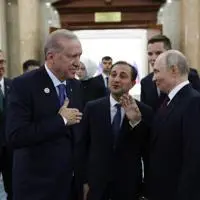
President Recep Tayyip Erdoğan concluded his visit to Kyrgyzstan on Sept. 1 after attending the Shanghai Cooperation Organization (SCO) summit in Bishkek, an event marked by the approval of 28 documents and a series of high-level bilateral meetings on the margins of the gathering.
A landmark summit for the SCO
The summit was held in the Kyrgyz capital as the organization celebrated its 25th anniversary. It offered the leaders of Asia, Europe and the Middle East a platform to discuss security, economic connectivity, technology governance and diplomatic responses to a range of conflicts. In addition to President Erdoğan, the expanded meeting brought together Chinese President Xi Jinping, Russian President Vladimir Putin, Indian Prime Minister Narendra Modi, Iranian President Masoud Pezeshkian, Pakistani Prime Minister Shehbaz Sharif, Azerbaijani President Ilham Aliyev and Armenian Prime Minister Nikol Pashinyan, among other regional leaders. United Nations Secretary-General Antonio Guterres also attended the main session, underscoring the summit’s significance beyond the immediate SCO membership.
The SCO, founded in the early 2000s as a permanent intergovernmental organization, has evolved from a border-security mechanism into a platform for political, economic and security cooperation. Its rotating presidency passed to Kyrgyzstan for this summit, and Pakistan is scheduled to take over the chairmanship and host the next summit in 2027. Türkiye follows the organization as a dialogue partner, a status that allows Ankara to take part in selected SCO activities without becoming a full member.
Bishkek Declaration and adopted documents
At the end of the meeting, SCO member states approved the 25th-anniversary Bishkek Declaration. This document covers the organization’s core principles, including respect for sovereignty, non-interference in internal affairs and a commitment to resolving disputes through political and diplomatic instruments. The declaration described the SCO as a non-military organization that is not directed against any country or international body, a message intended to reassure partners about the group’s long-term orientation.
The 28 adopted documents also touched on several practical areas. Regional security was a central theme, and the leaders endorsed regulations for SCO security and anti-drug centers. These institutions will form part of a broader effort to strengthen coordination in the fight against organized crime, narcotics trafficking and emerging trans-border threats. Another set of decisions concerned an international information security plan, reflecting the growing importance of preventing cyber conflict and protecting digital infrastructure. On the economic side, the summit approved a road map for ports and logistics centers, with the aim of improving transit routes and supply chains across Eurasia.
Energy and climate change were also high on the agenda. The documents included cooperation memorandums on climate change and artificial intelligence, signaling that SCO members are looking to align their ambitions with evolving global standards. The focus on AI is particularly relevant because many SCO states are investing heavily in digital services and need common guidelines for data security, algorithmic governance and technological development.
Transport was discussed in the broader context of reconnecting regional markets. With several major powers represented at the table, the approval of logistics and port-related regulations can help create more predictable conditions for trade, investment and infrastructure development. These measures may have direct consequences for landlocked Central Asian states, as they offer new pathways to global maritime markets and industrial hubs.
Erdoğan’s message from Bishkek
Türkiye attended the meeting as an SCO dialogue partner, and Erdoğan used his address to explain Ankara’s approach to regional cooperation. He said that Türkiye would seek closer cooperation with the organization on secure transport corridors and energy supplies while continuing its efforts to resolve regional conflicts through dialogue and diplomacy. His remarks were in line with Türkiye’s broader foreign-policy emphasis on connectivity, energy security and mediation. Ankara has, in recent years, positioned itself as a bridge between Europe and Asia, and Erdoğan’s presence in Bishkek reflected the country’s desire to engage both Western institutions and Eurasian structures.
The Turkish president’s emphasis on transport corridors is based on the country’s strategic location between the Balkans, the Caucasus, the Middle East and Asia. Turkish policymakers have repeatedly pointed to projects in the Caucasus and Central Asia as critical for diversifying supply routes and ensuring energy diversification. The SCO’s interest in logistics centers is therefore an area of natural overlap for Türkiye, which has also developed infrastructure programs to facilitate trade through its eastern provinces and across the Caspian region.
Energy supplies represent another major item on the Turkish-SCO agenda. Türkiye, while not a major producer, is a consumer and transit country with growing energy needs. Cooperation with SCO members is relevant for natural gas, electricity trading and nuclear energy. The administration has often stated that maintaining independent energy routes reduces vulnerability and strengthens economic resilience.
Details of the bilateral talks
On the sidelines of the summit, President Erdoğan held several bilateral meetings, the most closely watched being his closed-door talks with Russian President Vladimir Putin. The meeting lasted about 90 minutes and came at a time when Türkiye and Russia were managing a broad agenda that includes trade, regional security and the future of Black Sea and Caucasus stability.
Ahead of the talks, Erdoğan said that Türkiye-Russia relations had reached their most advanced level in many respects. He drew attention to the Akkuyu Nuclear Power Plant, describing the project as nearing completion. The plant, which is being built by Russia’s state nuclear energy corporation in Mersin Province, has long been a prominent symbol of bilateral economic cooperation. Putin, for his part, called Türkiye a privileged partner. He also said that the first unit at the Akkuyu project was expected to begin operating this year. The plant, once fully completed, is designed to generate a significant share of electricity from four reactor units and is intended to reduce Türkiye’s dependence on imported natural gas for power generation.
The conversation between Erdoğan and Putin reflected a pattern of continuous high-level interaction between the two countries. While their governments cooperate in energy, defense and trade, they also hold different views on some international questions. In public statements, both sides have emphasized their ability to separate cooperation from disagreement. The 90-minute meeting in Bishkek allowed the leaders to conduct a detailed review of pending economic projects, regional security issues and diplomatic initiatives and to prepare for future contacts.
Erdoğan also spoke with Azerbaijani President Ilham Aliyev. Their meeting focused on cooperation in energy, infrastructure and transport. During the discussion, Erdoğan reiterated Türkiye’s support for peace between Azerbaijan and Armenia. The two leaders addressed the normalisation process in the South Caucasus, where Türkiye and Azerbaijan have worked closely together, while Armenia has held separate talks with Azerbaijan on border issues and a future peace agreement. As regional powers seek to consolidate stability after years of conflict, Ankara has put particular emphasis on transport links that could connect Azerbaijan and Armenia to regional markets.
In addition to economic cooperation, Erdoğan and Aliyev have traditionally discussed defense and security matters within the framework of allied relations. The Bishkek meeting gave them an opportunity to coordinate on post-conflict reconstruction and on efforts to promote peace across the Caucasus more broadly.
The Turkish leader’s final bilateral meeting at the summit was with the host Kyrgyz President Sadyr Japarov. During their conversation, Erdoğan and Japarov reviewed bilateral ties and discussed cooperation in energy, defense, trade, investment, security and counterterrorism. The two presidents also considered projects related to infrastructure, education and institutional capacity, areas where Ankara has been an active partner for Central Asian states.
At the end of the meeting, Erdoğan invited Japarov to attend the upcoming Organization of Turkic States summit. This invitation reinforces Türkiye’s commitment to Turkic cooperation, which has grown in institutional depth in recent years. In addition, Erdoğan invited his Kyrgyz counterpart to attend COP31 in Türkiye. The invitation is part of Ankara’s efforts to raise its profile in climate diplomacy and to bring regional partners into global environmental discussions.
The bilateral talks in Bishkek underlined the different layers of Turkish diplomacy. With Putin, Erdoğan discussed sensitive energy infrastructure and strategic questions. With Aliyev, he worked through the details of regional integration and security cooperation. With Japarov, he explored concrete ways to expand ties with a Central Asian country where Türkiye has historically significant cultural and political connections.
President Erdoğan and the accompanying delegation returned to Türkiye later in the day after a visit that combined multilateral summitry with bilateral diplomacy. For Turkish policymakers, the SCO meeting served as a reminder that Ankara’s engagement in Eurasia does not depend on its relations with any single bloc. By remaining active in the Group of Twenty, NATO, the Organization of Turkic States and in cooperation with the SCO, Türkiye has kept open a wide network of diplomatic channels. The results of the Bishkek summit, including the approved documents and the resumed dialogue between major leaders, are likely to shape regional discussions in the months ahead, and Türkiye’s participation in that conversation is set to continue as its leaders develop follow-up steps across energy, transport and security tracks.
Source: Hürriyet Daily News News