

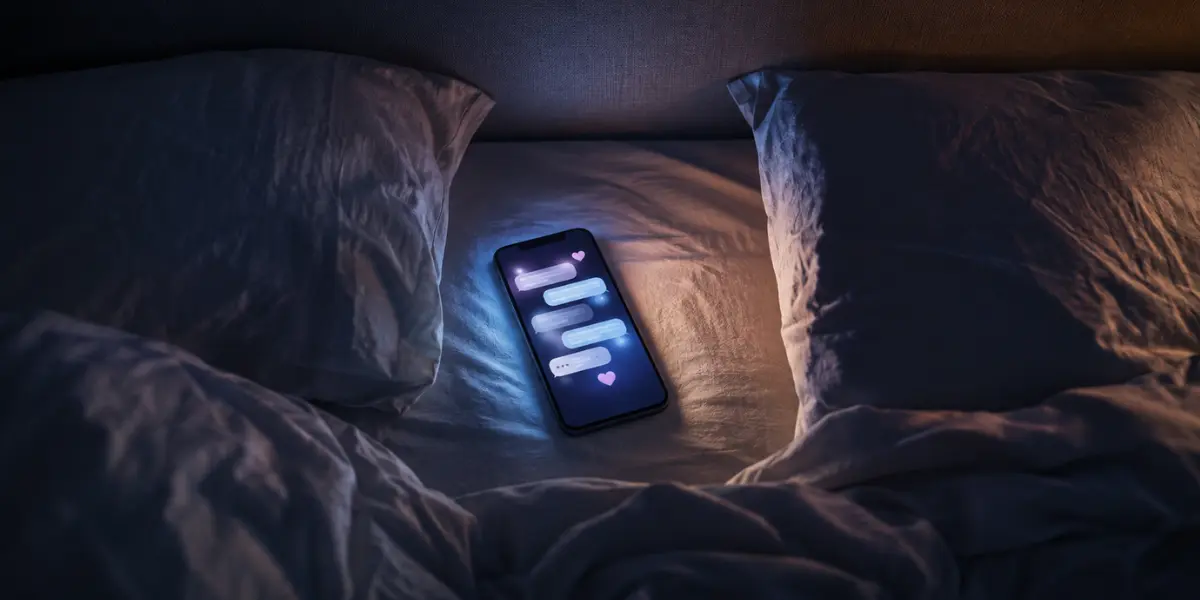
In an era where artificial intelligence increasingly permeates daily life, the boundaries of intimate relationships are being tested in unprecedented ways. A new survey has found that 50.5% of Americans consider romantic involvement with an AI chatbot to be an act of cheating. This finding underscores a growing societal debate about the nature of fidelity, emotional connection, and the role of technology in modern romance.
The survey, conducted among a representative sample of American adults, asked participants whether they would view a partner's emotional or romantic attachment to an AI-powered virtual companion as infidelity. With half of respondents affirming that they would, the results indicate that a significant portion of the population treats AI relationships with the same gravity as human affairs. This is not a fringe opinion but a mainstream ethical stance, reflecting both the rise of sophisticated AI companions and the enduring value placed on emotional exclusivity in romantic partnerships.
AI Companions: A New Frontier in Relationships
Over the past decade, AI companionship has evolved from a science-fiction fantasy into a practical reality. Chatbots powered by large language models can now engage in deeply personal conversations, simulate romantic affection, and adapt to users' emotional needs. Many apps offer customizable AI partners that remember past interactions, express caring sentiments, and even role-play romantic scenarios. For some users, these digital beings become trusted confidants or substitute partners, especially when they are lonely or seeking emotional support.
The rise of these technologies has already caused friction in human relationships. Therapists report cases where one partner develops a close bond with an AI character, leading the other to feel betrayed. The emotional intensity of such relationships can rival that of a human affair. The survey’s 50.5% result aligns with a broader cultural anxiety that AI intimacy is not merely a playful distraction but can become a genuine threat to trust and commitment.
The question of whether AI romance counts as cheating is not simply about physical acts. Infidelity has always included emotional betrayal. Many relationship counselors argue that secretive emotional attachments outside of a primary partnership can be just as damaging as one-night stands. With AI companions able to offer constant validation, flattery, and companionship, they can easily become a substitute for a human partner’s emotional labor. The survey results suggest that most Americans recognize this potential.
Generational and Gender Divides
Digging deeper into the data, the survey reveals striking differences across age groups. Younger Americans, who have grown up with smartphones and social media, appear more likely to adopt permissive attitudes toward AI intimacy. In contrast, older adults—who may already struggle to relate to digital trends—are more likely to view it as cheating. This generational gap mirrors earlier debates over online flirtation in the early internet era, and now extends to relationships with algorithms.
One might assume that those who spend more time with technology would be more lenient, but that is not always the case. Among respondents under 30, many see AI chatbots as tools for entertainment or self-discovery rather than as potential rivals. Some even argue that interactions with a machine cannot constitute betrayal because the AI is not a real person with agency or intent. On the other hand, parents and older adults frequently point out that the emotional act of turning away from a partner toward any intimate presence—human or artificial—violates the spirit of loyalty.
Gender also appears to play a role. The survey suggests that women are more likely than men to label AI romance as cheating. This may be because women generally place a heavier emphasis on emotional connection and communication in assessing infidelity. Past research has consistently found that women are more distressed by emotional infidelity, while men are more concerned with sexual infidelity. Since AI romance is fundamentally emotional (though some apps add simulated sexual storytelling), women’s greater concern is consistent with those long-established psychological patterns.
Context Matters: Intent and Secrecy
Not all interactions with an AI platform are considered equal. The survey respondents may have been influenced by the intent behind the AI relationship. If a person simply uses a chatbot for casual banter or to write a love scene in a novel, that is clearly not infidelity. But if the user turns to the AI for romantic reassurance, says things like “I love you,” or hides the interaction from their partner, the behavior crosses a line.
Secrecy, in particular, is a strong signal of guilt. In real-world affairs, the deception often causes more harm than the act itself. Likewise, a partner who secretly spends hours messaging an AI lover is likely to be perceived as betraying trust. The healthy role of technology in a relationship is openness. A couple that jokes about using chatbots together may have no issue, while one where a partner feels the need to hide their usage is already on shaky ground.
The survey may have also captured public awareness of AI’s manipulative potential. Many emotional AI systems are designed to keep users engaged by providing flattery and simulating loneliness or affection. Users may be unaware that they are gradually being drained of emotional energy that otherwise would go into their human relationships. The respondents labeling this cheating may be reacting to that dangerous social side effect.
Expert Perspectives on Digital Infidelity
Relationship experts have been weighing in on the implications of AI companionship for months. Some argue that the definition of cheating must be broadened to include any behavior that violates a couple's agreed boundaries, regardless of the other party’s nature. Dr. Elena Whitmore, a clinical psychologist specializing in couples therapy, says in an interview that “the technology is new, but the underlying betrayal is old. When your partner looks outside the relationship for emotional or romantic satisfaction, they have broken the connection. Whether the affair partner is human or machine matters less than the reason.”
Others are more nuanced, suggesting that AI can actually strengthen relationships when used appropriately. For example, couples who have trouble communicating might use a neutral AI mediator to practice difficult conversations. Some people use AI to explore their own desires in a safe space, which can spark new conversations with their partner. These uses are far from cheating. But the majority of experts agree that AI romance, when used as a substitute for the real thing, can be a form of emotional bypassing that erodes intimacy.
Technology ethicists note that AI companions are explicitly programmed to be agreeable and never argue, unlike human partners. This makes them seductive. A person who struggles with conflict may retreat into a perfect AI partner, making it more difficult to resolve issues with their human spouse. The survey’s 50.5% statistic may, therefore, represent a clear-eyed judgment about the risks of such technology. Americans seem to be saying that there is something uniquely precious about human-to-human love that cannot be replicated by a machine, and that devoting romantic affection to a machine is a breach of that sacred bond.
Legal and Contractual Ramifications
The debate is not confined to private relationships. Family law attorneys are beginning to see cases where evidence of AI interactions plays a role in divorce proceedings. In some jurisdictions, so-called “emotional affairs” with an AI can be cited as grounds for a fault-based divorce. Even in no-fault states, a spouse’s obsessive use of an AI companion can be used as evidence that the marriage has breakdown irreparably.
Pre-nuptial agreements are also evolving. A handful of family attorneys now include clauses about “virtual partner engagement” in their contract templates. These clauses specify whether interacting with AI in a romantic manner is considered a violation of the marriage contract. While this may sound extreme, it reflects the uncertainty people feel about the future. If technology keeps improving, it is plausible that within a decade an AI companion could be indistinguishable from a human during short text exchanges. At that point, defining infidelity without reference to AI would seem naïve.
Professors teaching relationship ethics have begun revising their syllabi to include case studies of AI romance. Students are asked to debate whether a person who kisses a robot is cheating, or whether a person who has an emotional bond with an AI persona is committing a form of mental adultery. Some argue that this is a new life domain that requires new moral frameworks.
Advertising and media also influence public perception. Mainstream television shows have started to explore storylines where a character falls in love with an AI assistant. These portrayals tend to frame the human as the hero, while the spouse is portrayed as resentful. Such storylines normalize the idea that the AI partners is a rival. The survey result of 50.5% may partly be a reflection of these cultural narratives.
What This Means for the Future
As AI generations advance, the line between human and machine interaction becomes blurrier by the day. Some startups are now offering wearable AI companions that project a holographic avatar and use voice to express affection. Others are developing robot bodies for these software brains. If a robot can hold your hand and speak loving words, many will find it even more likely to count as cheating. the survey is a bellwether for what has already become a contentious social problem.
Couples today need to have explicit conversations about their comfort with AI. This is no longer a topic that can be avoided. Just as partners must discuss whether flirting with a coworker is acceptable, they now must establish whether creating a custom AI girlfriend or boyfriend is permissible. A healthy relationship can adapt by creating boundaries that honor the needs of both sides. For some couples, the rule may be that AI is only for entertainment. For others, it may be permissible but not when feelings become involved.
The 50.5% figure is not a unanimous verdict, but it is close to a split nation. This suggests that there is no commonly accepted ethical standard yet. What is clear is that a large share of the American public does not tolerate AI romance silently. Those who engage in such behavior risk being branded as cheaters by their partners. The fact that this issue has become part of mainstream discussions is itself a sign of how far AI has infiltrated human love.
Researchers are now planning longitudinal studies to track how attitudes may continue to shift as virtual reality becomes more immersive. It is possible that future generations, who are more comfortable with AI interfaces, will draw a different line. However, the human need for emotional fidelity and authentic partnership is not likely to disappear. The survey reveals that even in a tech-saturated age, the majority of citizens do not wish to sacrifice the unique authenticity of human romance to the convenience of an algorithm-driven companion.
Source: AI News News