

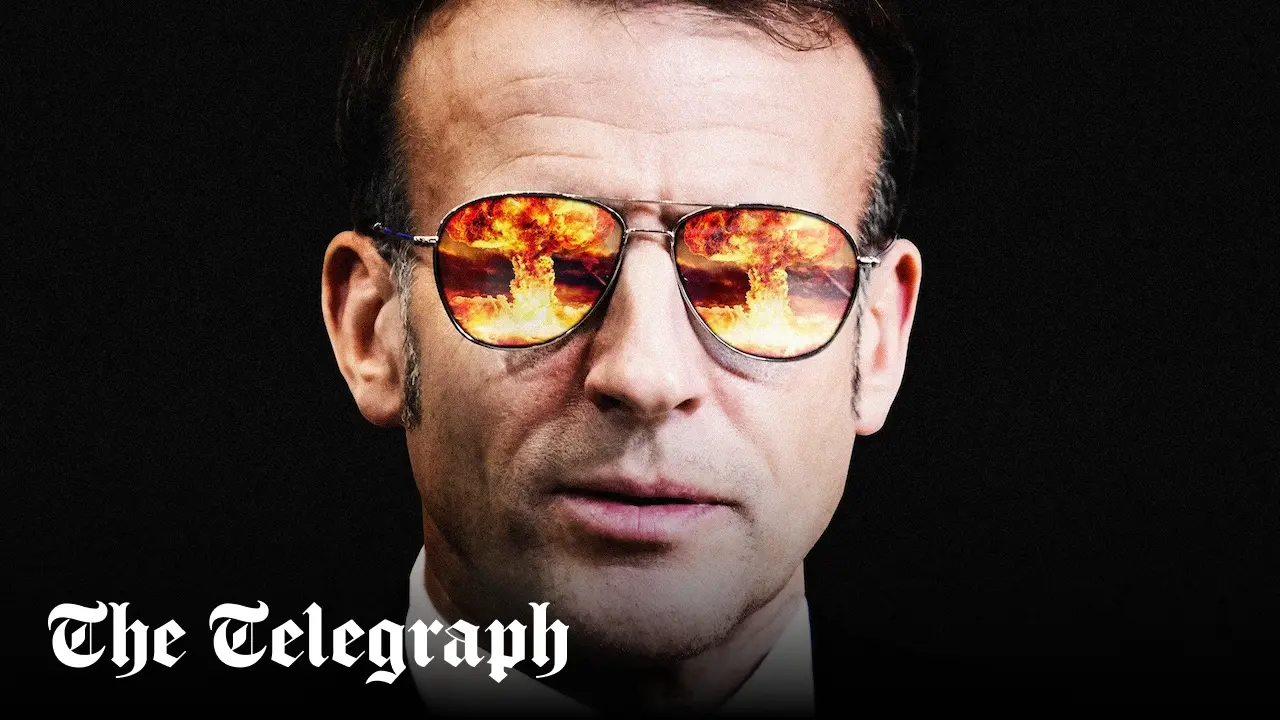
Emmanuel Macron, the French president, has drastically shifted the European security landscape by extending France’s nuclear deterrent to cover the continent. In a landmark speech at the Île Longue submarine base, he declared that “to be free, we must be feared” and outlined a new doctrine of forward deterrence designed to make Vladimir Putin think twice before attacking Europe. The move comes as the United States, under repeated doubts about its commitment to NATO, appears to be pivoting away from the alliance.
The French proposal breaks with 65 years of Gaullist tradition that kept the country’s nuclear arsenal strictly independent. Now, Paris is offering to place its atomic weapons—both submarine-launched ballistic missiles and air-launched tactical warheads—under a broader European umbrella. This is a response to Russia stationing tactical nuclear weapons in Kaliningrad and Belarus, as well as threatening European capitals with long-range missiles.
Under Macron’s vision, Britain’s four Trident submarines and France’s four ballistic-missile-armed submarines will maintain a continuous at-sea deterrent. At the same time, French Rafale jets equipped with ASMP-A supersonic missiles—and soon with upgraded ASMP variants and hypersonic ASN4G weapons—will rotate secretly through bases in allied countries such as the Netherlands, Belgium, Greece, Sweden, Denmark, and Poland. Joint exercises will demonstrate solidarity and create a web of ambiguity that complicates Russian planning.
The Coalition of the Willing
Recent diplomatic efforts have brought together a group of European nations willing to host French nuclear-capable aircraft and participate in joint exercises. The Kensington Treaty with Poland and the Northwood Declaration with Britain have formalised cooperation on nuclear operations. Germany’s new chancellor, Friedrich Merz, has also shown interest in discussing the French deterrent, a shift from previous reluctance. However, Spain and Italy have so far ruled out joining, and the Czech prime minister, Andrej Babiš, has indicated a desire to participate despite his pro-Russian election platform.
Analysts note that the initiative is not intended to replace the US nuclear umbrella but to complement it. Europe’s conventional forces have been neglected for decades, and rearmament will take time. Forward deterrence buys that time by forcing Russia to consider the risk of a French—or Franco-British—nuclear response even if the US withdraws. As William Alberque, former director of NATO’s nuclear non-proliferation division, explained, “The idea that France can go it alone with their Rafale aircraft is not true. They’re still going to need allied fighter escort.”
The Mechanics of Forward Deterrence
French doctrine now embraces the concept of a single, non-renewable “nuclear warning shot” aimed at a military target. Unlike the US approach, which allows for a limited back-and-forth nuclear exchange, French thinking considers any nuclear use beyond the warning shot as the start of Armageddon. This makes the threat credible: a French president might order a single limited strike, but further escalation would lead to annihilation. The flexibility of air-launched weapons—visible, recallable, and capable of being dispatched without immediate escalation—adds a diplomatic tool.
France is modernising its arsenal with 61 new Rafale jets (worth €6 billion), an upgrade of older models to F5 standard, and a third-generation nuclear-powered ballistic missile submarine (SNLE 3G) scheduled for 2035. The fleet of nuclear-powered attack submarines is also being expanded to six boats, three of which are already in service. These conventional submarines carry deep-strike cruise missiles that can support nuclear missions.
The strategic ambiguity is key: by not revealing the precise number of warheads or the locations of nuclear-capable assets, Europe makes it harder for Russia to preemptively target them. This compensates for the numerical disparity between the European nuclear arsenals (225 British warheads and 290 French warheads) and the much larger stockpiles of Russia (around 5,459) and the United States (about 5,177).
Political Implications and Future Challenges
Macron’s offer also serves to balance Germany’s growing conventional military ambitions. Berlin has pledged to build the most powerful army in Europe, and continued French nuclear primacy will preserve political equilibrium within the EU. However, the 2027 French presidential election poses a risk: the frontrunner, Jordan Bardella of the far-right National Rally, has historically been close to Putin. A senior National Rally source warned that a French nuclear umbrella cannot be offered without a quid pro quo, hinting at demands for financial contributions or policy concessions from host nations.
Despite these uncertainties, European nations are increasingly accepting that relying entirely on the United States for their security was a strategic mistake. Paul Van Hooft, head of the deterrence initiative at Rand Europe, noted that “the end point will be a more European NATO with a greater role for France and the UK in deterrence and sufficient conventional means to give the Russians pause that we are not entirely reliant on the US.” The Franco-British coordination, rooted in the Northwood Declaration and subsequent treaties, provides a framework for joint planning and shared intelligence.
The Rafale jets, when deployed to allied bases, will be escorted by host-nation fighters, integrating European air forces into the nuclear mission. This creates a shared responsibility and deepens trust. Meanwhile, the development of long-range precision missiles by countries like Germany and Poland will eventually reduce reliance on French air-launched weapons, but for the near future, the Rafales plug a critical gap. Macron’s decision to merge conventional and nuclear deterrence into a single strategy has created “strategic dilemmas” for Russia, forcing it to consider the possibility of a European nuclear response even if the US is absent.
Europe is now racing against time. Macron has just over a year left in office, and the full implementation of forward deterrence depends on continued political will. Yet the momentum is building: more nations are joining talks, exercises are being planned, and the infrastructure for hosting nuclear-capable aircraft is being prepared. The message from Paris is clear: Europe must take responsibility for its own defence, and that includes learning to love the bomb.
Source: The Telegraph News